
Red-bellied clerid
Enoclerus sphegeus
Description
How to identify
The red-bellied clerid (Enoclerus sphegeus) is a species of beetle belonging to the family Cleridae, order Coleoptera. It is a highly specialized predator found in many coniferous regions.
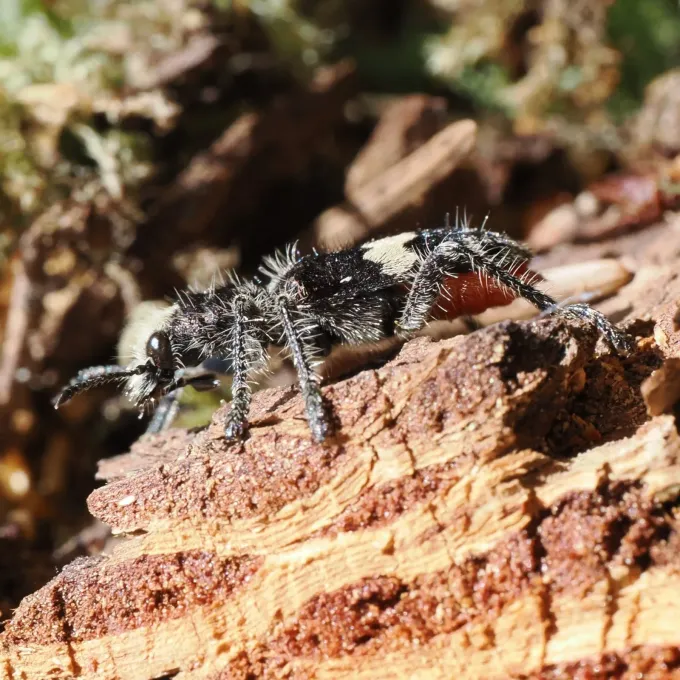
Adults are easily recognized by their striking appearance. They grow between 8 and 12 mm in length and feature a black body with a distinctive broad, bright red or orange transverse band across the elytra.
The body is covered in dense hairs, which gives them a soft, velvet-like texture. Their head and thorax are robust, adapted for their predatory lifestyle on the surface of tree trunks.
Larvae are elongated and often reddish in color, allowing them to blend into the galleries where they hunt. They undergo a complete metamorphosis, including egg, larval, pupal, and adult stages.
Unlike many other insects, this beetle is often considered a beneficial organism in forest ecology due to its role in suppressing wood-boring pest populations.
What it damages
The red-bellied clerid primarily inhabits coniferous trees, such as pine species. It is not a pest itself, but rather a natural enemy of various bark beetles and wood-boring insects.
Adult beetles are active hunters. They roam the bark of infested trees, capturing and consuming adult bark beetles that are attempting to bore into or emerge from the timber.
The larvae are particularly effective predators. They enter the tunnels created by bark beetles, where they feed on the eggs, larvae, and pupae of the pests, significantly reducing their reproductive success.
There is no direct harm to the tree from the clerid. Its presence is typically a biological response to an existing infestation of bark beetles that are attacking the host tree.
Consequently, the red-bellied clerid serves as a natural monitor of forest health; its population size usually mirrors the availability of bark beetle prey in the immediate area.
When it appears
Adult activity typically begins in late spring and continues through the summer. This timing is critical, as it aligns with the peak emergence and flight period of bark beetles.
Females lay their eggs in the vicinity of bark beetle entrance holes or existing galleries, ensuring that their offspring have immediate access to a food supply upon hatching.
The larval stage may last for one or more seasons, depending on the availability of food and environmental conditions. Overwintering usually occurs within the bark of the host tree.
Optimal conditions for activity include warm, sunny weather, which increases the movement of both the predator and its prey on the surfaces of tree trunks.
Abiotic factors such as heavy rainfall or sudden temperature drops can interrupt their hunting cycle, potentially leading to a temporary decrease in the control of bark beetle populations.
Signs of infestation
The most reliable sign of the red-bellied clerid's presence is the visual observation of adults on the bark of infested conifers, particularly during the warm parts of the day.
If you peel back loose bark on a stressed pine tree, you may find the reddish larvae patrolling the beetle galleries in search of prey.
Empty galleries showing remains of prey (chitinous husks) are indicators that the area has been visited or is inhabited by these predatory beetles.
Monitoring efforts using traps designed for bark beetles often capture Enoclerus sphegeus, confirming their presence in the forest stand as a natural control agent.
A high density of these beetles is a strong indicator of a significant bark beetle infestation, signaling the need for a forest health assessment.
Control measures
Direct control of the red-bellied clerid is neither recommended nor necessary, as they are essential natural predators that help manage forest pest populations.
Forest management should focus on the primary pests. Silvicultural practices, such as the removal of heavily infested trees during sanitation thinning, are the most effective way to maintain forest health.
The use of broad-spectrum insecticides should be avoided, as these chemicals can indiscriminately kill beneficial predatory beetles, leading to secondary pest outbreaks.
Promoting a balanced ecosystem by protecting natural predators is a cornerstone of sustainable forest management. Enoclerus sphegeus performs its job without requiring human intervention.
If bark beetle populations reach epidemic levels, Integrated Pest Management (IPM) strategies should prioritize non-toxic biological methods to keep both the predators and the forest in balance.
Taxonomy
- Latin name
- Enoclerus sphegeus
- Order
- Coleoptera (beetles)
- Family
- Cleridae
- EPPO code
- ENOCSH
Discussion
No discussions yet — be the first.