
Enoclerus signatus
Enoclerus signatus
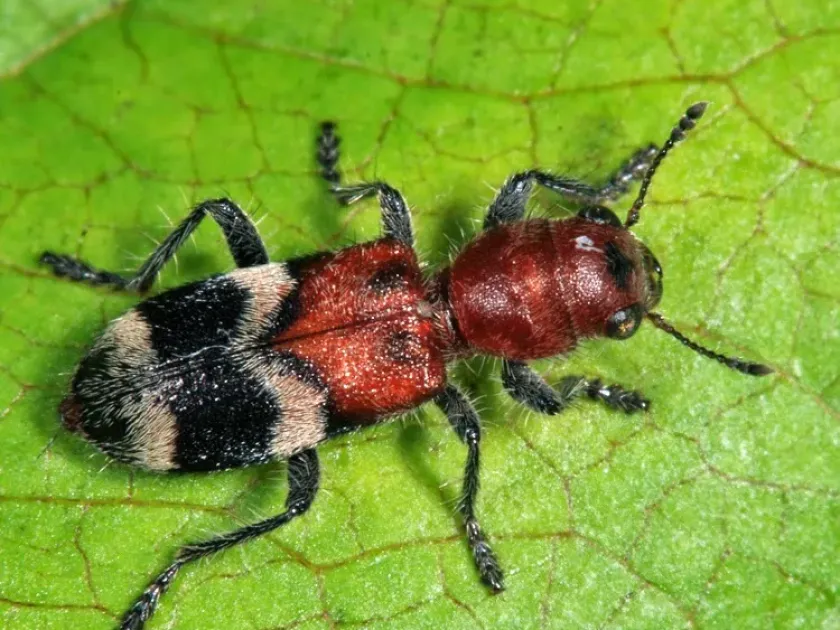
Description
How to identify
Enoclerus signatus belongs to the Cleridae family, commonly known as checkered beetles. This species is recognized for its vivid patterns, characteristic of the family, and its distinct body shape.
Adult beetles possess an elongated body covered with fine hairs, which aid in tactile sensing. Their wing covers (elytra) often display bright, contrasting bands that help in species recognition and mimicry.
The larvae are specialized predators with powerful mandibles designed for navigating the galleries carved by wood-boring insects. They are highly active and mobile under the bark of host trees.
Sensory organs in Enoclerus signatus are highly developed, allowing the beetle to track the chemical signatures (pheromones) of its prey, such as bark beetles, from a significant distance.
Identifying this species in the field requires close inspection of bark surfaces, where they are often found actively searching for prey during the peak activity of xylophagous insects.
What it damages
Enoclerus signatus is primarily a predator rather than a direct pest. It inhabits coniferous and deciduous trees that are already compromised or attacked by bark beetles and wood borers.
Its main impact is biological: larvae and adults feed on the immature stages of harmful wood-boring insects, effectively acting as natural regulators of pest populations within the forest.
While they provide a beneficial service by reducing pest numbers, their presence is an indicator of underlying forest health issues, signaling that the host tree is struggling with primary infestations.
In cases of severe outbreaks of bark beetles, the population of Enoclerus signatus may increase significantly, outcompeting other predators and altering the local entomological balance.
There is no direct damage caused to healthy, vigorous trees by this beetle; however, it remains part of the complex biological processes occurring in damaged wood habitats.
When it appears
The activity of adult Enoclerus signatus beetles peaks during the warm months, typically from late spring through summer, aligning with the emergence of major bark beetle species.
Their life cycle is strictly synchronized with the phenology of their hosts. Females lay eggs in close proximity to galleries where bark beetle larvae are feeding, ensuring immediate access to food.
Larvae pass through several stages, pursuing their prey through tunnels. Their development is entirely dependent on the availability of sufficient host density to sustain them until pupation.
Hibernation usually occurs in the adult stage or as a mature larva, often deep within bark crevices or in the topsoil layer at the base of the host tree to protect against winter temperatures.
Environmental conditions, particularly temperature and humidity, play a critical role in determining the speed of their generation development throughout the growing season.
Signs of infestation
The primary sign of the presence of Enoclerus signatus is the existence of xylophagous activity, such as entry holes and wood dust produced by bark beetles on the tree trunk.
By peeling back sections of the bark, one can observe the tunnels where these predatory larvae hunt, often leaving behind the exoskeletons of consumed pest larvae.
Adult beetles are often spotted patrolling tree trunks on sunny days, demonstrating rapid, erratic movement as they hunt for prey or search for suitable egg-laying sites.
- Abandoned bark beetle galleries showing signs of predation.
- Presence of predatory larvae under loose bark in stressed trees.
- Increased activity of clerid beetles near bark beetle infestation sites.
Detecting this beetle requires a keen eye for subtle changes in bark surface, particularly on trees showing signs of moisture stress or initial bark beetle colonization.
Control measures
As a predatory species, Enoclerus signatus generally does not require specific control measures. It is often encouraged as a biological control agent to mitigate pest outbreaks.
Forest management strategies focus on sanitation, such as removing infested or deadwood to reduce the primary food sources for wood-boring insects, which indirectly manages the entire associated fauna.
Indiscriminate use of broad-spectrum insecticides should be avoided, as it can eliminate these beneficial predators, potentially leading to further unchecked outbreaks of primary pests.
Regular monitoring of forest health helps to assess the effectiveness of natural biological control and determines if further silvicultural interventions are necessary.
Preserving a diverse forest ecosystem remains the most effective way to maintain a balance where natural predators like Enoclerus signatus can effectively keep harmful insect populations in check.
Taxonomy
- Latin name
- Enoclerus signatus
- Order
- Coleoptera (beetles)
- Family
- Cleridae
- EPPO code
- ENOCSI
Discussion
No discussions yet — be the first.