
Enoclerus lunatus
Enoclerus lunatus
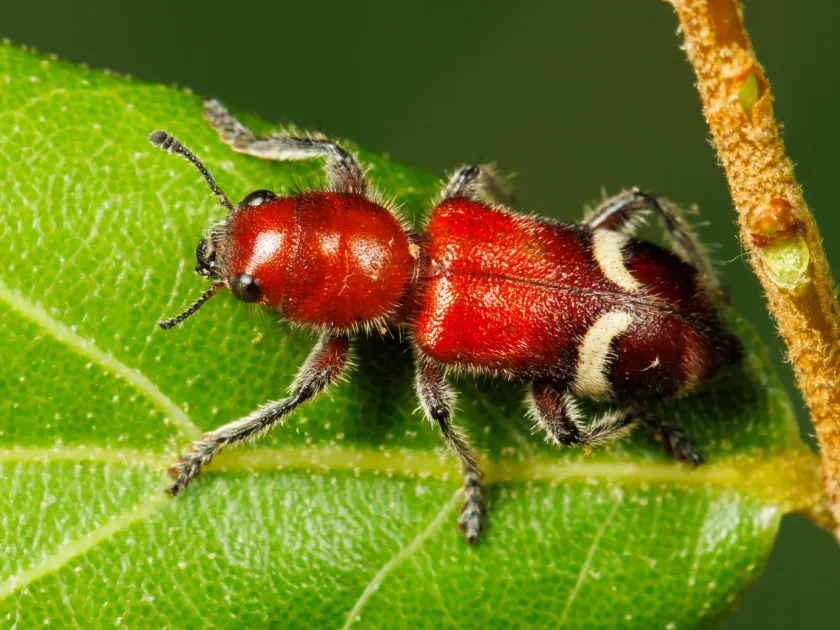
Description
How to identify
Enoclerus lunatus belongs to the family Cleridae (checkered beetles) within the order Coleoptera. Adult beetles are known for their distinct appearance and relatively bright markings, often used for mimicry.
The body is elongated and covered with dense, often bristle-like hairs. The species name comes from the characteristic crescent-shaped light spots on the dark elytra.
Larvae possess a soft, elongated body, typically pale or reddish in color. They feature a sclerotized head capsule, which is an adaptation for navigating through galleries under tree bark.
The insect undergoes complete metamorphosis. Its life cycle is closely tied to the health of woody plants and the presence of prey species, specifically wood-boring insects.
While often categorized alongside pests, adults of this species frequently display predatory behavior, playing a complex role in forest ecosystems.
What it damages
The larvae are primarily predatory, feeding on the larvae and pupae of bark beetles and weevils that infest conifers and some deciduous trees.
Although Enoclerus lunatus acts as a natural enemy to primary forest pests, its presence often indicates that the tree is already suffering from severe infestation by wood-boring species.
Direct damage by the beetle involves the excavation of tunnels in the bark and phloem during its larval stage while searching for prey or preparing for pupation.
The beetle typically concentrates on trees weakened by drought, wind damage, or previous insect attacks, contributing further to the decline of the host tree.
In high populations, the collective activity of wood-boring insects and their predators can significantly accelerate the mortality of trees in managed forests.
When it appears
Adult flight occurs predominantly in the spring and summer, coinciding with the peak activity period of the bark beetle populations they prey upon.
Imago are most active during sunny days, which facilitates mating and the search for suitable bark surfaces for oviposition.
Wintering usually occurs in the larval or adult stage, with the insects sheltering within the tree bark or in the layer of organic debris beneath the tree.
The life cycle typically takes one year to complete, though environmental conditions like temperature can extend this period in colder climates.
Population surges are often observed in the aftermath of natural disturbances like storm-felled timber or forest fires where wood-boring insects thrive.
Signs of infestation
Visual identification of infestation is primarily through the presence of exit holes on the bark surface created by emerging adults.
The accumulation of boring dust at the base of the tree is a common indicator of a complex of wood-boring insects being present under the bark.
Premature yellowing of needles or leaves and branch dieback are warning signs that a tree has been compromised by insect activity.
Removing a portion of the bark often reveals characteristic galleries, where the predatory tunnels of Enoclerus larvae intersect with bark beetle passages.
Observing adult beetles on tree trunks during warm periods is a reliable method for detecting their presence in an infested area.
Control measures
The most effective management strategy is the timely removal and processing of infested timber to prevent the emergence of new beetle generations.
Feveral traps used for monitoring bark beetles can also provide data on the population status of Enoclerus lunatus within a forest stand.
Maintaining high forest vigor through proper silvicultural practices minimizes the host availability for wood-boring insects.
Chemical control is rarely recommended for this species specifically, as it is a predator of other pests; management should focus on the pest complex as a whole.
- Regular monitoring of forest health and tree vitality.
- Rapid disposal of wind-thrown or storm-damaged wood.
- Encouraging natural biological control agents in the stand.
Taxonomy
- Latin name
- Enoclerus lunatus
- Order
- Coleoptera (beetles)
- Family
- Cleridae
- EPPO code
- ENOCLU
Discussion
No discussions yet — be the first.