
LeConte's clerid
Enoclerus lecontei
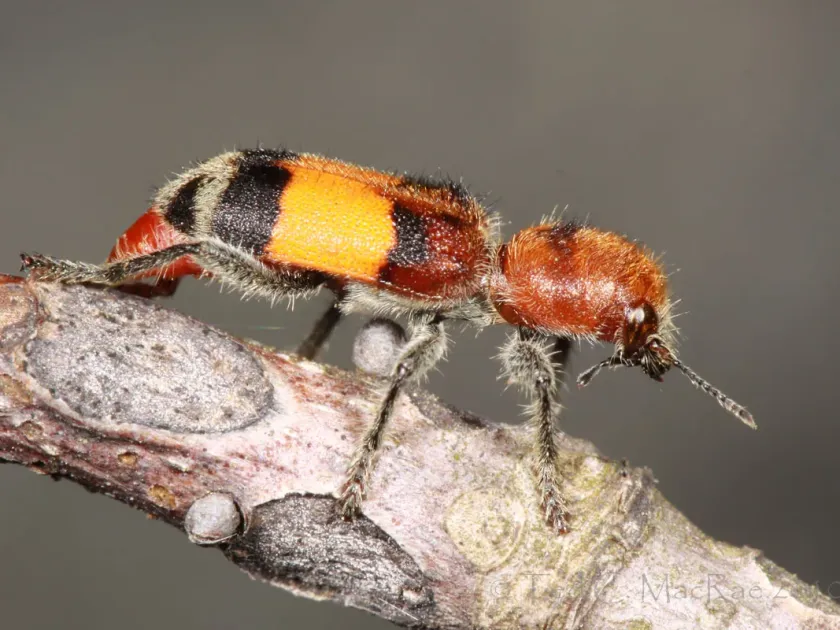
Description
How to identify
LeConte's clerid (Enoclerus lecontei) is a beetle species belonging to the family Cleridae, also known as checkered beetles. These insects are well-known predators that play a significant role in forest health.
The adult beetle is relatively small, with a robust body covered in fine hairs. Their coloration is distinct, typically featuring dark tones with light bands across the elytra, helping them blend into tree bark.
The head and pronotum are highly developed, reflecting their predatory nature. They possess strong mandibles adapted for hunting and subduing prey, which is characteristic of the Cleridae family.
Larvae are elongated and equipped with powerful mouthparts, allowing them to navigate the narrow galleries created by bark beetles beneath the bark of host trees.
Biology of this species is highly specialized, as they have evolved to track the pheromones and scents emitted by bark beetles infesting coniferous trees.
What it damages
LeConte's clerid is primarily an entomophagous insect, meaning it feeds on other insects. It is most commonly associated with coniferous trees, particularly various pine species.
They do not cause damage to the wood or living tissue of the trees themselves. Instead, they occupy the same habitat as wood-boring pests, such as engraver beetles and bark beetles.
While they are considered beneficial because they consume large numbers of bark beetles, their population dynamics are directly linked to the availability of these prey species.
The damage associated with the species is secondary; its presence is a clear indicator that the tree has already been attacked by primary wood-boring pests.
In forest management, they are viewed as natural regulators that help keep bark beetle outbreaks in check under stable ecological conditions.
When it appears
Adult activity begins in the spring when temperatures rise, allowing beetles to emerge from their overwintering sites within the bark of trees.
Peak activity typically occurs during mid-summer, synchronizing with the flight and colonization periods of various pine bark beetle species.
As autumn approaches, the beetles begin seeking protected areas under tree bark or in abandoned tunnels to survive the winter season.
The life cycle duration can vary depending on the local climate, sometimes spanning over a year in cooler regions, whereas it may be faster in warmer areas.
The ability of the larvae to locate prey is synchronized with the development stages of their host bark beetles, ensuring a continuous food supply for the next generation.
Signs of infestation
The presence of LeConte's clerid is identified by spotting adults crawling on the surface of pine trunks, particularly in areas with visible bark beetle boreholes.
One may find larvae within the bark galleries where they actively hunt for bark beetle larvae, pupae, and eggs, often clearing out entire sections of a gallery.
Evidence of their activity includes the discovery of empty bark beetle galleries and a noticeable reduction in the number of live bark beetle broods.
Monitoring for these predators is often conducted alongside bark beetle pheromone trapping, as they are attracted to the same chemical cues.
- Adult beetles visible on tree bark
- Larvae found within bark beetle tunnels
- Presence of predated pupal chambers
Control measures
There is no specific need to control LeConte's clerid, as it serves as a valuable natural enemy of harmful wood-boring insects in forest ecosystems.
Management efforts should focus on the overall health of the forest, such as removing overly stressed or dead trees to minimize the breeding grounds for primary pests.
Chemical treatments used to control bark beetle outbreaks should be selective to avoid harming predatory Cleridae populations that assist in natural suppression.
Integrated Pest Management (IPM) strategies emphasize biological control, making the preservation of LeConte's clerid an essential part of sustainable forestry.
Maintaining high biological diversity in pine stands is the most effective way to ensure that natural predators remain present to regulate pest numbers.
Taxonomy
- Latin name
- Enoclerus lecontei
- Order
- Coleoptera (beetles)
- Family
- Cleridae
- EPPO code
- ENOCLE
Discussion
No discussions yet — be the first.