
Frit fly (Elachiptera cornuta)
Elachiptera cornuta
Description
How to identify
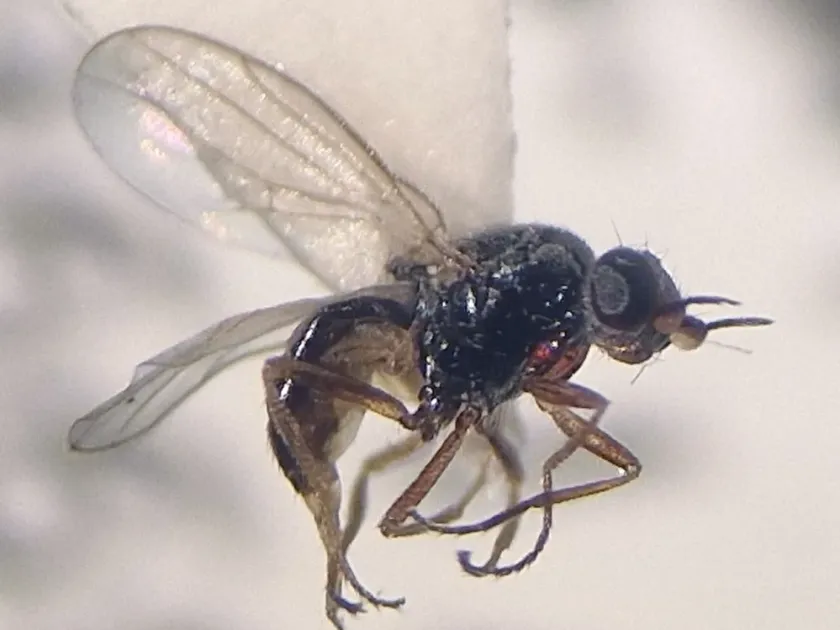
Elachiptera cornuta belongs to the Chloropidae family, commonly known as grass flies or frit flies, within the order Diptera.
The adult fly is a small insect, typically measuring about 2 to 3 mm in length, with a body coloration often ranging from light brown to dark blackish tones.
These flies possess distinct, somewhat prominent eyes and clear wings with a characteristic venation pattern typical for members of the Chloropidae family.
The larvae are typically maggot-like, legless, and exhibit a creamy-white or yellowish color, reaching up to 4 mm when fully developed.
The life cycle involves complete metamorphosis, consisting of four stages: egg, larva, pupa, and adult, with development heavily dependent on environmental conditions.
What it damages
The primary hosts for Elachiptera cornuta include economically important cereal crops such as wheat, barley, oats, and rye, as well as various wild grasses.
Damage is caused by the larvae, which burrow into the stems, leaf sheaths, or developing floral parts, disrupting the nutrient supply of the host plant.
Early-stage infestations are particularly destructive, as the larvae target the growing point, causing stunted development or the complete death of the main shoot.
In later developmental stages, larvae can infiltrate the base of the ear or spike, resulting in grain shriveling or the production of empty, non-viable kernels.
Severe infestations can lead to significant thinning of the crop canopy, drastically reducing the potential yield and overall quality of the harvested grain.
When it appears
The activity of overwintered adults typically begins in early spring as temperatures rise, aligning with the tillering stage of cereal crops.
Females deposit their eggs directly onto leaves or within the leaf sheaths, with the subsequent larval development lasting several weeks depending on the temperature.
Throughout the growing season, the species can undergo multiple generations, which allows for continuous population pressure on developing crops.
The speed of the life cycle is highly sensitive to heat and moisture levels, with warmer conditions generally accelerating the reproduction rates of the fly.
As autumn approaches, the final generation migrates to winter cereals or grassy vegetation, where they prepare for overwintering in various stages of development.
Signs of infestation
The most visible symptom of an infestation is the yellowing and subsequent withering of the central leaf, often referred to as 'deadheart' symptom in young plants.
Upon dissecting the stems, one may find the larvae or evidence of their feeding, such as fecal matter and deteriorated plant tissues inside the shoot.
Affected plants often display signs of increased, but weak, tillering, with secondary shoots failing to develop properly into mature, productive stems.
During the heading phase, partial or complete 'whitehead' symptoms may appear, signaling that the vascular supply to the grain has been severed by larvae.
Field-level indicators include patchy growth patterns and reduced plant vigor, which become increasingly apparent as the crop approaches the flowering stage.
Control measures
Integrated pest management strategies are crucial, starting with proper crop rotation to break the life cycle of the pest in infested fields.
Deep plowing after the harvest helps bury crop residues, which serves to eliminate the overwintering pupae and prevents early emergence in the following spring.
Weed management, particularly focusing on the removal of wild grasses along field borders, reduces the reservoir of pests available for crop colonization.
When economic thresholds are reached, the application of systemic or contact insecticides is recommended to protect the crop during critical growth phases.
- Use of yellow sticky traps for monitoring fly migration.
- Adjusting sowing dates to avoid synchronization with peak fly emergence.
- Application of insecticidal seed treatments for early-stage protection.
Taxonomy
- Latin name
- Elachiptera cornuta
- Order
- Diptera (flies)
- Family
- Chloropidae
- EPPO code
- ELACCO
Discussion
No discussions yet — be the first.