
Hairy shieldbug
Dolycoris
Description
How to identify
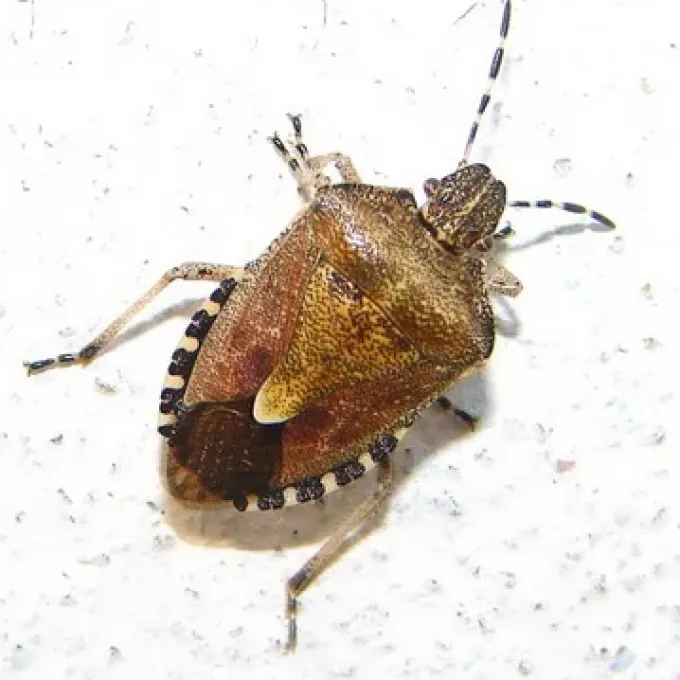
The Hairy shieldbug, scientifically known as Dolycoris baccarum, is a member of the Pentatomidae family. Adult bugs are shield-shaped, typically reaching 10–12 mm in length, and are covered with fine, dense hairs.
Their body coloration is usually brownish-yellow or reddish, which provides camouflage among vegetation. A key identification feature is the pale longitudinal stripe on the pronotum and the alternating dark and light spots on the abdominal edges.
The eggs of this species are barrel-shaped and are typically laid in neat, dense batches on the undersides of leaves, providing them with protection from the elements.
Nymphs undergo five developmental stages. Unlike adults, they are wingless and have a more uniform, lighter appearance during the early stages of their growth.
Adult bugs overwinter in leaf litter, debris, or topsoil, emerging in the spring once temperatures become sufficiently warm for them to resume feeding and mating.
What it damages
This species is a polyphagous pest, meaning it feeds on a wide variety of plant hosts, including both cultivated crops and wild plants found in surrounding areas.
The Hairy shieldbug causes significant damage to berry-producing shrubs such as raspberries, blackberries, currants, and gooseberries, as well as various garden vegetables.
When feeding, the bug uses its piercing-sucking mouthparts to penetrate plant tissues and extract vital sap, which weakens the plant and stunts fruit development.
The primary economic damage occurs when the bug feeds on developing fruits. The introduction of saliva during the feeding process can cause the fruit to deform, dry out, or become bitter.
Because they are highly mobile, they can quickly move between different types of plants, making it challenging for gardeners to localize the infestation and protect the harvest.
When it appears
The life cycle begins in early spring when adults emerge from their overwintering sites. They initially feed on various weeds before migrating to more desirable cultivated hosts.
Mating and egg-laying typically coincide with the flowering and fruit-setting stages of garden crops, ensuring that food is available for the emerging nymphs.
In most temperate climates, there is one generation per year, although warmer regions may see a second generation, leading to higher pest pressure throughout the summer.
The period of maximum infestation usually occurs in mid-to-late summer, which is precisely when most soft fruits reach maturity and are most vulnerable to damage.
As autumn approaches and day length decreases, adults search for sheltered environments to enter diapause, effectively ending their active feeding cycle for the year.
Signs of infestation
The most distinctive sign of a Hairy shieldbug presence is a pungent, unpleasant odor that is released when the insects are disturbed, particularly during harvest time.
Berries that have been fed upon by the bugs often show signs of deformation, shriveling, or premature dropping. In many cases, the fruit loses its characteristic flavor.
Leaves of the host plant may exhibit small, chlorotic spots or punctures where the bugs have been feeding, which may eventually lead to yellowing or tissue necrosis.
Regular visual inspections, especially of the undersides of leaves, can reveal the presence of egg batches or groups of nymphs, allowing for early intervention.
- Strong, unpleasant odor emanating from the berry patches;
- Deformed or shriveled fruits that are bitter to the taste;
- Chlorotic spots on leaves due to sap extraction;
- Presence of shield-shaped adult insects on stems and fruits;
- Reduced overall vigor of the infected plants.
Control measures
Cultural control practices, such as the consistent removal of weeds and wild host plants around the garden, are essential to reducing the local population.
Proper sanitation in the autumn, including the removal of dead leaves and organic debris, helps destroy the overwintering habitat of the adult bugs.
On a smaller scale, mechanical removal can be effective. This involves shaking the plants early in the morning, when the bugs are sluggish, and collecting them on a cloth or tray.
When chemical intervention is necessary, insecticides must be applied with careful attention to the pre-harvest interval to ensure the safety of the fruit for human consumption.
Integrated pest management, including the use of entomopathogenic fungi or beneficial predatory insects, can help maintain population levels below the economic threshold.
Taxonomy
- Latin name
- Dolycoris
- Order
- Hemiptera (bugs, aphids, leafhoppers)
- Family
- Pentatomidae
- EPPO code
- DOLYSP
Discussion
No discussions yet — be the first.