
Moroccan locust
Dociostaurus maroccanus
Description
How to identify
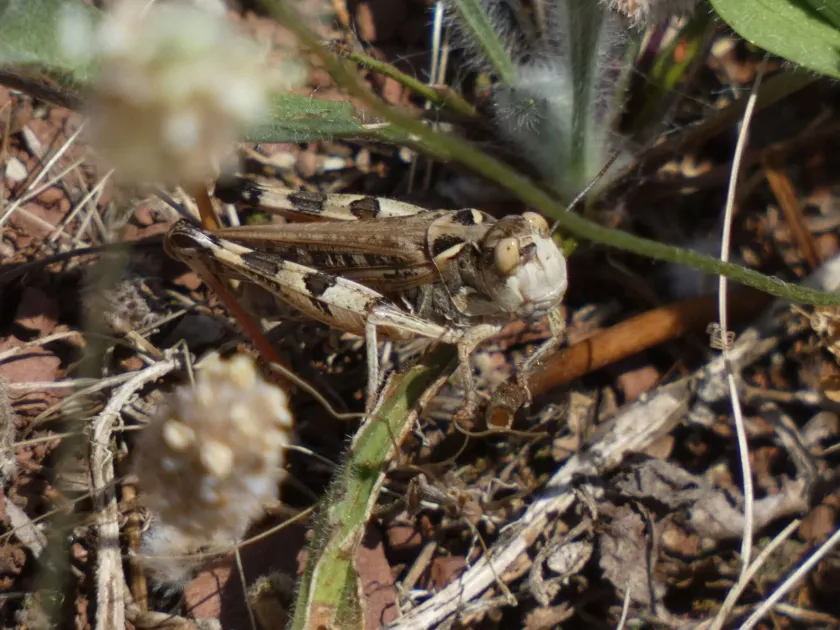
The Moroccan locust (Dociostaurus maroccanus) is a member of the Acrididae family within the order Orthoptera. Adults typically measure between 20 and 38 mm in length, displaying a yellow-gray to brown coloration with distinct dark markings.
A key diagnostic feature is a pale, cross-shaped pattern on the pronotum, which is clearly visible in adult specimens. The wings are well-developed and transparent, enabling adults to fly over long distances, which is crucial for their migratory behavior.
The nymphs go through five developmental stages (instars) before reaching maturity. Throughout these stages, they gradually increase in size and morphological complexity, eventually gaining the ability to fly and form massive swarms.
Eggs are laid in robust, underground capsules known as egg pods. Each female can produce several pods, which are buried in firm, compact soil, protecting the offspring from environmental extremes and natural predators.
This species exhibits phase transformation, moving from a solitary existence to a gregarious phase when population density increases. In this gregarious phase, individuals congregate into large bands and swarms, which are highly destructive to vegetation.
What it damages
The Moroccan locust is a serious polyphagous pest that threatens a wide range of agricultural crops. Its preferred hosts include cereal crops such as wheat, barley, rye, corn, and sorghum, where it consumes both leaves and developing grain.
Beyond cereals, the pest severely impacts legumes and various forage grasses. During outbreak years, pastures and rangelands can be completely stripped of green biomass, leading to significant losses in livestock feed and productivity.
Vegetable crops, including tomatoes, peppers, and eggplants, are also susceptible to locust attacks. The insects often consume all succulent parts of the plants, causing irreparable damage to seedlings and mature crops alike.
Orchards and vineyards are not spared; the locusts feed on young shoots, foliage, and even the bark of fruit trees. This continuous feeding weakens the trees and reduces fruit quality and yields significantly.
The economic impact of a locust swarm is profound. Because of their voracious feeding habits and mobility, they can devastate large agricultural areas in a short time, making proactive management essential for food security.
When it appears
The life cycle of the Moroccan locust is annual. They overwinter in the egg stage, with the eggs safely contained within egg pods situated in the top 2–5 cm of soil, typically in undisturbed areas like fallows or grazing lands.
Egg hatching generally occurs in the spring, typically April or May, dictated by soil temperature increases and the accumulation of thermal units. Favorable warm, dry springs promote mass hatching of the nymphs.
The nymphal stage lasts approximately 30 to 45 days. During this time, they actively feed and move in bands, which is the most critical period for field monitoring and implementing control measures to prevent adulthood.
Fledging occurs in late May or June, as the insects reach their adult stage. Once they gain wings, their range of activity expands significantly, and they begin forming large migratory swarms that can move between regions.
Egg-laying begins mid-summer and continues into early autumn. Females search for specific soil conditions—usually firm, sparsely vegetated ground—to deposit their egg pods before the adults perish at the end of the season.
Signs of infestation
One of the earliest indicators of an infestation is the appearance of small, jumping nymphs along the perimeters of fields bordering wasteland or rangeland. Their concentrated presence is a clear sign of an emerging problem.
Visible damage to crop foliage, characterized by ragged edges or completely shredded leaves, indicates active feeding by the bands. In many cases, the crops appear as if they have been mown down by machinery.
Large swarms are impossible to miss, as they generate a loud, buzzing sound when taking flight. The sight of a massive cloud of insects moving over the fields is a sign of a severe, high-level infestation.
Soil inspections can reveal the presence of egg pods in traditional breeding sites. These areas often appear as bare, dry, and compacted patches of earth where the locusts have congregated for oviposition.
Monitoring the flight paths and movement direction of nymphal bands allows agronomists to predict which fields are at the highest risk, enabling the targeted application of protective measures.
Control measures
The cornerstone of management is regular monitoring. By identifying egg-laying sites during the off-season, farmers can target and destroy egg pods via deep tillage, which is highly effective at reducing the next generation's population.
Chemical control remains the most immediate solution during outbreaks. Insecticides are most effective when applied early, targeting young nymphal bands before they become highly mobile adults or migrate to new fields.
Biological control options, such as the use of entomopathogenic fungi or bacteria, offer environmentally sustainable alternatives. These methods are particularly useful in sensitive habitats or regions where chemical use is restricted.
Cultural practices, such as maintaining healthy, dense crop stands or managing surrounding uncultivated lands, can make areas less attractive to egg-laying females, helping to suppress local populations.
Regional cooperation is essential. Since locust swarms do not respect administrative or farm boundaries, success depends on unified, multi-stakeholder strategies to manage the pests at a landscape level.
Taxonomy
- Latin name
- Dociostaurus maroccanus
- Order
- Orthoptera (locusts)
- Family
- Acrididae
- EPPO code
- DICIMA
Discussion
No discussions yet — be the first.