
Krauss's grasshopper
Dociostaurus kraussi
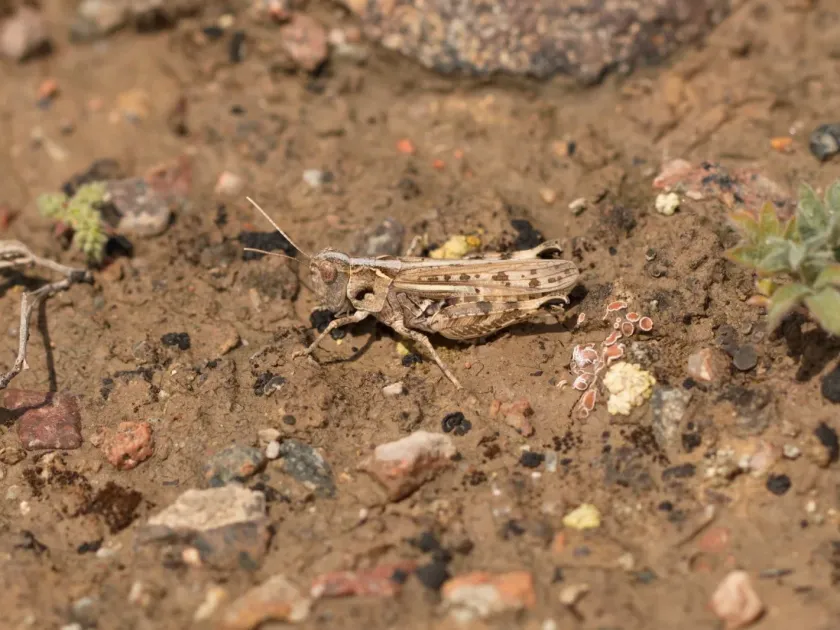
Description
How to identify
Krauss's grasshopper (Dociostaurus kraussi) belongs to the Acrididae family and is widely recognized as a significant pest in arid agricultural zones and steppes.
Adult insects typically reach 15–25 mm in length. A key identification feature is the distinctive cross-shaped pattern found on their pronotum, which distinguishes them from other species.
The coloration of these grasshoppers is adapted to their environment, usually ranging from sandy yellow to brownish-grey, which provides excellent camouflage on dry soil and grass.
This species is highly resilient to heat and drought. They prefer open, sparse vegetation environments, including pastures, fallow lands, and cereal fields where they find optimal conditions for development.
They undergo incomplete metamorphosis, meaning the nymphs look like miniature versions of the adults but lack wings. Wings develop gradually through several molting stages.
What it damages
As a polyphagous insect, this grasshopper feeds on a wide variety of plants, making it a major threat to both agricultural crops and natural rangelands in affected regions.
Cereal crops, including wheat, barley, rye, and oats, are primary targets. The insects feed on foliage and young stems, severely reducing the plant's ability to undergo photosynthesis.
During outbreaks, these pests can migrate to row crops such as maize, sunflower, and millet, often consuming young seedlings and causing significant yield losses across fields.
Beyond crop damage, they pose a serious threat to livestock farming by devouring natural grasses on pastures, which diminishes the quality and availability of forage.
Their swarming behavior allows them to move through fields systematically, potentially leaving large areas of land completely stripped of green vegetation in a matter of days.
When it appears
The life cycle of this grasshopper is univoltine, meaning there is only one generation per year. Winter is spent in the egg stage, safely buried in the soil.
Egg hatching begins in the spring when soil temperatures rise to optimal levels, usually aligning with the active growth phase of local grain crops.
The nymphal stage lasts for approximately 30 to 45 days, during which they grow rapidly and increase their daily intake of plant material through five developmental stages.
Adult insects (imago) appear in early summer, becoming mobile and spreading across agricultural land. This is the period when they actively mate and lay eggs.
Oviposition (egg-laying) takes place in late summer and early autumn. Females deposit eggs in soil clusters, ensuring survival through the coming winter until the next spring season.
Signs of infestation
Early signs of infestation include ragged or torn leaf edges on crops. Grasshoppers prefer the succulent parts of leaves, often leaving only the tough midribs behind.
High population densities lead to skeletonized leaves and, in severe cases, the complete destruction of young plants, resulting in visible patches of bare soil in fields.
If you suspect an infestation, observe the fields during the morning or evening hours when the insects are most active. You will likely see them jumping or fleeing from vegetation.
Accumulation of insect excrement (frass) on the ground near the base of plants or on leaves serves as a clear indicator of recent feeding activity.
Monitoring the field margins, ditches, and neglected areas is crucial, as these sites often act as breeding grounds where population numbers rise before spreading to the main crop.
Control measures
Effective management requires a combination of cultural practices and chemical control to prevent excessive crop damage and population explosions.
Deep autumn plowing is one of the most efficient cultural methods, as it disturbs and destroys the egg clusters in the soil, exposing them to freezing temperatures and natural predators.
Sanitation of field borders, ditches, and roadsides is essential to eliminate egg-laying sites and reduce the primary areas where grasshoppers thrive.
Chemical control using insecticides (such as pyrethroids or organophosphates) should be implemented during the early nymphal stages, as younger insects are more susceptible to treatment.
Scouting programs are necessary to assess population densities; once the economic threshold is reached, immediate application of targeted insecticides is recommended to protect the crop.
Taxonomy
- Latin name
- Dociostaurus kraussi
- Order
- Orthoptera (locusts)
- Family
- Acrididae
- EPPO code
- DICIKR
Discussion
No discussions yet — be the first.