
Moroccan locust
Dociostaurus
Description
How to identify
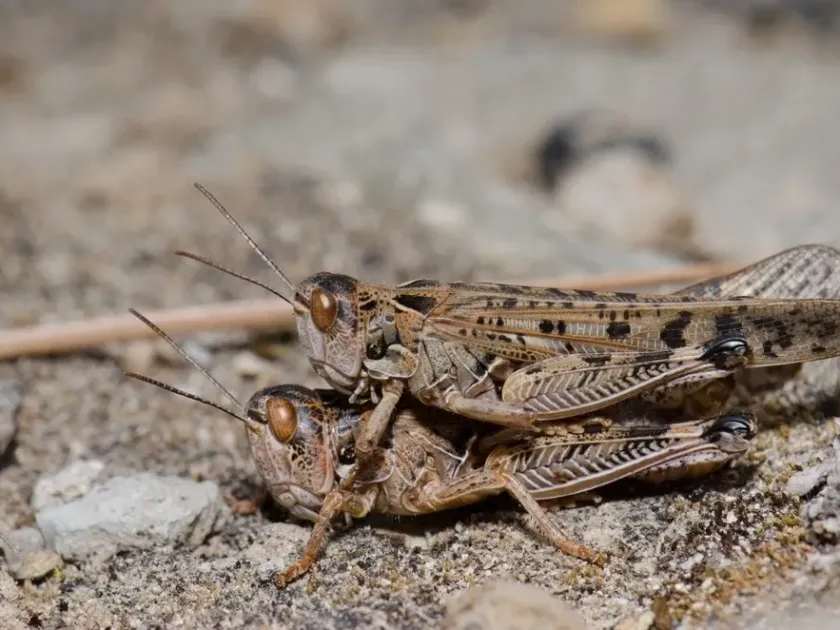
The Moroccan locust (Dociostaurus maroccanus) belongs to the order Orthoptera, family Acrididae. These insects are medium-sized and possess a light coloration with darker spots, allowing them to blend into arid soil environments.
Adults typically measure between 20 and 38 mm in length. A defining physical characteristic is the light-colored, cross-shaped marking on the pronotum, which serves as a key identification mark.
Depending on their phase, these locusts can transition from a solitary existence to a gregarious phase, where they change behavior and appearance to form massive, migrating swarms.
Nymphs undergo several developmental stages, increasing in size and gradually developing wings. Females deposit eggs in the soil within protective, hardened capsules known as egg pods.
This species thrives in xerophytic habitats, preferring steppe and semi-desert regions with sparse vegetation and firm, dry soil surfaces.
What it damages
The Moroccan locust is a polyphagous pest, meaning it attacks a wide range of agricultural crops, including cereals, fodder grasses, and various vegetable plants.
Gregarious swarms are notoriously destructive, capable of consuming entire fields of wheat, barley, or maize in a very short amount of time, often leading to total crop failure.
Beyond cereals, the pest severely damages sunflower plantations, sugar beets, tobacco, vineyards, and young orchard trees by stripping foliage and stems.
Even if the entire plant is not consumed, the physical weight of a settling swarm can flatten crops, rendering them impossible to harvest with heavy machinery.
The economic impact of an unchecked locust outbreak is devastating, often resulting in significant yield loss and long-term degradation of agricultural pastures.
When it appears
The life cycle of the Moroccan locust is strictly seasonal, heavily dictated by soil temperature and moisture levels during the early spring months.
Eggs overwinter inside pods buried in the topsoil. As spring temperatures rise, the hatching process begins, usually synchronized with the growth of early vegetation.
Nymphs typically emerge during April and May. This stage is crucial for monitoring, as the young insects congregate in dense patches, making them easier to control.
Adults start to fly by early summer. Once they reach the winged stage, they become highly mobile, facilitating large-scale migrations across vast agricultural territories.
The cycle concludes in late summer when females lay their eggs in the ground, ensuring the survival of the next generation through the winter months.
Signs of infestation
Early warning signs include the appearance of irregular holes in the leaves of native grasses or wild vegetation located near known breeding sites.
The presence of large groups of nymphs marching in coordinated patterns towards green crops is a definitive indicator of an imminent threat.
Plants affected by locusts often exhibit heavily chewed leaf edges, denuded stems, or are reduced to mere vascular skeletons after a swarm passes through.
Field scouting during the off-season or early spring, looking for egg pods in the soil, provides essential data for forecasting the severity of the upcoming season.
A sudden, loud buzzing sound combined with a shift in the landscape's color as a dense swarm moves confirms a massive infestation requiring immediate intervention.
Control measures
Proactive monitoring of breeding grounds is the most effective way to prevent catastrophic outbreaks by catching the pest before it reaches the flying stage.
Chemical control involving systemic insecticides is commonly applied to localized breeding patches to disrupt the nymphal stages before migration occurs.
- Application of insecticides in identified infestation zones during the early nymph stage.
- Deep plowing of infested soil areas to destroy overwintering egg pods mechanically.
- Use of biological control agents, such as specific fungi that target locust populations.
- Establishment of insecticidal buffer zones to impede the movement of migrating swarms.
- Community-wide surveillance to coordinate efforts against swarms crossing regional boundaries.
Successful management relies on an integrated approach that prioritizes early detection and timely application of controls before the insects reach maturity.
Taxonomy
- Latin name
- Dociostaurus
- Order
- Orthoptera (locusts)
- Family
- Acrididae
- EPPO code
- DICISP
Discussion
No discussions yet — be the first.