
Dissosteira
Dissosteira
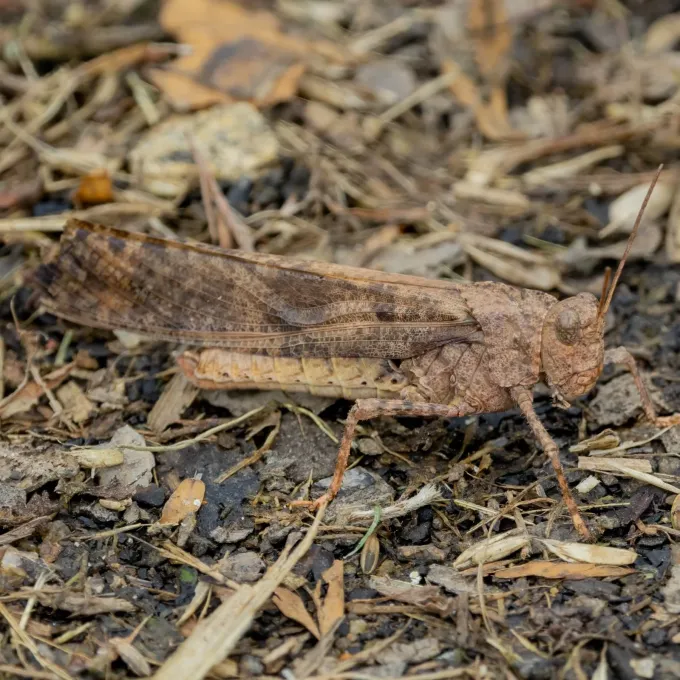
Description
How to identify
Dissosteira is a genus of band-winged grasshoppers belonging to the family Acrididae (order Orthoptera). These are relatively large insects often characterized by cryptic coloration, such as gray, brown, or tan, allowing them to blend perfectly with bare soil and dry vegetation.
Adults are known for their well-developed wings, which often display bright, contrasting colors (such as yellow or black patterns) during flight, serving as a defense mechanism against predators or as mating signals.
Nymphs resemble smaller, wingless versions of the adults. Throughout their development, they undergo several molts, gradually increasing in size and developing wing pads before reaching the adult stage.
The genus includes several species, with the Carolina grasshopper (Dissosteira carolina) being the most well-known representative, primarily found in North America but sharing similar biological traits with other common grasshoppers.
Identifying these grasshoppers in the field involves examining the pronotal crest, wing venation, and specific color patterns on the hind wings, along with observing their distinctive jerky hopping flight patterns.
What it damages
Dissosteira species are polyphagous, meaning they feed on a wide variety of plant species. This broad diet allows them to attack almost any crop found in agricultural fields, including cereals, legumes, and vegetable crops.
Large outbreaks of these grasshoppers can cause severe damage to grain crops such as wheat, barley, and corn, often consuming entire fields if the population density is high enough.
Beyond cereals, they frequently infest vegetable gardens, feeding on leaves, stems, and fruits, which significantly reduces the yield and marketability of the produce.
Forage crops, including alfalfa and clover, are also frequently damaged. This reduces the quality and volume of hay production, directly impacting the profitability of livestock farming.
During periods of resource scarcity, these insects may move from weeds to agricultural crops, turning an otherwise manageable situation into an economically devastating infestation for farmers.
When it appears
The life cycle of Dissosteira is heavily dependent on temperature. Females typically deposit their eggs in the soil during late summer or autumn, where the eggs remain dormant throughout the winter, protected by a pod.
In spring, as soil temperatures rise, the eggs hatch. The timing of this emergence depends on the depth of the egg pods and the local soil warmth, usually occurring between May and June.
The nymphal stage lasts for several weeks or months, during which the insects are highly active and feed voraciously as they progress through five or six instar stages.
Adults emerge in mid-summer, typically peaking in July and August. This is the period of greatest activity, characterized by active mating and the search for suitable oviposition sites in the soil.
Generally, there is one generation per year, although favorable conditions like a warm, dry autumn followed by a mild winter can lead to high overwintering success and subsequent population explosions.
Signs of infestation
The first sign of a Dissosteira infestation is the presence of irregular holes in leaves or "skeletonized" foliage, where only the tough veins remain after the softer tissue has been consumed.
Visual detection is straightforward; when walking through or near a field, one will observe the grasshoppers jumping away in a characteristic flight pattern accompanied by a distinctive clicking sound.
Patches of severely damaged or completely defoliated plants often appear on the edges of fields, indicating that the population is migrating from adjacent non-cropped areas or wasteland.
In cases of high density, one might find frass (insect droppings) on the soil surface, alongside discarded bits of shredded vegetation resulting from their inefficient feeding habits.
Without intervention at the early stages, the damage can spread rapidly, leading to bare patches in the field that are unable to recover if the attack occurs during a critical growth phase.
Control measures
The primary control method is cultural: deep plowing of the soil in late autumn or early spring helps destroy egg pods by exposing them to mechanical damage and adverse weather conditions.
Consistent monitoring of field margins, roadsides, and fallow land is essential, as these areas often serve as the original breeding grounds from which grasshoppers migrate to crops.
If economic damage thresholds are exceeded, chemical control via the application of contact insecticides (pyrethroids or organophosphates) is often necessary to protect the harvest.
Biological control using entomopathogenic fungi is an effective and environmentally friendly approach that can suppress grasshopper populations without leaving toxic residues on the crops.
Timely mowing of weeds and grass around the field perimeter reduces available habitat and food sources, significantly decreasing the risk of a mass migration into the primary crop area.
Taxonomy
- Latin name
- Dissosteira
- Order
- Orthoptera (locusts)
- Family
- Acrididae
- EPPO code
- DISSSP
Discussion
No discussions yet — be the first.