
Dichroplus
Dichroplus
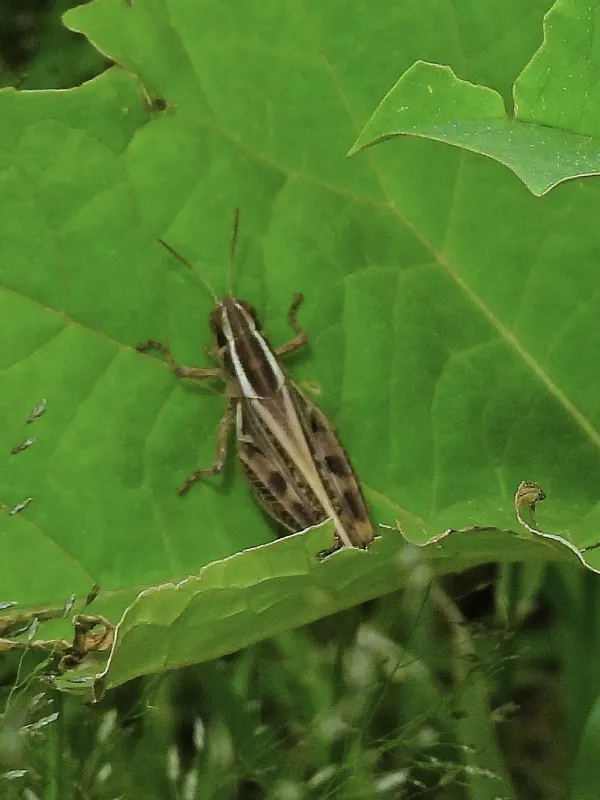
Description
How to identify
The genus Dichroplus belongs to the order Orthoptera and the family Acrididae. This group of short-horned grasshoppers is primarily distributed across South and Central America.
Physically, these insects are characterized by a sturdy, medium-sized body. Their coloration often ranges from greenish to brownish-grey, which provides effective camouflage in meadow and field vegetation.
A distinctive feature of this genus is the presence of a clear tubercle or spine on the prosternum, located between the front legs.
Their biology is closely tied to open landscapes. They possess powerful hind legs adapted for jumping, and adults have well-developed wings, facilitating active migration and dispersal.
The life cycle includes egg, nymph, and adult stages. Females lay eggs in the soil, forming protective structures known as egg pods, reinforced with secretions.
What it damages
Dichroplus species are generalist feeders, or polyphagous pests. They are capable of consuming a wide range of wild grasses and cultivated crops.
The most significant economic damage occurs in cereal crops such as wheat, corn, and sorghum. Pastures are also frequently affected, which reduces their nutritional value for livestock.
In their regions of distribution, these pests can damage legumes, including soybeans and alfalfa, by chewing on leaf tissue and damaging plant reproductive organs.
Mass outbreaks of these grasshoppers lead to complete defoliation of crops. In cases of critical population density, the pests can destroy young seedlings, resulting in thin, unproductive crop stands.
Beyond direct destruction of green matter, the feeding wounds provide entry points for secondary fungal and bacterial infections in plant tissues.
When it appears
Insect activity begins with the onset of the warm season. The emergence of nymphs from eggs typically coincides with the period of active vegetation growth in spring.
Peak damage usually occurs in mid-summer, when the population reaches its maximum development and adults feed intensively before the mating season.
Temperature plays a crucial role in population dynamics: dry and hot periods accelerate metabolism and lead to faster egg maturation.
The life cycle is typically univoltine (one generation per year), although depending on the climatic zone, some species may show distinct seasonal cycles.
As autumn approaches, activity decreases, and adults lay eggs in the soil. These eggs undergo winter diapause and are highly resistant to low temperatures.
Signs of infestation
The first sign of infestation is characterized by ragged or "windowpane" leaf damage. Leaf margins appear roughly chewed, often down to the midrib.
In the fields, the insects themselves can be spotted when moving through the crop: sudden jumping and flight are clear signals of a high population density.
During the early stages, pest droppings (frass) can be found on leaves or on the soil surface beneath the plants.
Upon field inspection, areas of intensive grazing become visible, where plants appear significantly thinner and stunted compared to surrounding plots.
Wilting of tops or damage to inflorescences in the later stages of plant development is a sign of a critical infestation level requiring immediate intervention.
Control measures
The primary control method involves monitoring nymph population density during early development, which allows for targeted chemical applications.
The use of broad-spectrum insecticides is effective during periods of mass nymph emergence, when the insects are most vulnerable to chemical treatments.
Agronomic methods include deep autumn tillage, which helps destroy egg pods, exposing them to freezing temperatures or desiccation.
It is important to manage weed density on field margins, as these areas often serve as primary reservoirs for the pest population.
The use of biological agents, such as entomopathogenic fungi or natural predators, can be effective as part of an integrated pest management (IPM) system.
Taxonomy
- Latin name
- Dichroplus
- Order
- Orthoptera (locusts)
- Family
- Acrididae
- EPPO code
- DICRSP
Discussion
No discussions yet — be the first.