
Zeller's Lacewing
Dichochrysa zelleri
Description
How to identify
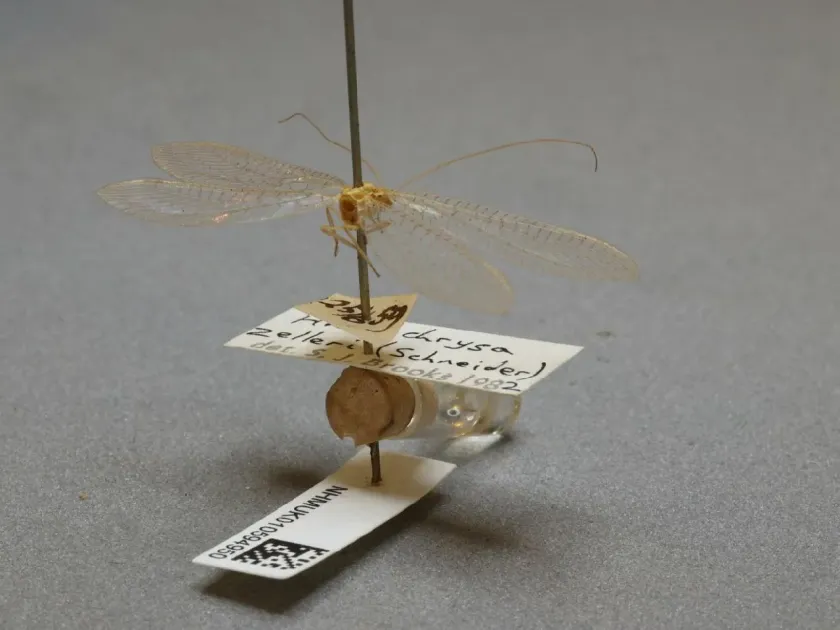
Zeller's Lacewing (Dichochrysa zelleri) belongs to the order Neuroptera and the family Chrysopidae. It is a delicate insect characterized by four transparent, membranous wings with a complex network of veins.
Adults typically feature a pale green body, allowing them to blend seamlessly into foliage. Their eyes are known for a striking, iridescent golden reflection, which gives the family its common name.
The body length of the adult is approximately 10 to 15 mm, with a wingspan that can extend up to 30 mm. They possess long, thread-like antennae that are highly sensitive to environmental changes.
The larvae are specialized predators, often referred to as "aphid lions" due to their voracious appetite for aphids. They have elongated, flattened bodies and prominent, curved mandibles.
Distinguishing Dichochrysa zelleri from other related species within the genus often requires close examination of specific morphological characters or genetic analysis, as they appear very similar.
What it damages
In most agricultural settings, Dichochrysa zelleri is considered a highly beneficial insect rather than a pest, as it plays a key role in natural pest population management.
However, under conditions of extreme prey scarcity, adults might occasionally supplement their diet with plant nectar or pollen, resulting in negligible impact on the host plants.
These insects are frequently found on fruit trees, berry bushes, and vegetables where aphid infestations occur, as aphids provide the necessary protein for larval development.
Direct damage to agricultural crops is rarely documented and does not typically reach a level that would justify control measures aimed at suppressing the lacewing population.
The presence of this species is generally an indicator of a balanced ecosystem where natural enemies are actively suppressing secondary pests such as mites and aphids.
When it appears
The life cycle of Dichochrysa zelleri follows complete metamorphosis, consisting of egg, three larval stages, pupa, and adult. Multiple generations can occur within a single year.
Overwintering usually occurs at the adult or prepupal stage within a protective silken cocoon hidden in bark crevices, leaf litter, or sheltered areas of agricultural structures.
As spring temperatures stabilize, adults emerge to begin their mating cycle. They actively search for plants infested with aphids to deposit their eggs.
Larval activity peaks during the mid-summer months, coinciding with the highest aphid density. During this period, the larvae consume large numbers of pests daily.
As autumn progresses and daylight decreases, the insects move toward overwintering sites, entering a state of diapause to survive the winter temperatures.
Signs of infestation
A hallmark sign of lacewing presence is the discovery of eggs attached to the undersides of leaves via long, slender silk stalks, which protect them from predators and cannibalistic siblings.
The activity of larvae can be observed by the sudden decrease in aphid colony size and the presence of "mummy" skins or discarded debris on plants, which larvae often carry for camouflage.
Adults are frequently attracted to artificial light sources at night, making them easy to spot near porch lights or greenhouse lamps during the summer months.
Actual damage to plants is virtually non-existent, but if a high population exists alongside flowers, one might see very minor pollen feeding, which has no commercial significance.
A healthy garden with low aphid pressure is the best evidence that Dichochrysa zelleri is successfully patrolling the area and performing its ecological service.
Control measures
Active control measures against Dichochrysa zelleri are generally discouraged, as the species provides essential biological control services by feeding on destructive crop pests.
The primary strategy should be the preservation of this predator. Growers should avoid using broad-spectrum insecticides that inadvertently kill beneficial insects alongside targeted pests.
Integrating nectar-rich flowering plants into the farm landscape ensures that adult lacewings have a food source, which increases their longevity and overall egg production.
An Integrated Pest Management (IPM) approach should be prioritized, where chemical interventions are used only when pest density exceeds economic thresholds and selective products are available.
- Avoid preventative spraying with non-selective insecticides.
- Provide flowering border strips to attract beneficial insects.
- Monitor pest populations to determine if intervention is necessary.
- Use bio-rational pesticides that are safer for lacewing larvae.
Taxonomy
- Latin name
- Dichochrysa zelleri
- Family
- Chrysopidae
- EPPO code
- DCHOZE
Discussion
No discussions yet — be the first.