
Yellow-fronted lacewing
Dichochrysa flavifrons
Description
How to identify
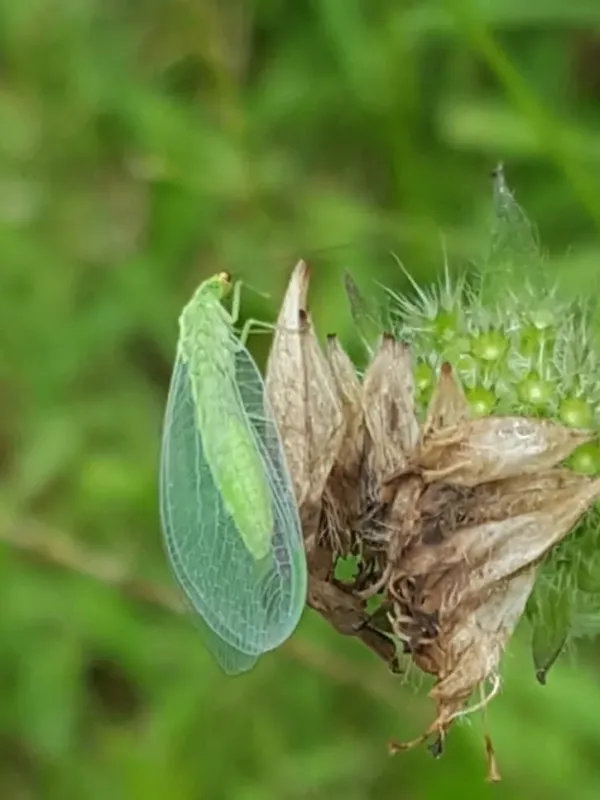
The yellow-fronted lacewing, scientifically known as Dichochrysa flavifrons, belongs to the Neuroptera order and Chrysopidae family. Adult specimens are slender, green insects with distinct golden eyes and a characteristic yellow stripe on the frons.
Their wings are transparent with a complex, dense network of veins. When at rest, the wings are held roof-like over the abdomen, which is a classic identification feature for this group.
Larvae have a specific appearance often described as alligator-like, equipped with elongated, sickle-shaped mandibles. Their bodies are covered with tubercles and setae that hold debris for camouflage.
A unique biological feature is the way they lay eggs: each is attached to a long, thin stalk. This structure prevents cannibalism among newly hatched larvae and protects them from predators.
The life cycle undergoes complete metamorphosis, including egg, three larval instars, pupation inside a silken cocoon, and the adult stage. The species can complete several generations per season.
What it damages
While lacewings are often regarded as beneficial, the larvae of Dichochrysa flavifrons can cause damage to crops when their primary prey is scarce, forcing them to feed on plant sap.
The species primarily affects fruit trees, vineyards, and various ornamental shrubs. Larvae pierce the tissues of young shoots, leading to wilting and poor development of the apical parts.
Damage to buds and tender leaves causes localized necrosis and distortion, which significantly inhibits the growth rate of young plants or grafted saplings.
During periods of extreme heat and drought, the pests become more aggressive in seeking moisture, which increases the likelihood of physiological damage to the host plant.
In vineyards, the damage to flower clusters and developing berries can lead to reduced fruit quality and increased vulnerability to secondary infections such as gray mold.
When it appears
Adults typically emerge from winter hibernation in late spring, once the average daily temperature consistently reaches at least 15 degrees Celsius.
The peak egg-laying period occurs during the early summer months, synchronizing with the flush of new vegetative growth in orchards and gardens.
Larval development takes place during the height of the summer season, with the three instars lasting several weeks depending on food availability and temperature.
Pupation occurs inside silk cocoons hidden in bark crevices or among fallen leaf litter, providing a safe haven for the development of the next generation.
The species overwinters as adults, seeking protection in sheltered environments such as dense bushes, tree hollows, or human-made structures.
Signs of infestation
The presence of eggs on individual long stalks on the underside of leaves is the most reliable early indicator of this species' colonization.
Observing larvae moving along branches, often carrying camouflaging material on their backs, confirms an active infestation of the plant.
Deformed, curled, or necrotic leaves at the tips of shoots are characteristic symptoms of the larval feeding activity on plant sap.
Blackened, shriveled buds that fail to open are another common sign of damage occurring in the spring, which can stunt the branch growth for the entire season.
Finding tiny white or cream-colored cocoons in protected areas like branch forks or under loose bark during autumn indicates where the population resides.
Control measures
Effective management begins with good horticultural hygiene, such as removing old, loose bark and clearing debris from the garden floor to eliminate overwintering sites.
Maintaining a balanced ecosystem that supports the native predators and parasitoids is essential for keeping the yellow-fronted lacewing population within manageable levels.
If chemical intervention becomes necessary, priority should be given to soft, selective pesticides that minimize harm to other beneficial insects in the ecosystem.
The use of biological control agents, such as specific fungal pathogens, can be an effective way to suppress outbreaks without relying on synthetic chemicals.
- Regular monitoring of sensitive crop stages.
- Pruning of damaged shoots to remove high-density areas.
- Installation of insect-attracting habitats for predators.
Taxonomy
- Latin name
- Dichochrysa flavifrons
- Family
- Chrysopidae
- EPPO code
- DCHOFL
Discussion
No discussions yet — be the first.