
Dichelops
Dichelops
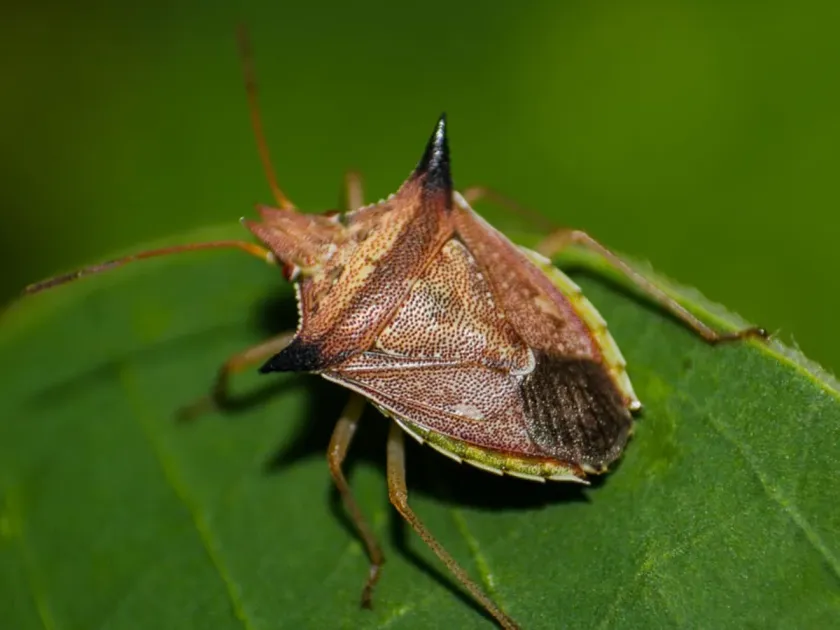
Description
How to identify
Dichelops is a genus of stink bugs belonging to the family Pentatomidae. These insects are characterized by a shield-shaped body, which is typical for the family. They often possess a cryptic coloration ranging from light brown to olive green, providing excellent camouflage on host plants.
A key diagnostic feature of this genus is the presence of sharp spines or projections on the anterolateral margins of the pronotum. Their head is relatively small and triangular, housing specialized piercing-sucking mouthparts designed to feed on plant sap.
The life cycle includes the egg stage, five nymphal instars, and the adult stage. Eggs are usually laid in masses on the underside of leaves, a behavior that protects them from environmental stressors and visual detection by many predators.
Nymphs resemble smaller, wingless versions of the adults. As they pass through different instars, they gradually develop the characteristic markings and size of the mature insects, while continuing to feed on the same host plants as the adults.
These bugs thrive in temperate and humid climates, which support rapid population growth. Understanding their phenology is essential for timely detection and management within agricultural ecosystems.
What it damages
Dichelops is a polyphagous pest, meaning it attacks a wide variety of crops. Significant economic losses are frequently observed in soybeans, corn, wheat, and various other grain and legume crops during their reproductive stages.
The insects damage the plant by inserting their stylets into tissues, including stems, leaves, flowers, and developing seeds. This feeding process extracts vital nutrients and often introduces toxic saliva, causing tissue necrosis.
In legumes, feeding on the pods results in shriveled or deformed seeds. This damage significantly reduces yield, lowers the seed weight, and compromises the quality and germination potential of the harvested grain.
When attacking corn, Dichelops feeds on the kernels during the milk or dough stage. The damage caused by these punctures creates entry points for secondary pathogens, leading to fungal infections and kernel rot within the ears.
Severe infestations lead to stunted plant growth, lodging, and significant yield reductions. The overall impact on plant health is exacerbated by the disruption of nutrient flow within the vascular bundles of the plant.
When it appears
The seasonal activity of Dichelops begins in the spring as temperatures rise, signaling the emergence of overwintered adults from their hiding spots. They initially colonize weed hosts before moving into primary agricultural crops.
The period of greatest concern for farmers is mid-summer, when the population peaks. During this time, multiple life stages—including eggs, various nymphal instars, and adults—are often present simultaneously in the fields.
Climate variables significantly influence the number of generations per season. In warmer regions with long growing seasons, the pest can complete several generations, leading to a constant threat to crops throughout the summer.
As autumn approaches and photoperiods decrease, the insects prepare for diapause. They seek protected environments, such as crop residues, field borders, or leaf litter, which provide the necessary insulation to survive the winter.
Monitoring the seasonal movement of these bugs from wild hosts to commercial fields is a crucial part of an effective integrated pest management (IPM) program.
Signs of infestation
Early signs of Dichelops infestation include chlorotic spots on the leaves at the site of feeding. As the damage progresses, these spots often turn necrotic, causing localized tissue death that can be confused with nutrient deficiencies or disease.
Visual observation of the plants may reveal the insects themselves, particularly on the underside of leaves or within the ears of corn. They are often shy and may drop to the ground when disturbed.
The presence of aborted flowers or poorly developed pods is a strong indicator of heavy bug pressure. In corn, dark discolorations on the kernels are a classic symptom of puncture feeding by stink bugs.
Small, dark fecal droplets found on leaves and stems serve as another diagnostic sign of insect activity. These spots are often clearly visible in fields where the population density has reached high levels.
Severe damage to soybeans may include the presence of deformed pods and seeds that fail to develop properly. Farmers should inspect these areas carefully if yield reduction is suspected in specific parts of the field.
Control measures
Effective control of Dichelops relies on an integrated approach. Cultural practices, such as weed management, are the first line of defense, as many weeds act as early-season reservoirs for the pest.
- Utilizing crop rotation to disrupt the life cycle.
- Performing deep tillage after harvest to bury overwintering sites.
- Deploying pheromone traps to monitor population density.
- Applying insecticides only when economic thresholds are exceeded.
Chemical control usually involves the application of contact or systemic insecticides. Applications are most effective when targeted at the earlier nymphal stages, which are typically more susceptible to treatment.
Resistance management is a critical concern in chemical control. It is important to rotate products with different modes of action to prevent the development of resistant populations in intensive agricultural zones.
Biological control efforts, focusing on the conservation of natural enemies such as egg parasitoids, can help suppress populations and reduce the overall dependency on chemical inputs over time.
Taxonomy
- Latin name
- Dichelops
- Order
- Hemiptera (bugs, aphids, leafhoppers)
- Family
- Pentatomidae
- EPPO code
- DICLSP
Discussion
No discussions yet — be the first.