
Cactus scale
Diaspis echinocacti
Description
How to identify
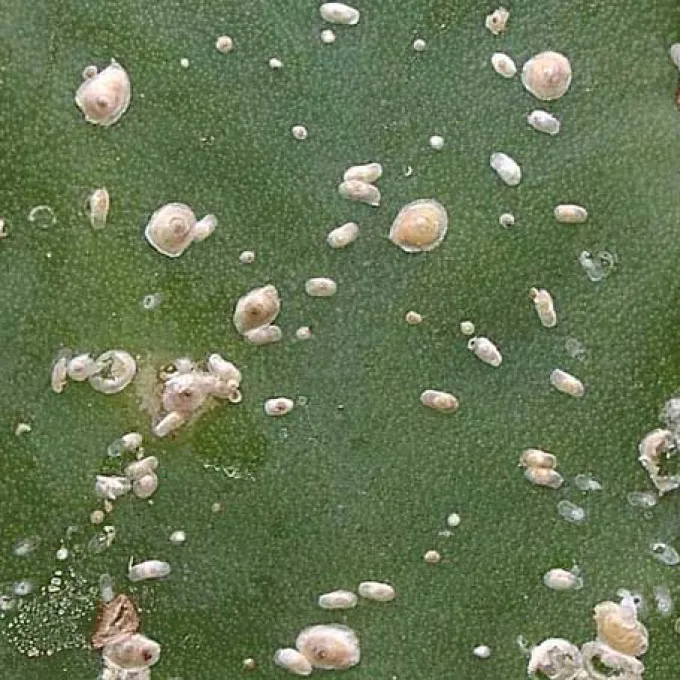
Cactus scale (Diaspis echinocacti) belongs to the order Hemiptera, family Diaspididae. Adult females possess a rounded or oval, grayish-white or yellowish scale that covers the insect's body.
Males of this species have a more elongated scale and a lighter color. Due to their flat shape and coloration, they often blend into the epidermis of the cactus, making them difficult to detect for the collector.
The size of adult individuals is only 1–2 millimeters. Unlike the sedentary adult females, the crawlers (larvae) are very mobile and can actively move across the plant's surface to find a suitable feeding site.
This species is a typical sap-sucking pest. Because of their protective waxy shield, they are resistant to many external factors and standard contact insecticides, which dictates specific treatment requirements.
Identification of the pest requires a magnifying glass, as scale colonies often appear as harmless crusts or small bumps on the cactus stem.
What it damages
This pest specializes in infesting members of the cactus family (Cactaceae). Colonies are most frequently found on genera such as Echinocactus, Cereus, Opuntia, and Selenicereus.
In greenhouses and indoor environments, the scale can spread to other succulent types with fleshy stems or leaves. High plant density in a collection significantly facilitates the rapid spread of the pest.
Insects suck cell sap from the plant tissues, leading to the depletion of the cactus's vital resources. Yellowish or brown spots appear at the site of epidermis punctures, ruining the aesthetic value.
Damaged areas become entry points for secondary infections, including fungal diseases and rots. In severe cases, stem deformation occurs, accompanied by significant growth retardation.
Under heavy infestation, the cactus loses turgor, turns yellow, and may eventually die without timely intervention by the owner.
When it appears
Reproduction of cactus scale in greenhouses and homes occurs almost year-round, as indoor temperature regimes are favorable for the pest's development.
The peak of activity and population size usually occurs during the spring and summer, when higher temperatures and longer daylight hours accelerate the insects' metabolism, leading to mass emergence of crawlers.
In winter, when plants are in a dormant state at lower temperatures, the scale development slows down. However, the pest does not die, remaining in a state of rest or hidden reproduction in hard-to-reach areas of the stem.
A major risk is the introduction of infested material into the collection. New plants that have not undergone a quarantine period are the primary source of outbreaks at any time of the year.
Monitoring the condition of the collection should be constant, regardless of the season, with special attention given to areoles and stem joints.
Signs of infestation
The main sign of infestation is the appearance of sedentary, flat gray or white scales on the cactus epidermis, which can be easily removed by scraping with a needle.
Discoloration of the plant's skin often occurs around the feeding sites. Tissues lose chlorophyll, becoming pale, yellowish, or gray-brown.
The presence of a large number of pests leads to stem bending at the feeding sites. The plant looks sickly, shriveled, and loses its natural shape due to the drain of nutrients.
A secondary sign is the appearance of sticky honeydew, which later becomes a substrate for sooty mold. This gives the cactus a dirty, dark appearance and inhibits photosynthesis.
Upon careful inspection, one can find clusters of tiny white dots inside the areoles, which are preferred habitats for young individuals.
Control measures
The first step in control is mechanical removal: clearing visible individuals with a cotton swab dipped in alcohol or insecticidal soap, which helps reduce the total population.
An effective protection method is systemic application of insecticides containing imidacloprid or acetamiprid. The substance is absorbed by the roots and makes the plant's sap toxic to the scale.
- Isolate the infested plant from the main collection immediately.
- Thoroughly treat the substrate with systemic pesticides.
- Regularly inspect neighboring plants for at least a month.
- Dispose of severely damaged specimens if recovery is impossible.
Prevention involves mandatory quarantine for any new plants for at least 3–4 weeks. During this time, it is important to monitor the cactus's condition using a magnifying glass.
To prevent re-infestation, maintain optimal humidity and cleanliness in the growing area, as weakened plants are the most susceptible to pest attacks.
Taxonomy
- Latin name
- Diaspis echinocacti
- Order
- Hemiptera (bugs, aphids, leafhoppers)
- Family
- Diaspididae
- EPPO code
- DIASEC
Discussion
No discussions yet — be the first.