
Spotted diaphorina
Diaphorina punctulata
Description
How to identify
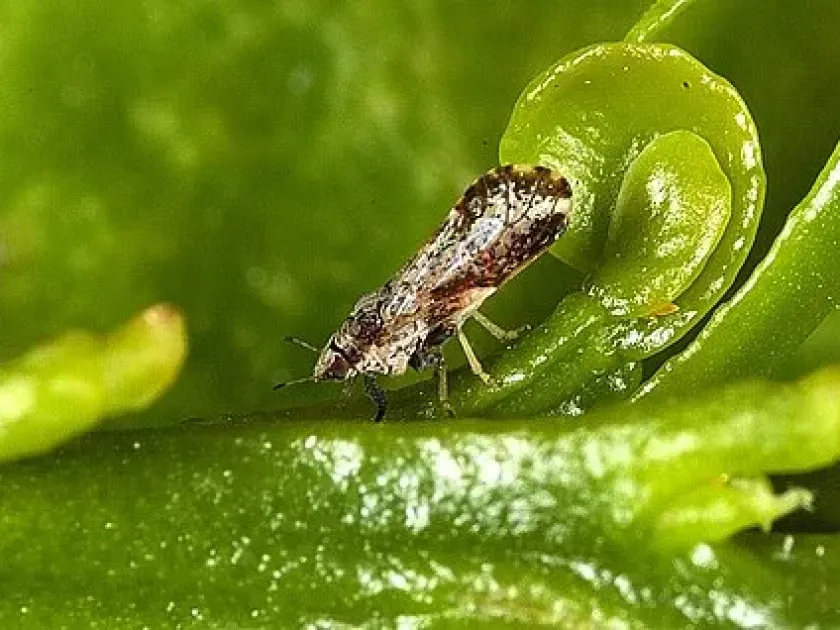
The Spotted Diaphorina (Diaphorina punctulata) is a small insect classified within the order Hemiptera and the family Psyllidae. Adults are distinguished by a mottled appearance, which provides effective camouflage against the foliage of host plants.
The adult insect has a sturdy body structure, with well-developed eyes and antennae used for navigating through the canopy. The wings are transparent and often feature distinctive dark spots, which are a key identification feature for this species.
The larvae go through several developmental stages, during which they differ morphologically from adults. They are typically flat and often secrete a waxy, white substance that acts as a protective shield against predators and desiccation.
This pest develops through incomplete metamorphosis. Both adults and nymphs possess piercing-sucking mouthparts, allowing them to extract sap directly from the plant's vascular system, causing significant physiological stress.
Due to their mobility, adults can quickly jump or fly when disturbed, which often complicates manual inspection and early detection efforts in orchards and nurseries.
What it damages
The primary hosts for the Spotted Diaphorina are citrus plants, specifically within the genus Citrus. They show a strong preference for young, succulent growth where nutrients are most readily available for their development.
Beyond cultivated citrus, the pest can reside on various wild shrubs belonging to the Rutaceae family, which often serve as reservoirs for re-infestation of agricultural sites throughout the growing season.
High populations of this insect can severely weaken host plants. By removing essential fluids and nutrients, the pest inhibits the plant's ability to grow, leading to stunted shoots and reduced overall tree vigor.
Feeding activities lead to reduced photosynthetic capacity, which directly results in lower yields and poorer fruit quality. In cases of extreme infestation, branches may become brittle and die back.
Furthermore, the pest is a suspected vector for several plant pathogens. By damaging the plant tissue, it creates entry points for secondary infections that can compromise the health of entire groves.
When it appears
The seasonal appearance of the Spotted Diaphorina is closely linked to the vegetative flushing of the host plants. Infestations typically begin in early spring as buds break and new, tender shoots emerge.
The insect is capable of producing multiple generations within a single season, provided that temperatures remain favorable for development. Peak populations are often observed during the warmest months of the year.
As temperatures begin to drop in the autumn, reproductive rates decrease. Adult insects may survive for extended periods, sometimes sheltering in dense foliage or protected areas until the return of warmer conditions.
Early-season monitoring is critical for management. Agronomists focus their scouting efforts on the first spring flush, as controlling the initial generation is much easier than managing an established outbreak.
Weather conditions significantly impact the lifecycle, with hot and dry weather generally accelerating the development time from egg to adult, leading to rapid population explosions.
Signs of infestation
One of the earliest signs of an infestation is the distortion of young leaves, which often curl or cup significantly due to the reaction of the plant to the insect's salivary secretions.
The presence of honeydew is another major indicator. This sticky, sugar-rich substance excreted by the larvae accumulates on leaves and branches, frequently leading to the development of sooty mold.
Careful inspection of the undersides of leaves and leaf axils usually reveals colonies of nymphs. These nymphs are often found embedded within waxy secretions, making them appear as white, scale-like spots.
Yellowing of terminal shoots and branch dieback are common symptoms of a mature or heavy infestation. As the plant loses vitality, the canopy may appear sparse and unhealthy upon visual inspection.
If you suspect an infestation, gently tapping the branches will often cause the adults to jump away from the foliage, making their presence clearly evident to the observer.
Control measures
Management of the Spotted Diaphorina requires an integrated approach. Cultural practices, such as pruning to remove heavily infested shoots and managing surrounding host weeds, are the foundation of control.
Chemical control involving systemic insecticides is often necessary when populations exceed economic injury levels. These products move through the plant's system to provide protection against sap-feeding.
Biological control plays a vital role in sustainable management. Encouraging or releasing natural predators like ladybugs, lacewings, and parasitic wasps can significantly keep pest numbers in check.
Resistance management is crucial, so rotating between different classes of insecticides is recommended to ensure that the pest does not develop tolerance to commonly used chemicals.
- Utilize yellow sticky traps to monitor adult flight activity.
- Maintain orchard hygiene by removing alternate host plants.
- Apply systemic insecticides according to phenological plant stages.
- Promote biodiversity to maintain populations of natural predators.
Taxonomy
- Latin name
- Diaphorina punctulata
- Order
- Hemiptera (bugs, aphids, leafhoppers)
- Family
- Psyllidae
- EPPO code
- DIAAPU
Discussion
No discussions yet — be the first.