
Asian citrus psyllid
Diaphorina
Description
How to identify
The Asian citrus psyllid (Diaphorina citri) is a small insect belonging to the family Liviidae, known globally as a primary pest in citrus orchards.
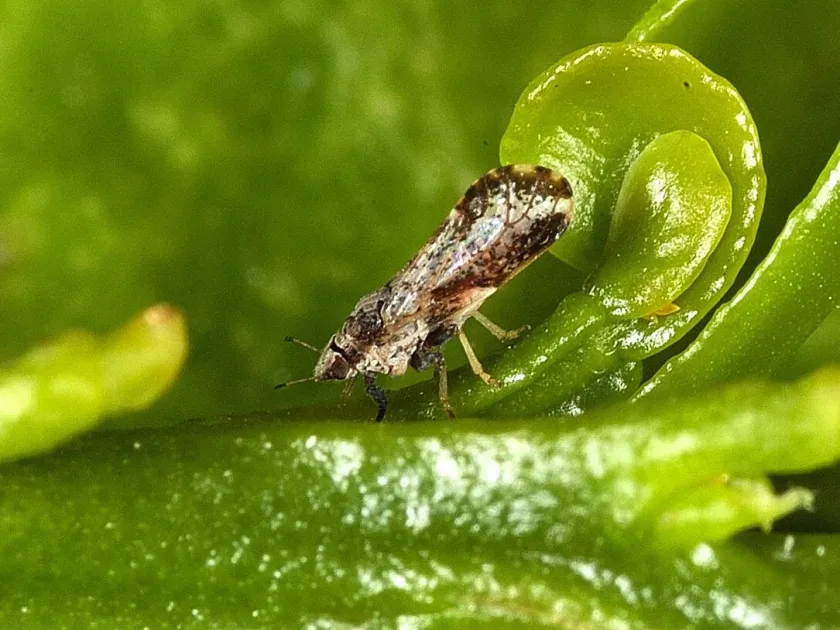
Adult psyllids are about 3 to 4 mm long with brownish bodies and mottled wings, often making them difficult to detect on branches.
A key identifying feature is the insect's posture when resting on a leaf: it elevates its rear end, forming a distinct 45-degree angle.
Eggs are tiny, yellow to orange in color, and are deposited in large numbers on newly emerging leaves and tender plant tissue.
Nymphs are flattened, orange-yellow creatures covered in wax-like excretions and white filaments, usually found near the growing tips.
What it damages
This pest feeds on all citrus species, including oranges, lemons, limes, and grapefruits, as well as several ornamental Rutaceae plants.
Direct damage occurs through sap-sucking, which causes distortion, curling, and stunting of new growth in young and established trees.
Beyond direct feeding damage, the psyllid is the primary vector for Candidatus Liberibacter, the bacterium causing Citrus Greening (HLB).
Citrus Greening is a devastating disease that eventually kills citrus trees, making the psyllid one of the most destructive agricultural pests.
The pest's ability to migrate and spread quickly makes it a major concern for citrus industries, necessitating strict regional quarantine measures.
When it appears
The life cycle of the Asian citrus psyllid is closely linked to the availability of new plant flushes, as nymphs require tender growth to survive.
In warm climates, the insect breeds continuously, completing a full generation from egg to adult in as little as 15 to 20 days during the summer.
The population tends to surge during periods of active vegetative growth, usually in spring and after pruning, when new leaves are abundant.
During cold or dry seasons, the insects enter a state of dormancy or slow development, surviving in the canopy of host trees.
Monitoring efforts should be intensified during the spring and late summer to capture the peak activity of the pest's life cycle.
Signs of infestation
The most visible sign of infestation is the curling and twisting of new leaf growth, often accompanied by terminal shoot dieback.
Presence of waxy, white, cotton-like excretions on the underside of leaves indicates the presence of developing nymph colonies.
Sooty mold growth is common on leaves and branches, as the psyllids excrete honeydew that fosters fungal development.
Citrus Greening symptoms include blotchy mottle patterns on leaves and yellowing of the canopy, which does not follow a typical nutrient deficiency pattern.
Infected trees often exhibit fruit drop, small and misshapen fruit, and a distinctively bitter taste, making the crop commercially unusable.
Control measures
Effective management begins with quarantine and the use of certified, disease-free nursery stock to prevent the introduction of the pest.
Chemical control involving systemic insecticides like imidacloprid is frequently used to manage population outbreaks in commercial orchards.
Biological control agents, such as the parasitic wasp Tamarixia radiata, have been successfully introduced in many regions to suppress psyllid numbers.
Good horticultural practices, including timing pruning to minimize the growth of succulent shoots, can help reduce the psyllid's habitat.
Implementing regular monitoring programs with yellow sticky traps is essential to identify infestations early and initiate targeted control actions.
Taxonomy
- Latin name
- Diaphorina
- Order
- Hemiptera (bugs, aphids, leafhoppers)
- Family
- Psyllidae
- EPPO code
- DIAASP
Discussion
No discussions yet — be the first.