
Diabolocatantops axillaris
Diabolocatantops axillaris
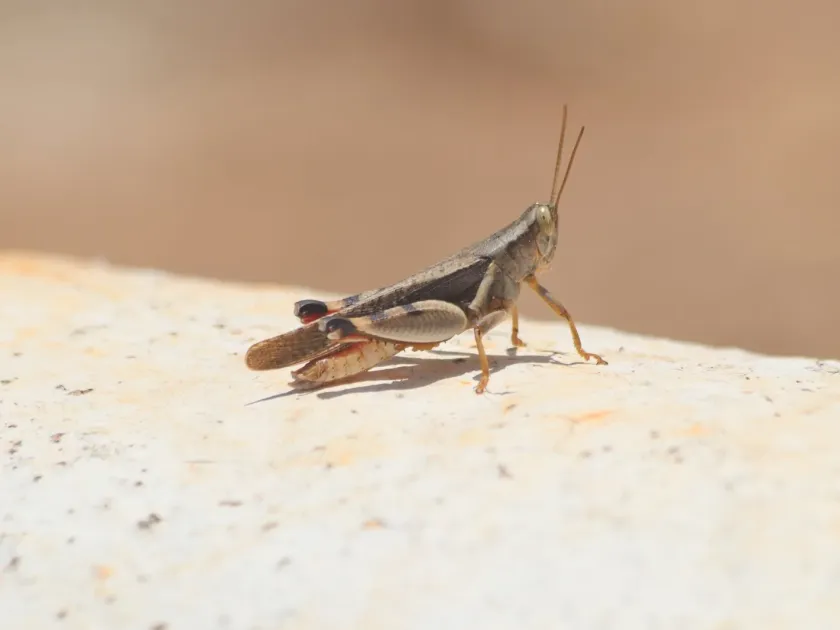
Description
How to identify
Diabolocatantops axillaris is a member of the Acrididae family, commonly referred to as grasshoppers. These insects are well-adapted to survive in various environments, exhibiting cryptic coloration that provides camouflage against dry soil and vegetation.
The morphology of the adult includes powerful hind legs for jumping and well-developed wings for flight, enabling them to migrate over significant distances when food sources become scarce in their primary habitats.
Like other grasshoppers, this species undergoes incomplete metamorphosis, consisting of egg, nymph, and adult stages. Nymphs closely resemble miniature adults but lack functional wings, making them local to their hatching site initially.
They are generally found in open, arid to semi-arid regions. Their ability to change color density based on environmental factors and population pressure is a survival mechanism common among locust-like insects.
Identification is primarily based on anatomical features of the hind femur and the specific shape of the male genitalia, which are distinct for this species within its geographical range.
What it damages
This species is highly polyphagous, meaning it feeds on a wide variety of plant materials. Major targets include cereals like wheat, sorghum, and maize, which suffer direct foliage loss.
In addition to field crops, the pest significantly impacts pastures and rangelands by depleting green biomass, which creates a competitive struggle for forage with livestock.
Severe infestations often result in the complete removal of leaf blades, leaving only the stem and vascular tissues. This destruction severely impacts the photosynthetic capacity of the plant.
Reproductive organs such as grain heads or flowering parts are frequently consumed, leading to substantial yield reductions. In high-density populations, the damage can be total for a given crop area.
The pest's feeding habit is characterized by rapid consumption, where a swarm can denude a field in a very short amount of time if conditions remain favorable for their development.
When it appears
Activity typically aligns with the onset of the growing season and warmer temperatures. Eggs overwinter in the soil and hatch when moisture and temperature reach threshold levels.
The peak destructive period is usually mid-summer, when the majority of the population reaches the nymphal stage of high development or the adult phase, which is highly mobile.
The lifecycle is generally univoltine, but development speed is heavily dependent on thermal accumulation; hotter, drier years often lead to explosive population growth.
Monitoring should begin shortly after the first spring rains or rising temperatures, focusing on border areas where nymphs congregate shortly after hatching from egg pods.
Towards the end of the season, adults focus on egg-laying in compact soil, ensuring the next generation survives the dormant period until the cycle repeats the following year.
Signs of infestation
The first signs of infestation are ragged leaf edges, as the insects typically consume leaf margins first before moving inward toward the midrib.
A noticeable presence of grasshoppers leaping away as one walks through a field is a clear indicator of a significant infestation level requiring immediate attention.
The presence of fecal pellets (frass) on the ground surface and foliage indicates active, recent feeding activity in the area.
Small patches of damage may appear initially; however, these patches expand rapidly as the nymphs grow and migrate across the crop rows, often leaving behind a trail of devastated vegetation.
Increased bird activity around specific field patches can sometimes act as a natural alarm, as predators begin to congregate in areas with high pest densities.
Control measures
Effective management requires an integrated approach that combines mechanical intervention with chemical or biological controls to keep populations below the economic injury level.
Cultural methods, such as deep tillage of known egg-laying sites, can significantly reduce the number of emerging nymphs by exposing egg pods to predators and desiccation.
Chemical control involving systemic or contact insecticides is most effective when applied during the early nymphal stages, as younger insects are more susceptible to treatment.
Biological control using entomopathogenic fungi such as Metarhizium species offers a targeted, environmentally friendly alternative for suppressing grasshopper outbreaks.
- Systematic field monitoring.
- Tillage of overwintering sites.
- Application of approved insecticides.
- Usage of biological control agents.
- Vegetation management on field borders.
Taxonomy
- Latin name
- Diabolocatantops axillaris
- Order
- Orthoptera (locusts)
- Family
- Acrididae
- EPPO code
- DCNPAX
Discussion
No discussions yet — be the first.