
Diabolocatantops
Diabolocatantops
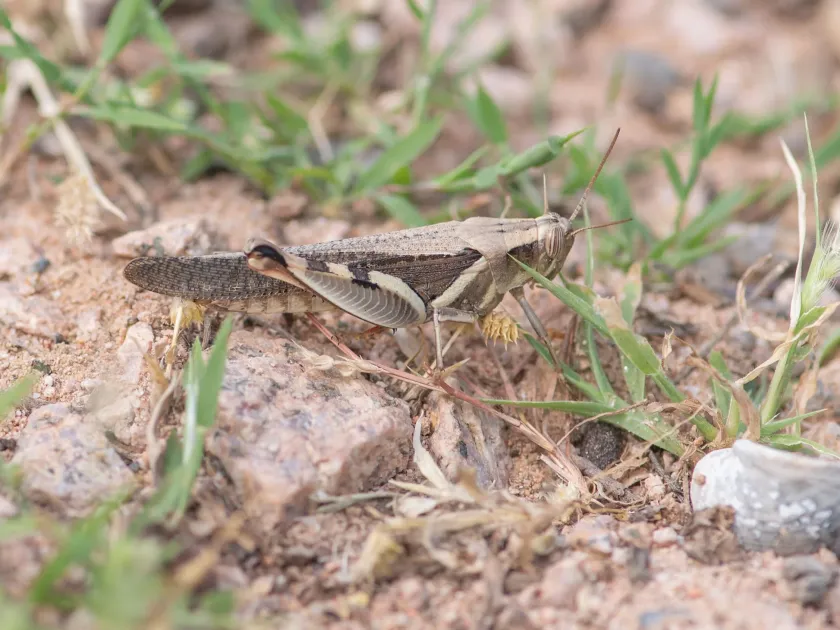
Description
How to identify
Diabolocatantops belongs to the family Acrididae (short-horned grasshoppers), order Orthoptera. It is a robust insect exhibiting typical morphological features of the Catantopinae subfamily, adapted to diverse environments.
Adult specimens are characterized by powerful hind legs designed for jumping, which is their primary mode of locomotion when disturbed. The body coloration typically ranges from brownish to greenish-grey, providing camouflage.
The head is large, featuring strong mandibles for chewing plant tissue. The antennae are of medium length, serving as a key taxonomic marker for distinguishing this genus from other common orthopterans.
Wing development is sufficient for active flight, enabling adults to migrate efficiently between fields in search of fresh food sources. The internal surface of the hind femora often bears distinct markings.
Nymphs resemble smaller, wingless versions of adults. Throughout their development, they undergo several molts, progressively increasing in size and developing wing pads until they reach maturity.
What it damages
Diabolocatantops is a polyphagous pest capable of consuming a wide variety of plant species. It poses a significant threat to agricultural productivity in several regions, especially in cereal-growing areas.
Primary hosts include maize, sorghum, millet, and rice. During population outbreaks, the pest can strip entire fields of foliage, leaving only the stalks, which severely stunts plant growth.
Beyond cereal crops, this grasshopper frequently targets vegetable crops, including legumes and solanaceous plants. In orchards, heavy infestations can lead to substantial defoliation of young trees.
The damage is caused by intensive feeding on the leaf laminae, which drastically reduces the photosynthetic surface area. This impairs the plant's ability to produce energy, resulting in reduced yields.
Severe infestations often cause the destruction of the growing points in young seedlings. This can result in the total death of the crop if the damage occurs at a critical development stage.
When it appears
The life cycle of Diabolocatantops is synchronized with local climatic patterns. Typically, there is one generation per year, although temperature and rainfall can influence the duration of development.
The species survives the winter stage as eggs buried in the soil. These eggs are protected within an egg pod (ootheca), which guards them against desiccation and temperature extremes until spring.
As soil temperatures rise, hatching occurs, coinciding with the early growth phase of agricultural crops. Young nymphs begin feeding immediately on available green vegetation.
The adult stage is reached mid-season, characterized by high mobility and voracious feeding behavior. This is the period when agricultural damage reaches its peak across infested areas.
In autumn, adults mate and females oviposit into the soil. The life cycle concludes as adult populations decline with the onset of colder weather, leaving the next generation in the soil.
Signs of infestation
The primary sign of an infestation is the presence of ragged, notched leaf edges. Unlike diseases that create spots, these are mechanical injuries caused by the grasshopper's chewing mouthparts.
Excrement in the form of small, dark pellets found on the ground or leaf surfaces indicates active feeding. The presence of these droppings often correlates with the population density of the pest.
Flushing out the pests while walking through a field is a reliable way to assess presence. Nymphs and adults will leap away, creating a noticeable disturbance in the crop canopy.
Damage to the stems, ears of corn, or fruit stalks indicates a mature or high-density population. Such damage is often accompanied by the sound of numerous individuals feeding during the day.
Discarded chitinous skins (exuviae) left behind after molting are another indicator. These can usually be found attached to plant stems or on the ground in areas of high activity.
Control measures
Managing Diabolocatantops effectively requires an integrated approach that focuses on prevention and timely intervention to maintain population levels below economic thresholds.
- Implementing deep autumn tillage to expose and destroy egg pods in the soil.
- Maintaining clean fields and perimeter borders to eliminate weeds that host nymphs.
- Applying insecticides as a last resort when monitoring indicates threshold levels have been exceeded.
- Using barrier treatments around the edges of fields to prevent nymphal migration from nearby habitats.
- Preserving natural predators, such as birds, reptiles, and parasitic insects, to keep grasshopper populations in check.
Taxonomy
- Latin name
- Diabolocatantops
- Order
- Orthoptera (locusts)
- Family
- Acrididae
- EPPO code
- DCNPSP
Discussion
No discussions yet — be the first.