
Common house martin
Delichon urbicum
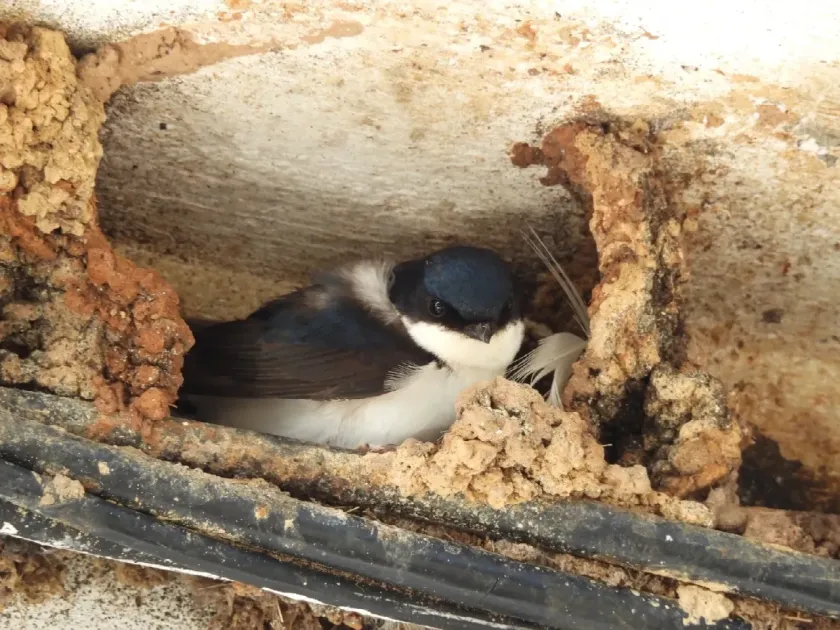
Description
How to identify
The common house martin, known by the scientific name Delichon urbicum, belongs to the Hirundinidae family. It is a small bird recognized by its glossy blue-black upperparts and distinct white underparts and rump.
It can be distinguished from other swallow species by its shorter, less deeply forked tail. A key diagnostic feature is the feathered legs, which are covered in white down right to the claws.
These birds prefer to nest in colonies, constructing enclosed, ball-shaped nests made of mud and clay pellets, which are attached to vertical surfaces, including farm buildings and warehouses.
The house martin's flight is rapid and agile, often accompanied by short, chattering calls. They are primarily diurnal, exhibiting high activity levels during the warmer months.
Their biology involves a strong site fidelity, meaning colonies often return to the same agricultural buildings year after year to establish their nests.
What it damages
Within agricultural settings, the common house martin can cause significant issues, which are typically classified as sanitary, hygienic, and technical damage to infrastructure.
Direct damage to agricultural crops is minimal as their diet consists of insects; however, their mass presence at grain stores and storage facilities poses risks to product hygiene.
Droppings accumulating beneath nesting sites can lead to the corrosion of building materials and the contamination of stored agricultural produce.
The mass occupation of attics and warehouse interiors can facilitate the introduction of parasites, such as mites and lice, which pose a health risk to livestock and poultry.
Interference with ventilation and electrical systems, resulting from nest construction, can lead to malfunctions in automated climate control or storage machinery.
When it appears
The common house martin is a migratory bird that arrives in temperate regions in early spring as soon as warm weather stabilizes and insect populations emerge.
Peak activity and the associated damage occur during the spring and summer months when birds are actively constructing nests and rearing their young.
In late August or September, the birds begin their migration to sub-Saharan Africa, leading to a significant reduction in activity on the farm until the next season.
Two distinct peaks of contamination occur during the season: during the initial egg-laying period and again during the intensive chick-feeding phase.
Agronomists suggest starting the monitoring of roofs and eaves immediately after the first arrival of the birds to prevent colonies from establishing in sensitive areas.
Signs of infestation
The first sign of a colony forming is the presence of fresh clay pellets on walls or under beams, which the birds begin to adhere to early in the spring.
A telltale sign is the accumulation of fecal matter on surfaces directly beneath planned or existing nesting sites, creating visible streaks.
Visual observation of large numbers of birds constantly circling or approaching farm buildings is a strong indicator of an impending nesting attempt.
Finding feathers and residual nesting materials like dried mud and straw caught in ventilation ducts indicates attempts by birds to infiltrate interior spaces.
- Presence of dried mud nests in corners under the roof eaves.
- Persistent noise and activity of birds near storage barns.
- Contamination of surfaces with white, viscous droppings.
Control measures
Management of the common house martin should be humane, as many bird species are protected by law; therefore, the focus should remain on exclusion and deterrents.
Using visual deterrents like predator decoys, reflective tapes, or shiny objects is effective during the early stages before nests are fully constructed.
Mechanical exclusion involves installing anti-bird spikes, netting, or sloped ledges (set at an angle of over 45 degrees) to prevent nest attachment to walls.
Acoustic systems that broadcast alarm calls of predatory birds can decrease the attractiveness of a site, discouraging birds from settling in the area.
Regular maintenance, including cleaning surfaces and sealing access points to attics or sheds with fine-mesh metal netting, is crucial for long-term prevention.
Taxonomy
- Latin name
- Delichon urbicum
- Family
- Hirundinidae
- EPPO code
- DLCHUR
Discussion
No discussions yet — be the first.