
Yellow-winged locust
Cyrtacanthacris aeruginosa
Description
How to identify
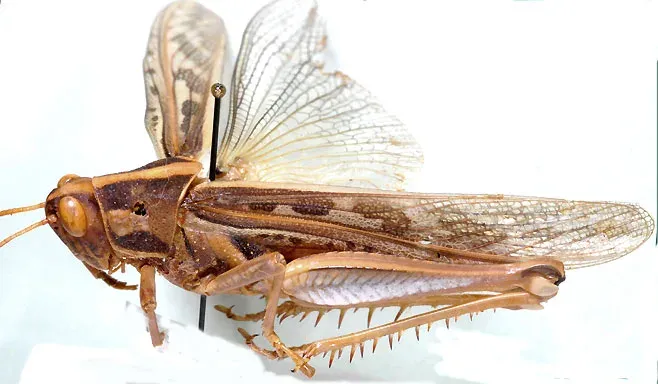
The Yellow-winged locust (Cyrtacanthacris aeruginosa) is a significant member of the Acrididae family. It is characterized by its large body size and the distinct yellowish coloration of its hind wings, which is a key diagnostic feature for visual identification in the field.
The adult insect has a robust, elongated body covered in a hardened cuticle, which serves as a protective layer against harsh environmental conditions. The head features powerful mandibles designed for cutting and chewing tough plant tissues, allowing the insect to feed efficiently.
The biology of this species is adapted to arid and semi-arid climates, where it can thrive under varying thermal conditions. The locust possesses significant sensory capabilities, allowing it to navigate and locate suitable environments for reproduction and feeding.
The life cycle proceeds through gradual metamorphosis, comprising egg, nymph, and adult stages. Females lay their eggs in soil chambers, selecting sites that offer optimal temperature and moisture levels to ensure the survival and development of the embryos.
The nymphal stages grow through a series of molts, progressively increasing in size and mobility. As they transition toward the adult stage, their potential for mass migration and resource consumption increases significantly, posing a threat to vegetation.
What it damages
This species is considered a generalist herbivore, meaning it feeds on a wide range of host plants. It can cause severe damage to grain crops, maize, sorghum, and various vegetable species, often consuming leaves, stems, and reproductive parts like flowers and fruits.
Feeding damage is usually characterized by irregular and ragged leaf edges, as well as the total stripping of plant foliage. In high-density populations, the consumption rate is so high that entire fields can be defoliated within a very short period of time.
The loss of photosynthetic area severely impairs the plant's ability to produce nutrients, leading to stunted growth, reduced yields, and plant mortality. This impact is particularly devastating in the early growth stages of agricultural crops.
Furthermore, the physical damage inflicted by the locusts makes plants more susceptible to secondary pathogens. Fungal and bacterial infections can easily enter the plant through the wounds created by the insect's mandibles, further compromising crop quality.
Economic damage is exacerbated by the locusts' mobility. Swarms can move between fields, effectively wiping out entire agricultural sectors within a region if immediate control measures are not implemented to halt their progression.
Control measures
Effective management of Cyrtacanthacris aeruginosa relies on early detection through diligent field monitoring. Scouting for nymphs before they develop wings is critical for localized control, preventing the spread of the population to larger areas.
Cultural control practices, such as tillage and plowing, are highly effective when targeted at egg-laying sites. By disturbing the soil, these mechanical methods destroy the egg pods, significantly reducing the hatching rate of the next generation.
Chemical control remains the primary method for dealing with large-scale infestations. Broad-spectrum or systemic insecticides applied as sprays are utilized to rapidly reduce the population density. Targeted applications should focus on high-risk areas to protect valuable crops.
- Regular monitoring of egg-laying and nymphal activity.
- Mechanical destruction of egg pods through deep soil cultivation.
- Application of approved insecticides at the nymphal growth stage.
- Creating barrier zones with insecticide sprays around affected plots.
Integrated Pest Management (IPM) strategies, which combine cultural, mechanical, and chemical approaches, are recommended for long-term sustainability. Adherence to chemical safety protocols ensures that the impact on non-target species is kept to a minimum.
Taxonomy
- Latin name
- Cyrtacanthacris aeruginosa
- Order
- Orthoptera (locusts)
- Family
- Acrididae
- EPPO code
- CYRHAE
Discussion
No discussions yet — be the first.