
Grass carp
Ctenopharyngodon idella
Description
How to identify
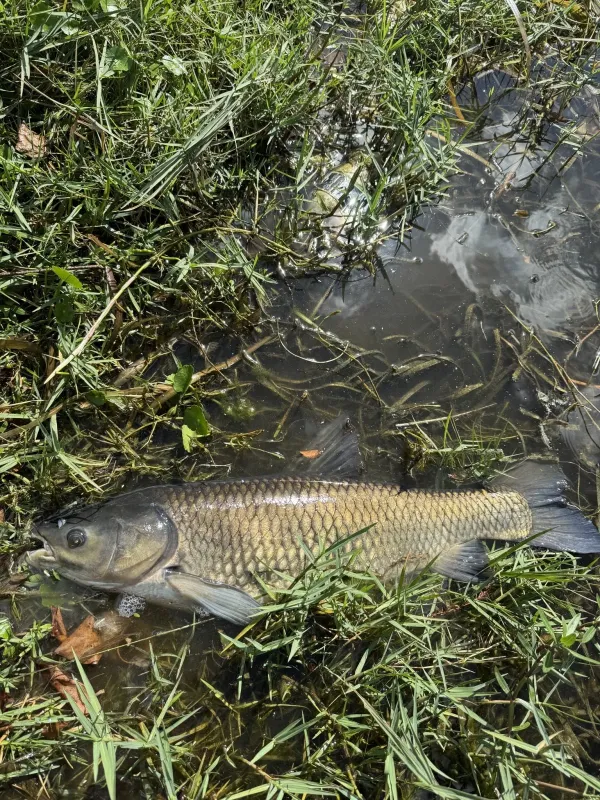
Grass carp (Ctenopharyngodon idella) is a species of fish in the family Cyprinidae, known for its significant impact on aquatic environments.
These fish have a streamlined, elongated body covered with large scales, and they can grow to over one meter in length, reaching weights of up to 30 kg.
They possess specialized pharyngeal teeth that function like a grinding mill, allowing them to process vast amounts of aquatic vegetation daily.
The species is native to East Asia but has been introduced worldwide for weed control, often leading to unintended ecological consequences.
Grass carp develop rapidly, and their survival depends on flowing water environments for the development of their pelagic eggs.
What it damages
Grass carp are highly destructive to irrigation canals, as they consume the aquatic plants that stabilize banks, leading to severe erosion and silting.
In agricultural settings, they can invade flooded rice fields, causing damage to young crops and competing with local species for resources.
By eradicating submerged vegetation, they destroy vital spawning habitats for native fish species, causing a decline in local biodiversity.
The removal of all aquatic flora by grass carp often triggers massive algal blooms, as the lack of plants allows nutrients to accumulate rapidly.
Economic damage is substantial, requiring costly dredging of canals and ongoing repairs to infrastructure compromised by bank instability.
When it appears
Feeding activity is highly temperature-dependent, with the most aggressive consumption occurring during the warm summer months when water is warmest.
As spring temperatures rise above 10 degrees Celsius, grass carp begin to forage actively, seeking out early green shoots to satisfy their high metabolism.
Peak damage occurs from June to August, during which a single fish can consume its own weight in vegetation every single day.
Autumn brings a decline in metabolic activity, and as temperatures drop, the fish reduce their feeding frequency in preparation for winter.
During the winter months, grass carp enter a state of dormancy and retreat to deeper waters, effectively ceasing their destructive activities.
Signs of infestation
One of the earliest signs of grass carp presence is a rapid and unexplained disappearance of weeds and reed beds in a contained water body.
The appearance of "bare patches" along the shoreline where vegetation was previously dense indicates active feeding by the fish.
Increased turbidity of the water is a common sign, caused by the fish disturbing bottom sediments while searching for roots and stems.
A large volume of waste pellets or excrement floating on the surface of the water confirms the presence of an active population of the fish.
Visible splashing or surface activity near the water's edge is common as large fish attempt to reach overhanging land plants.
Control measures
The installation of fine-mesh metal screens or barriers at the entrance of irrigation canals is the most effective way to prevent fish entry.
Systematic netting and removal programs help to maintain population density below the threshold that would cause significant ecological damage.
Promoting the presence of larger predatory fish, such as pike or large catfish, can help naturally regulate the juvenile grass carp population.
Utilizing structural bank reinforcement, such as stone rip-rap, helps mitigate the erosion caused by the loss of protective aquatic vegetation.
Managing the stocking levels in aquaculture ponds is essential, as overpopulation is the primary driver of uncontrolled vegetation consumption.
Taxonomy
- Latin name
- Ctenopharyngodon idella
- Family
- Cyprinidae
- EPPO code
- CTEPID
Discussion
No discussions yet — be the first.