
Eucalyptus psyllid
Ctenarytaina eucalypti
Description
How to identify
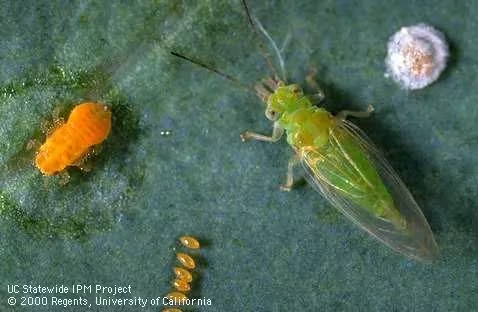
The Eucalyptus psyllid (Ctenarytaina eucalypti) belongs to the Hemiptera order and the Psyllidae family. Adult insects are tiny, measuring approximately 2-3 mm, with a yellowish-brown or green appearance often marked with darker patterns.
The life cycle includes eggs, five nymphal instars, and the winged adult stage. Females typically lay eggs on tender, actively growing foliage, securing them with a small stalk.
Early-stage nymphs are covered in a protective white waxy substance, which acts as a shield against environmental stressors and makes them resistant to many contact insecticides.
The developmental time from egg to adult is generally short, often spanning 3-4 weeks depending on the prevailing temperature and host plant condition.
Field monitoring is best achieved using yellow sticky cards, which are highly effective for detecting the presence and initial migration of adult psyllids into the canopy.
What it damages
The psyllid feeds exclusively on species of the Eucalyptus genus, showing a distinct preference for young leaves and terminal buds, which can severely stunt seedling growth.
By piercing the leaf surface, the nymphs and adults extract plant sap, causing significant physiological stress and weakening the host plant's structure.
The insects secrete large amounts of honeydew as they feed, which quickly creates a sticky film over the foliage, promoting the growth of unsightly sooty mold fungi.
Severe infestations often result in leaf curling, deformation, and eventually premature leaf drop, which can ruin the appearance of ornamental trees.
High population densities can lead to significant economic losses in commercial plantations by reducing overall biomass production and tree vigor.
When it appears
Psyllid activity usually begins in the spring, coinciding with the flush of new growth on eucalyptus trees, which provides the necessary nutrition for the insects.
Warm and stable weather conditions with moderate humidity are optimal for the rapid multiplication of the species throughout the growing season.
Summer heat can sometimes slow down development rates due to high mortality in early nymphal stages, but irrigation often maintains sufficient populations.
As temperatures begin to drop in autumn, the life cycle slows, though adults can remain active until significantly cooler weather sets in.
In regions with mild winters or within protected nursery environments, the Eucalyptus psyllid can breed continuously throughout the year.
Signs of infestation
The presence of white, fluffy wax deposits on the tips of branches and the underside of leaves is the most characteristic sign of an infestation.
Upon closer inspection, clusters of nymphs can be found embedded within these waxy secretions, typically concentrated on the youngest growth.
A black, charcoal-like coating on leaves and stems serves as a secondary indicator that the honeydew produced by the psyllids has triggered a sooty mold infection.
Visual symptoms include stunted, distorted, or gnarled foliage, which indicates long-term feeding by nymphs on developing tissues.
Disturbing the branches in sunny weather often reveals clouds of small, hopping insects flying off, confirming an active and potentially heavy infestation.
Control measures
Biological control is a primary strategy, utilizing natural predators such as the parasitic wasp Psyllaephagus pilosus to maintain population levels below the damage threshold.
Cultural practices, such as the pruning and disposal of heavily infested shoot tips, can significantly reduce the local psyllid population in small-scale plantings.
Systemic insecticides, particularly those containing imidacloprid, are highly effective as they are absorbed into the plant vascular system, reaching the hidden nymphs.
In nursery settings, regular preventative inspections and targeted insecticide applications are crucial during periods of rapid vegetative growth.
Maintaining a balanced fertilization program helps prevent excessive succulent growth, which is known to be the most attractive and vulnerable stage for psyllid colonization.
Taxonomy
- Latin name
- Ctenarytaina eucalypti
- Order
- Hemiptera (bugs, aphids, leafhoppers)
- Family
- Aphalaridae
- EPPO code
- CTNREU
Discussion
No discussions yet — be the first.