
Pistachio psyllid
Agonoscena succincta
Description
How to identify
The pistachio psyllid, Agonoscena succincta, is a member of the Psyllidae family within the order Hemiptera. These small sap-sucking insects are specialized pests of pistachio trees.
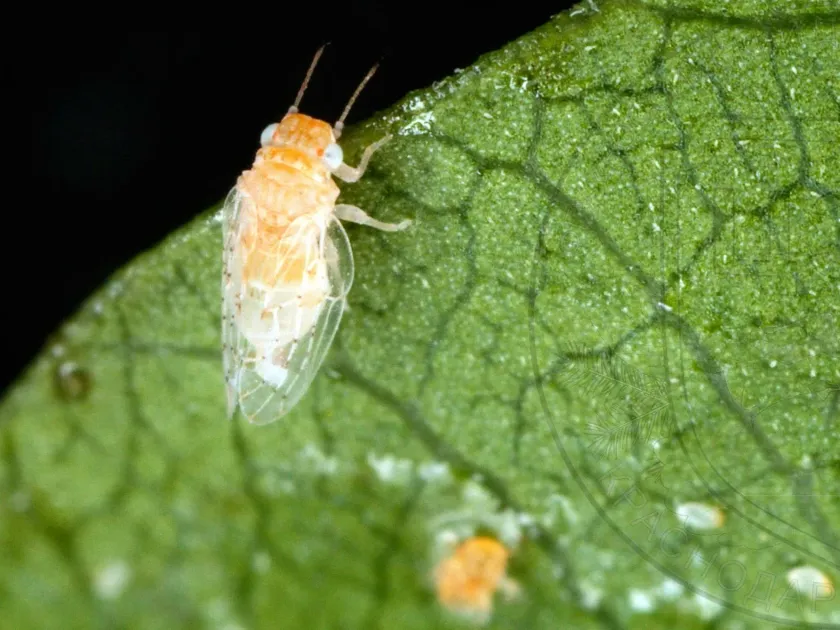
Adults typically measure between 2 to 3 mm in length. They possess two pairs of wings held in a roof-like position over the body when at rest, which is a key identification feature.
The body color ranges from yellowish-brown to brown. They have powerful hind legs, allowing them to jump effectively when disturbed, which gave rise to the common name "jumping plant lice."
Nymphs go through five instars of development. As they mature, they become more mobile and often create protective coatings or utilize the honeydew they secrete for defense.
Eggs are oval-shaped and are laid in clusters on young leaves, buds, or succulent stems, ensuring the emerging nymphs have immediate access to plant sap.
What it damages
The pest primarily infests Pistacia vera. Both adults and nymphs feed on the phloem sap of the plant, causing direct physiological stress to the tree.
Feeding activities cause localized chlorosis, necrosis of leaf tissues, and premature defoliation, which severely reduces the photosynthetic capacity of the pistachio tree.
Severe infestations lead to stunted growth, distorted shoots, and a significant drop in nut yield and quality due to the depletion of plant energy reserves.
Furthermore, these insects are known vectors for various plant pathogens, including phytoplasmas, which cause chronic diseases like pistachio decline and rosette symptoms.
In young plantations, a heavy infestation can jeopardize the long-term survival of the trees, leading to economic losses and orchard thinning.
When it appears
The lifecycle is highly synchronized with the phenological stages of the pistachio tree. The overwintering generation emerges as temperatures rise in early spring.
The pest produces multiple generations per growing season. The number of generations is influenced by the local microclimate, particularly temperature and humidity levels.
Population density typically peaks in late spring and early summer when the tree produces the most vigorous young foliage, which serves as a preferred food source.
As the season progresses and the weather turns hot and dry, the populations may fluctuate, but active feeding continues until the trees begin their dormant phase.
Adults retreat to sheltered areas, such as bark crevices or thick branch junctions, to overwinter, preparing to repeat the cycle once conditions improve.
Signs of infestation
The most common diagnostic sign is the presence of honeydew on the leaves and branches, which acts as a substrate for the development of sooty mold fungus.
Sooty mold manifests as a sticky, black coating on leaves and stems, significantly hindering gas exchange and reducing the tree's overall vigor.
Look for curled or distorted leaves and yellowing spots where the psyllids have been feeding. In high-density areas, entire terminal shoots may look wilted.
The presence of white, wax-like filaments or droplets produced by the nymphs on the underside of leaves is a clear indicator of a current active infestation.
Stunted growth of new shoots and a generally unthrifty appearance of the canopy are late-stage signs of a high-pressure infestation that requires intervention.
Control measures
Integrated Pest Management (IPM) is essential. Cultural practices, such as proper pruning to improve air circulation and canopy management, help discourage psyllid buildup.
Chemical control should be employed strategically, using insecticides only when monitoring indicates populations have exceeded established economic thresholds.
Biological control agents play a vital role. Conserving populations of natural predators like lacewings, lady beetles, and parasitic wasps can significantly suppress psyllid numbers.
Regular monitoring using yellow sticky traps is recommended to track adult flight periods and time chemical applications for maximum efficiency and reduced environmental impact.
Optimizing plant nutrition is crucial; avoiding excessive nitrogen applications helps prevent an overabundance of succulent, attractive growth that psyllids prefer.
Taxonomy
- Latin name
- Agonoscena succincta
- Order
- Hemiptera (bugs, aphids, leafhoppers)
- Family
- Aphalaridae
- EPPO code
- AGONSU
Discussion
No discussions yet — be the first.