
Common Pistachio Psyllid
Agonoscena pistaciae
Description
How to identify
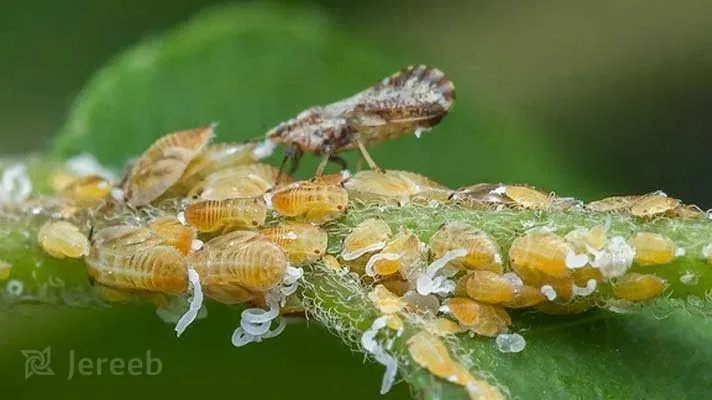
The common pistachio psyllid (lat. Agonoscena pistaciae) is a small insect belonging to the order Hemiptera and the family Psyllidae. Adult specimens typically measure 2 to 3 mm in length and possess strong hind legs, allowing them to jump effectively when disturbed.
The coloration of the adults ranges from light yellow to brownish, providing excellent camouflage against the foliage of pistachio trees. They have transparent wings with a distinct vein pattern, which are held roof-like over the body when at rest.
Nymphs of this species have flattened bodies and are often covered in waxy secretions, which serve as a protective barrier against environmental stressors and potential predators.
The life cycle progresses through egg, nymphal, and adult stages. Females lay eggs on the tender shoots and leaf surfaces, ensuring that the emerging nymphs have an immediate food source.
This species is highly specialized, feeding exclusively on trees within the Pistacia genus. Its biological adaptation to these trees makes it a significant pest in both natural stands and commercial orchards.
What it damages
The primary host for this pest is the pistachio tree (Pistacia vera). Both adults and nymphs feed by piercing plant tissues and extracting sap, which weakens the tree and disrupts its physiological balance.
Infestation typically leads to distorted leaf growth, curling, and chlorosis. In severe cases, high pest density results in early leaf drop and stunted development of new growth, which hampers the tree's health.
The excretion of honeydew by the psyllids creates a sticky environment that facilitates the growth of sooty mold. This fungus blocks sunlight and inhibits photosynthesis, directly impacting the quality and quantity of the nut harvest.
Young trees and new growth are particularly susceptible. Repeated feeding can severely hinder the formation of fruit buds, leading to a long-term decline in orchard productivity.
Without intervention, the cumulative stress on the tree makes it more vulnerable to secondary infections and environmental fluctuations, ultimately reducing the commercial viability of the crop.
When it appears
The seasonal activity of the pistachio psyllid is synchronized with the phenology of its host tree. Activity begins in early spring, coinciding with the swelling and opening of the buds.
The pest produces multiple generations per year, with the number of cycles largely determined by local temperature. Warmer climates allow for more rapid development and higher overall pest pressure.
The peak population density usually occurs during the phase of rapid shoot elongation and nut development. This is the period when trees are most sensitive to damage and require the most careful monitoring.
As temperatures begin to drop in late autumn, adult psyllids enter a diapause phase to survive the winter. They typically seek refuge in the cracks of the tree bark or within leaf litter on the ground.
Understanding the timing of the spring emergence is critical for agricultural managers, as early treatment is the most effective way to prevent widespread infestation throughout the season.
Signs of infestation
Visual identification of an infestation starts with checking the foliage for characteristic deformities, such as curling leaves and stunted, twisting stems.
The presence of honeydew is a primary indicator; the sticky substance coats leaves and branches, soon becoming black and powdery as sooty mold colonizes the area.
- Leaf curling, yellowing, and deformation.
- Sticky honeydew residues on leaves and shoots.
- Black sooty mold growth on leaf surfaces.
- Jumpers visible when branches are agitated.
- Premature shedding of young fruit and foliage.
Inspecting the underside of the leaves often reveals clusters of stationary nymphs, which look like small, light-colored specks. These should not be mistaken for harmless plant structures.
When tree health declines without obvious signs of disease, hidden infestations of psyllids deep within the dense canopy are often the cause of the underlying stress.
Control measures
Effective management of the pistachio psyllid requires an integrated approach. Cultural practices, such as proper pruning, help remove overwintering sites and ensure better canopy airflow, which is less favorable for the pest.
Chemical control involves the application of insecticides, ideally during the early nymph stages before they reach the highly resistant adult form. Systemic products are often preferred for long-lasting protection.
Biological control methods focus on encouraging the population of natural predators, such as lady beetles, lacewings, and predatory bugs, which can significantly suppress psyllid numbers.
Yellow sticky traps provide a reliable way to monitor adult population trends, allowing growers to time their insecticide applications precisely and avoid unnecessary chemical usage.
Maintaining optimal tree vigor through balanced irrigation and fertilization helps the plants withstand the impact of psyllid feeding and recover more effectively from damage during the growing season.
Taxonomy
- Latin name
- Agonoscena pistaciae
- Order
- Hemiptera (bugs, aphids, leafhoppers)
- Family
- Aphalaridae
- EPPO code
- AGONPI
Discussion
No discussions yet — be the first.