
Cornops
Cornops
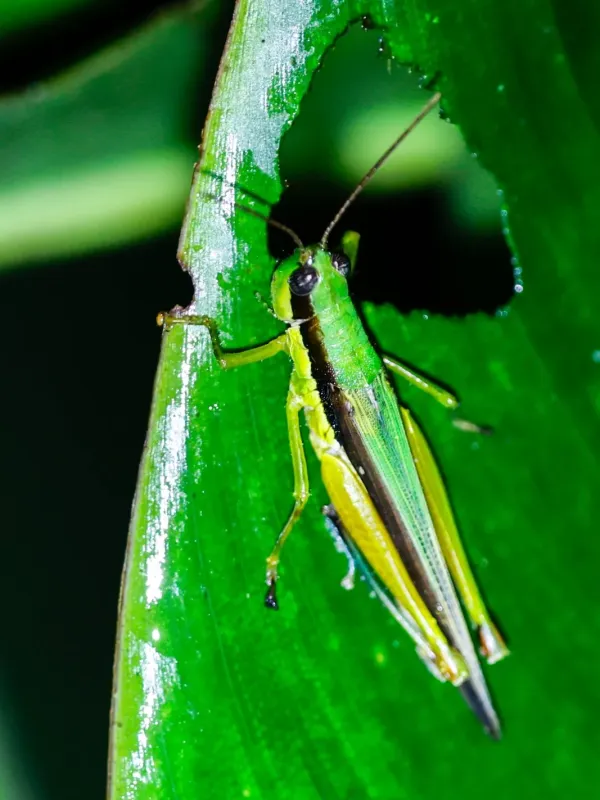
Description
How to identify
Cornops is a genus of grasshoppers within the family Acrididae, notable for its semi-aquatic lifestyle, particularly the species Cornops aquaticum.
These insects exhibit morphological adaptations that allow them to inhabit floating vegetation, including specialized structures on their legs for movement on leaves.
Their coloration is typically green or brown, providing effective camouflage against the backdrop of aquatic plants like water hyacinth.
The mouthparts are highly specialized for chewing, enabling the insect to feed on the fibrous tissues of its host plants efficiently.
The life cycle involves egg-laying directly into plant tissues, which serves as a protective mechanism against predators and environmental fluctuations.
What it damages
The primary host plant for this pest is the water hyacinth (Eichhornia crassipes), a notorious invasive species in many tropical and subtropical water bodies.
Feeding activity involves creating holes and consuming substantial parts of the leaf lamina, which drastically reduces the photosynthetic surface area.
Heavy infestations lead to the deterioration of the plant's structural integrity, causing wilting and eventual death of the aquatic plant colonies.
While considered a pest in agricultural or ornamental settings, it acts as a natural control agent by limiting the spread of invasive water hyacinth.
The damage caused by the insects can lead to the fragmentation of floating plant mats, altering the local aquatic ecosystem dynamics.
Signs of infestation
The most prominent sign of infestation is the presence of irregular bite marks and holes on the surface of the water hyacinth leaves.
Dark, scarred areas on the leaf stalks indicate sites where females have oviposited, often becoming necrotic over time.
Accumulated frass, or insect droppings, on the leaves or the surface of the water serves as a clear indicator of active feeding colonies.
General yellowing or chlorosis of the plant tissues is frequently observed around the heavily grazed sections of the leaves.
Observing the insects themselves is straightforward, as they tend to jump or move rapidly when disturbed while resting on the plants.
Control measures
Integrated Pest Management (IPM) for Cornops focuses heavily on biological control rather than widespread chemical intervention.
Natural enemies, including parasitic wasps and predatory invertebrates, play a crucial role in maintaining the balance of the insect's population.
Mechanical removal of the most heavily infested plant material can help manage local outbreaks without the need for toxic substances.
The use of chemical insecticides is generally discouraged near aquatic systems due to the high risk of environmental contamination and non-target species harm.
Ongoing monitoring of the host plant density is necessary to determine if the population of Cornops is reaching levels that require intervention.
Taxonomy
- Latin name
- Cornops
- Order
- Orthoptera (locusts)
- Family
- Acrididae
- EPPO code
- CORPSP
Discussion
No discussions yet — be the first.