
Cornitermes
Cornitermes
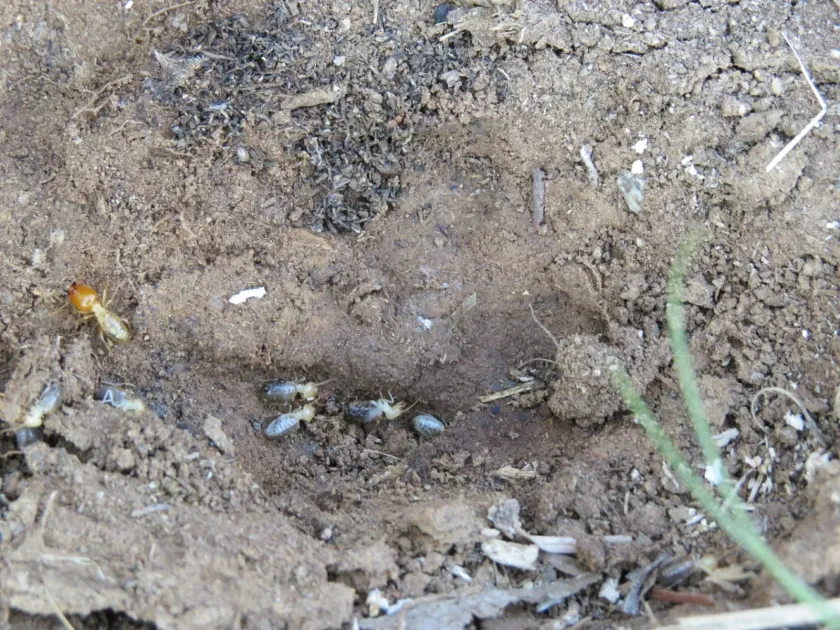
Description
How to identify
Cornitermes is a genus of termites belonging to the Termitidae family (order Isoptera). These insects are highly social and construct complex underground or mound-shaped nests known as termitaria.
Members of this genus are characterized by specialized soldier castes possessing powerful mandibles, which are evolved specifically for defending the colony against predators.
Worker termites are typically pale in color and lack pigmentation due to their strictly subterranean lifestyle, which keeps them protected from sunlight and dehydration.
The reproduction cycle involves the emergence of alates that swarm after the first rains, shed their wings, and form new royal pairs to establish colonies in the soil.
While their biological role is primarily the decomposition of organic matter, these termites can become significant agricultural pests when natural food sources are scarce.
What it damages
Cornitermes causes severe damage to forest crops, especially eucalyptus plantations, and various agricultural plants in regions throughout South America.
The termites attack the root systems of trees and shrubs, disrupting nutrient and water uptake, which often leads to the rapid decline or death of the host plant.
Beyond root damage, they penetrate the lower trunk and base of the stem, tunneling through tissues and wood, which reduces structural integrity and timber quality.
The impact is severe for young saplings, which can perish quickly, while mature trees may suffer from weakened vigor and stunted growth over several seasons.
The tunnels created by these insects also serve as entry points for various phytopathogenic fungi, further complicating the health status of affected plantation crops.
Signs of infestation
The primary indicator of an infestation is the appearance of earthen mounds or foraging tunnels built near the base of stems or across the soil surface.
Visual inspection often reveals mud-like galleries constructed by termites on the bark of tree trunks, providing them with protected transit routes to food sources.
Affected plants frequently exhibit signs of sudden wilting, chlorosis, and premature leaf drop, even when irrigation or soil moisture levels are adequate.
Closer examination of the root collar often reveals clear entrance holes or hollowed-out galleries beneath the bark, characteristic of termite feeding activity.
In advanced cases, digging around the base of the plant reveals a concentration of worker termites, soldier castes, and remnants of their fecal-soil tube constructions.
Control measures
The main strategy for controlling Cornitermes involves the application of specialized soil-applied insecticides around the root zone to establish a protective chemical barrier.
The use of bait stations containing slow-acting toxic baits is highly effective, as worker termites transport the poison back to the nest, eliminating the entire colony.
Agrotechnical practices such as deep plowing before planting help destroy surface nests and foraging galleries, making it difficult for the termites to re-establish.
It is essential to remove tree stumps and large woody debris from the field, as these serve as critical food reservoirs and potential nesting sites for new colonies.
Biological control, including the application of entomopathogenic fungi to known nesting areas, can induce epizootics within the colony and significantly reduce population numbers.
Taxonomy
- Latin name
- Cornitermes
- Family
- Termitidae
- EPPO code
- CRNTSP
Discussion
No discussions yet — be the first.