
Conwentzia psociformis
Conwentzia psociformis
Description
How to identify
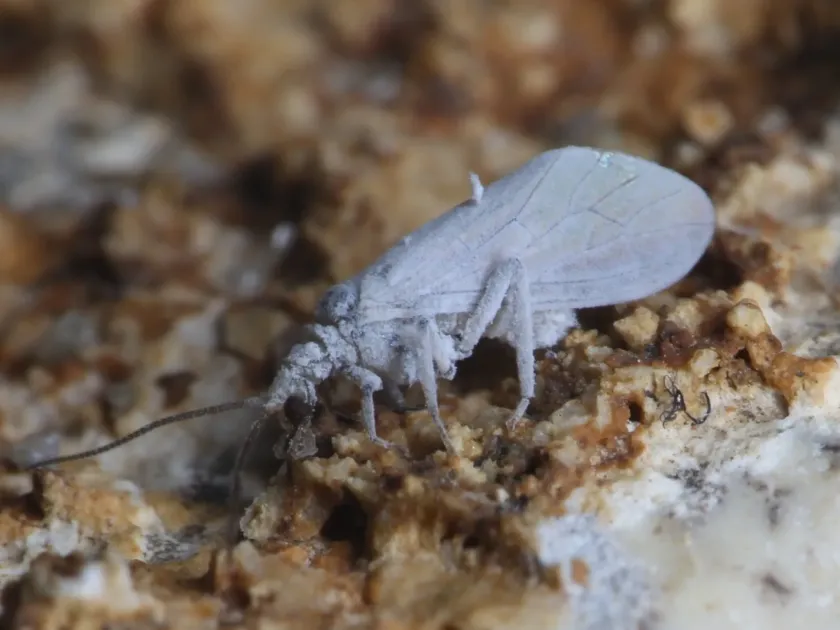
Conwentzia psociformis belongs to the Coniopterygidae family, commonly known as dusty wings, which is part of the order Neuroptera. These are tiny insects, typically measuring 2–3 mm in length.
Adults are covered in a white, waxy secretion that gives them a distinctive powdery appearance. Their wings are transparent and are held roof-like over their body when at rest.
The larvae are spindle-shaped and yellowish-brown in color. They are highly active predators, constantly moving across leaves to locate their prey.
Systematically, this insect is not a pest but a beneficial predatory species that helps maintain ecological balance in fruit orchards and woodland habitats.
Accurate identification is essential for orchard management to ensure that beneficial populations are not confused with harmful agricultural pests.
What it damages
It is crucial to clarify that Conwentzia psociformis does not cause damage to plants. On the contrary, it is an important natural enemy of several key pests.
The larvae and adults act as predators that feed primarily on aphids, spider mites, mealybugs, and scale insects found on fruit-bearing trees.
By consuming these sap-sucking pests, the insect effectively suppresses pest outbreaks and limits damage to foliage, flowers, and fruit.
The ecological role of this species is highly valued in Integrated Pest Management (IPM), where natural biological control is the primary objective.
Because they target multiple types of common orchard pests, their presence serves as a natural defense system for healthy fruit trees.
When it appears
Adults typically emerge during the spring once temperatures are consistently warm enough to support their activity and the availability of prey.
The population peaks during the summer months, aligning with the highest abundance of aphid colonies on fruit trees, providing ample food for larvae.
Multiple generations can occur throughout the growing season, allowing for continuous predatory pressure on pest populations until the autumn.
The species overwinters as a cocoon, usually finding shelter in the crevices of bark on fruit trees or amongst leaf litter and other organic debris.
Spring emergence is well-synchronized with the budding of host plants and the early-season activity of the prey species they depend upon for survival.
Signs of infestation
Presence of this insect can be confirmed by observing their white, fluffy, circular cocoons tucked away in bark crevices or under the foliage of trees.
Active larvae are easily spotted within aphid colonies, where their frantic hunting behavior makes them visible to the trained eye during orchard surveys.
A reduction in the rapid expansion of aphid colonies in the absence of chemical intervention is a strong indicator of successful predatory activity.
When conducting routine orchard inspections, checking the underside of leaves and branch crotches can reveal the presence of these beneficial lacewings.
Using a magnifying lens is recommended for field identification, as their small size can lead to them being overlooked or misidentified by orchard workers.
Control measures
No control measures are needed against Conwentzia psociformis, as it is a beneficial organism that contributes to sustainable orchard health.
When applying plant protection products, orchard managers should avoid broad-spectrum insecticides that could harm these natural predator populations.
Opting for selective biopesticides or targeted treatments allows for the preservation of natural enemies while managing damaging pest densities.
Maintaining diverse habitats around orchard edges, including wildflowers and hedges, provides refuges for these insects to survive during the winter.
Promoting the population of natural predators like Conwentzia psociformis is a cornerstone of modern, low-input horticultural production systems.
Taxonomy
- Latin name
- Conwentzia psociformis
- Family
- Coniopterygidae
- EPPO code
- CONWPS
Discussion
No discussions yet — be the first.