
Dusty lacewing
Coniopteryx
Description
How to identify
The genus Coniopteryx belongs to the family Coniopterygidae within the order Neuroptera, commonly known as dusty lacewings.
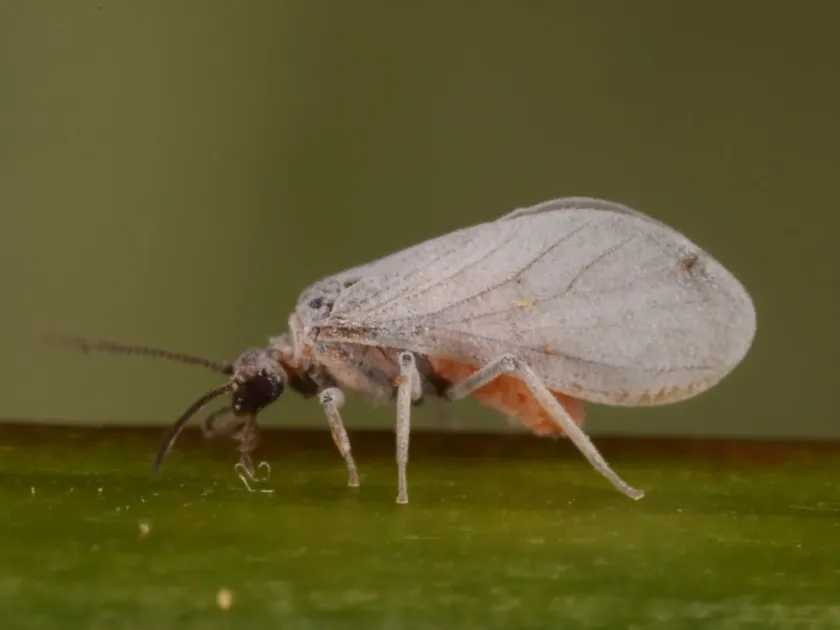
These insects are exceptionally small, typically measuring between 2 to 3 millimeters, which often makes them difficult to observe in the field.
The name "dusty lacewing" arises from the white, waxy powder that coats their wings and body, giving them an appearance similar to fine dust or whiteflies.
When at rest, their wings are folded roof-like over their bodies, providing excellent camouflage against tree bark or leaf surfaces.
Despite their appearance, they are essential members of the predator community in gardens and orchards, not plant pests.
What it damages
Coniopteryx species are strictly carnivorous predators and do not feed on plant tissue, meaning they cause no damage to agricultural crops.
They act as significant entomophages, feeding primarily on aphids, mites, scale insects, and the eggs of various other agricultural pests.
Their larvae are highly efficient hunters, capable of consuming large quantities of prey, thus providing natural biological control.
By regulating pest populations, they contribute to the overall health and productivity of the plant ecosystem without human intervention.
Therefore, their presence should be considered a positive indicator of a balanced and healthy agricultural environment.
When it appears
The life cycle of Coniopteryx is closely synchronized with the activity of their prey, ensuring they are present when pest populations begin to grow.
In temperate regions, they typically spend the winter in the pupal stage, protected by silken cocoons hidden in bark crevices or moss.
Adults emerge early in the spring, coinciding with the first appearance of aphid colonies on young, tender foliage.
The larval stage is most active during the peak of the growing season, effectively suppressing pest outbreaks in mid-summer.
As temperatures begin to drop in autumn, the insects complete their final development and seek protected locations to enter hibernation.
Signs of infestation
The most reliable sign of Coniopteryx presence is a noticeable reduction in aphid or spider mite infestations without chemical treatment.
Close inspection of infested leaves may reveal the tiny, white, dust-like adults moving among the prey colonies.
Small, white, silken cocoons found on the bark of trees are a definitive sign that a healthy population of dusty lacewings is established.
The absence of significant plant damage despite the presence of prey species is a strong indicator of successful biological regulation.
Gardeners and farmers can identify these beneficial insects by their distinct, waxy appearance and their active predatory behavior.
Control measures
No control measures are necessary for Coniopteryx as they are beneficial organisms that provide free pest suppression services.
To support their populations, it is vital to avoid broad-spectrum insecticides that can inadvertently harm these useful predators.
Adopting an Integrated Pest Management (IPM) approach allows these natural enemies to flourish alongside the crops they protect.
Preserving hedgerows and non-crop areas provides the necessary refuge and wintering sites for these insects to survive the off-season.
Monitoring populations before applying any chemical intervention ensures that natural controls are not disrupted unnecessarily.
Taxonomy
- Latin name
- Coniopteryx
- Family
- Coniopterygidae
- EPPO code
- CPTXSP
Discussion
No discussions yet — be the first.