
Conwentzia
Conwentzia
Description
How to identify
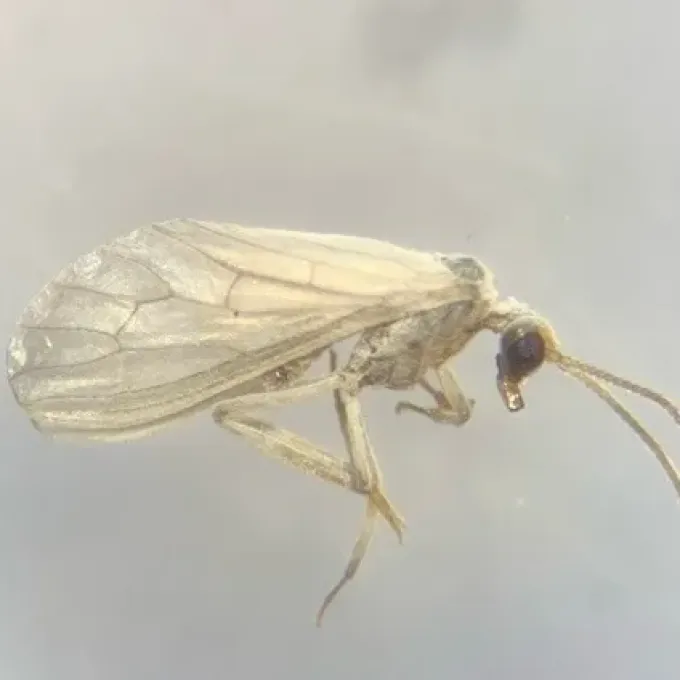
Conwentzia is a genus of insects belonging to the family Coniopterygidae (often called dusty wings) within the order Neuroptera. These are tiny insects, with adult specimens typically measuring between 2 to 3 millimeters in length.
The most distinctive feature of the adults is the white, waxy secretion covering their wings, giving them the appearance of tiny whiteflies. When at rest, their wings are folded tent-like over the body, which is a hallmark of the Neuroptera order.
The larvae are elongated and possess specialized, sickle-shaped mouthparts designed for piercing and sucking the body fluids of their prey. They are highly active predators, often found searching for food in dense insect colonies.
The life cycle undergoes complete metamorphosis, including egg, three larval stages, a pupal stage within a silken cocoon, and the adult phase. Their population dynamics are tightly coupled with the availability of prey.
Microscopic examination of wing venation or male genitalia is often required for specific identification, as members of the genus appear remarkably similar to the naked eye.
What it damages
It is crucial to clarify that Conwentzia species are not plant pests. They are beneficial entomophagous insects that act as natural biological regulators of various plant-damaging organisms.
They feed primarily on small, sap-sucking pests such as aphids, scale insects, and spider mites. In areas with high pest density, larvae can significantly reduce pest populations, acting as an effective natural control agent.
They do not consume plant tissues, sap, or foliage. Their presence on a crop is a positive ecological indicator, suggesting that the plant has an active and functional biological defense system.
The only harm associated with this insect occurs when growers misidentify them as pests and apply broad-spectrum insecticides, which inadvertently wipes out these beneficial predators and triggers pest outbreaks.
Therefore, agricultural management should treat Conwentzia as an essential component of Integrated Pest Management (IPM) rather than a target for eradication.
When it appears
Adults emerge in early spring once ambient temperatures reach a favorable threshold, typically above 10°C. They immediately begin searching for prey colonies to deposit their eggs.
The peak activity period occurs throughout the summer, coinciding with the massive reproduction cycles of aphids and mites. During this time, they can complete multiple generations.
As autumn temperatures drop, development slows down. Adults seek refuge in bark crevices or among dense foliage to enter a state of diapause and survive the winter months.
Weather factors, such as humidity levels, are critical for larval development. Excessive moisture can increase the susceptibility of larvae to fungal infections, which can limit their efficiency.
Monitoring these insects helps agronomists evaluate the ecosystem health and determine if chemical intervention is actually necessary or if natural predators are already managing the threat.
Signs of infestation
Presence of Conwentzia can be confirmed by inspecting leaves or needles that host aphid or mite colonies. They are most commonly found amidst these prey aggregations.
Active larvae are easily identified by their movement within prey clusters. They aggressively hunt down and consume smaller insects, making them visible to careful observation.
On coniferous trees, one may spot small, white, silky cocoons attached to needles or bark. These structures indicate that the beneficial population is established and reproducing in the area.
Adults in flight appear as tiny, slow-moving white flecks. In highly populated areas, they can be detected by shaking branches over a white sheet of paper on a sunny day.
The lack of common damage symptoms, despite the presence of prey insects, is a clear sign that natural predators are effectively controlling the pests in the orchard or field.
Control measures
The primary "protection" measure for Conwentzia is the conservation of their habitat. Avoiding the use of broad-spectrum chemical insecticides is essential to maintaining these populations.
If pest control is required, growers should prioritize biological pesticides and selective products that target specific pests while minimizing toxicity to neuropterans.
Maintaining field margins and hedges provides necessary refugia for these beneficial insects during the off-season. Avoiding the destruction of such habitats is a key IPM strategy.
Implementing practices such as proper mulching and moderate irrigation can improve the microclimate, helping to sustain high populations of predatory insects throughout the growing season.
By adopting an Integrated Pest Management approach, growers can harness the natural pest-suppression capabilities of Conwentzia, reducing the need for synthetic chemical inputs.
Taxonomy
- Latin name
- Conwentzia
- Family
- Coniopterygidae
- EPPO code
- CONWSP
Discussion
No discussions yet — be the first.