
Coniopteryx borealis
Coniopteryx borealis
Description
How to identify
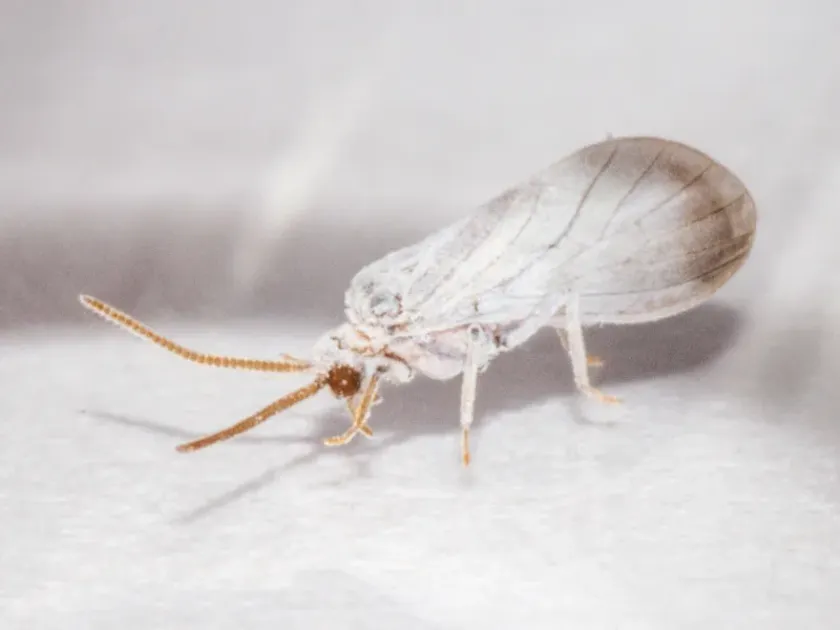
Coniopteryx borealis belongs to the order Neuroptera, family Coniopterygidae (dustywings). These are tiny insects with a wingspan rarely exceeding 3-5 millimeters.
The adult stage is characterized by a whitish or grayish coating on the wings, produced by a special waxy secretion. It is this coating that gives the insect its "dusty" appearance, hence the family name.
The larvae of this pest have an elongated body and developed mouthparts designed for sucking the juices of other insects. Notably, adults are secretive and most commonly found on woody plants and shrubs.
The biology of the species is closely linked to forest and garden ecosystems. The life cycle consists of the egg stage, three larval instars, a cocoon stage (prepupa and pupa), and the adult stage.
Identification is difficult due to the insect's microscopic size. For accurate determination in the field, agronomists use visual inspection of the undersides of leaves or the beating method onto a light-colored surface.
What it damages
Coniopteryx borealis is primarily a predatory insect, but in an agronomic context, its presence often indicates a disruption in the ecosystem balance.
The main impact is that the larvae feed on small pests such as aphids, coccids, and mites. In high numbers, they may compete with other beneficial entomophages.
While the species itself is not a classic "chewing" pest, its larval stages can damage tender bud tissues or young shoots while hunting for prey.
Damage manifests as microscopic punctures on the leaf surface, which can subsequently become entry points for secondary fungal infections.
The greatest risk lies in the disruption of biological control: if beneficial fauna is destroyed by non-selective interventions, the phytophage population may spiral out of control.
When it appears
The seasonal activity of the species begins with the arrival of stable warm temperatures in spring, when overwintered individuals emerge from their cocoons.
The peak of population density usually occurs in the first half of summer, coinciding with the active reproduction period of aphids and other small insects that the species feeds on.
During the growing season, Coniopteryx borealis can produce two or more generations depending on regional climatic conditions and the availability of food sources.
In autumn, as daylight hours shorten and temperatures drop, the insects prepare for diapause, hiding in tree bark crevices or under fallen leaves to overwinter.
Monitoring for the pest is recommended in May-June, using pheromone traps or regular inspections of garden plantings.
Signs of infestation
One of the main signs of presence is specific waxy secretions that look like fine white powder on leaves or tree bark.
The presence of larvae can be detected by their specific body shape, resembling a miniature "alligator" actively moving in search of food across the leaf blade.
An indirect sign is the general suppression of the plant's condition, accompanied by yellowing leaves if the pest attacks weakened specimens.
In cases of branch infestation, premature leaf curling and a sticky residue from the pest's prey activity can be observed.
Special attention should be paid to the condition of the bark: cocoons containing the next generation's pupae are often found under loose bark scales.
Control measures
Controlling this pest requires an integrated approach focused on maintaining biological balance in the garden and using soft treatment methods.
As a preventive measure, timely pruning and cleaning of old tree bark, where pupae often overwinter, is recommended.
If chemical control is necessary, preference should be given to biological products based on entomopathogenic fungi or bacteria.
- Early spring spraying with horticultural oils
- Attracting natural enemies: birds and predatory bugs
- Crop rotation and spatial isolation of plants
- Removal of weeds around tree trunks
Widespread use of broad-spectrum insecticides is not recommended, as they kill beneficial insects, leading to outbreaks of secondary pests.
Taxonomy
- Latin name
- Coniopteryx borealis
- Family
- Coniopterygidae
- EPPO code
- CPTXBO
Discussion
No discussions yet — be the first.