
Montagu's harrier
Circus pygargus
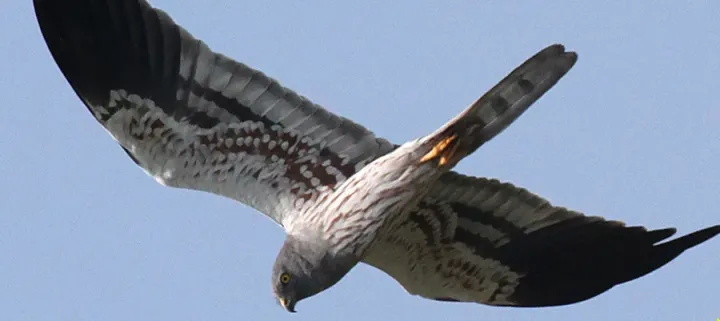
Description
How to identify
The Montagu's harrier (Circus pygargus) is a bird of prey belonging to the Accipitridae family, known for its slender body and elegant flight.
Males feature a distinct grey plumage with black wing bars, while females and juveniles have a more cryptic, brownish appearance for camouflage.
These birds are characteristic of open landscapes, including agricultural fields, where they hunt by gliding low over the ground.
Their flight is very light and agile, often performed with wings held in a distinct V-shape, which is a key identification feature for observers.
As a protected species, it plays a vital role in natural pest control, acting as a natural partner for environmentally conscious farmers.
What it damages
Montagu's harrier does not damage crops because it is an insectivore and carnivore, feeding strictly on animal prey rather than vegetation.
The diet consists mainly of large insects like grasshoppers and small rodents, particularly voles that can cause significant damage to grain yields.
They act as a natural check on rodent populations, providing an ecosystem service that reduces the impact of agricultural pests on the farm.
The only potential conflict arises when harriers nest within cereal crops, which requires careful management during the harvest season.
Because they do not eat crops, they are considered highly beneficial for maintaining ecological balance within intensive agricultural areas.
When it appears
As a migratory species, they arrive at their breeding grounds in early spring, typically around April, coinciding with crop growth stages.
The nesting and incubation phase occurs throughout May and June, a critical period for both crop development and chick rearing.
By late July, the young fledge and begin to hunt independently, which often coincides with the peak of grain harvesting activities.
In August, both adult and juvenile harriers spend time hunting over stubble fields to build up energy reserves before their long migration.
The autumn migration to wintering grounds usually takes place in September, marking the end of their activity in the cropping cycle.
Signs of infestation
Evidence of their presence includes characteristic low-altitude patrol flights over fields, where the bird scans for movement in the vegetation.
They can often be seen plunging into crops to seize prey, followed by a swift ascent back into the air with the capture.
The presence of pellets (regurgitated remains of indigestible food items) along field edges indicates the bird uses the area for hunting.
During the nesting season, adults are seen carrying food frequently to a fixed location within the crop canopy.
Restless behavior or alarm calls by the birds when farm machinery approaches indicates a nest site is located nearby.
Control measures
Montagu's harriers are protected by law across their range, and any attempt to harm them or their nests is illegal and counterproductive.
Farmers are encouraged to implement conservation measures, such as leaving a buffer strip of unharvested crops around identified nest sites.
Communication between field managers and machinery operators is essential to prevent accidental destruction of nests during the harvest.
Supporting these raptors on your land provides biological control of rodents, reducing the financial necessity for chemical pest management.
Maintaining field margins and avoiding excessive use of broad-spectrum insecticides helps support the prey base required by the harriers.
Taxonomy
- Latin name
- Circus pygargus
- Family
- Accipitridae
- EPPO code
- CIRKPY
Discussion
No discussions yet — be the first.