
Harrier
Circus
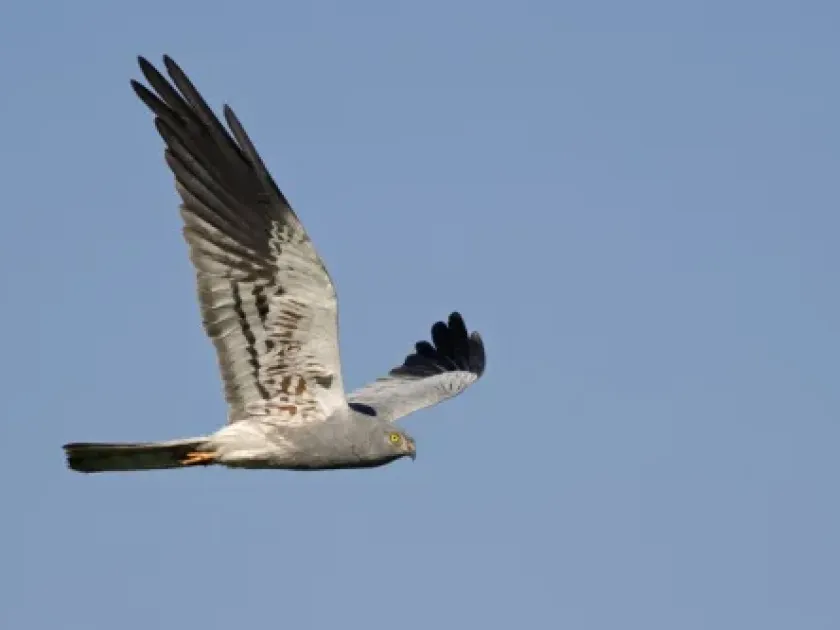
Description
How to identify
Harriers (genus Circus) are medium-sized birds of prey in the family Accipitridae, easily recognized by their slender bodies, long wings, and long tails.
They are famous for their unique hunting style: gliding low over the ground and open fields with wings held in a V-shape, listening for small prey.
Harriers exhibit marked sexual dimorphism, where males usually display grey plumage with black wingtips, while females and juveniles are brown with streaked patterns.
Their distinctive facial disc, which improves their hearing to detect prey in thick grass, is a key morphological feature that distinguishes them from other raptors.
Common species found in agricultural landscapes include the Hen Harrier, Montagu's Harrier, and the Marsh Harrier, all adapted to open habitat hunting.
What it damages
Harriers are not considered agricultural pests; they do not feed on crops, seeds, or farm produce, meaning they cause no direct damage to yield.
In fact, their presence is highly beneficial to farmers, as their primary diet consists of rodents and other small mammals that are major agricultural pests.
The only operational challenge occurs if nesting takes place inside crop fields, potentially requiring short-term adjustments to machinery traffic patterns.
There is no record of harriers damaging irrigation systems, fencing, or machinery, making them non-destructive components of the farm environment.
Promoting the presence of these birds contributes to natural pest management, reducing the reliance on rodenticides and promoting ecological balance.
When it appears
Harriers are migratory or nomadic birds, appearing in fields typically during the early spring as they establish their breeding territories.
The peak activity season in agricultural areas coincides with the breeding and chick-rearing period, spanning from late spring through late summer.
After the fledging period, which usually concludes by autumn, harriers often disperse or migrate to warmer southern regions for the winter months.
The visibility of harriers increases during the growth stages of cereals and tall grasses, which provide necessary camouflage for their ground-based nests.
In winter, sightings are significantly lower in temperate zones, although some species may remain if the prey population remains stable throughout the season.
Signs of infestation
The most reliable sign of a harrier's presence is the characteristic low-level flight pattern over crops, with frequent banking and turning movements.
Observation of small piles of rodent remains, often found on slightly elevated mounds or dry spots in the field, indicates active hunting territory.
During the nesting season, one might find small areas of flattened vegetation within the field, which serve as the base for their ground nests.
Auditory signs include the sharp, whistled calls made during courtship or when warning intruders, particularly near their nesting sites.
Periodic sightings of the same individual bird over several weeks are a strong indicator that the harrier has designated the field as its primary hunting range.
Control measures
Harriers are protected species in many jurisdictions, and no control or eradication measures are necessary, nor are they legally permitted.
Field management should focus on conservation, specifically by identifying nesting areas and avoiding intensive mechanical operations near those zones.
By protecting nesting sites, farmers contribute to natural rodent control, which offers a significant return on investment through reduced crop loss.
Avoiding the use of toxic rodenticides is crucial, as raptors are susceptible to secondary poisoning when they consume contaminated prey in the field.
Integrating these raptors into an Integrated Pest Management (IPM) plan enhances farm sustainability and promotes long-term health of the agroecosystem.
Taxonomy
- Latin name
- Circus
- Family
- Accipitridae
- EPPO code
- CIRKSP
Discussion
No discussions yet — be the first.