
Common green lacewing
Chrysoperla carnea
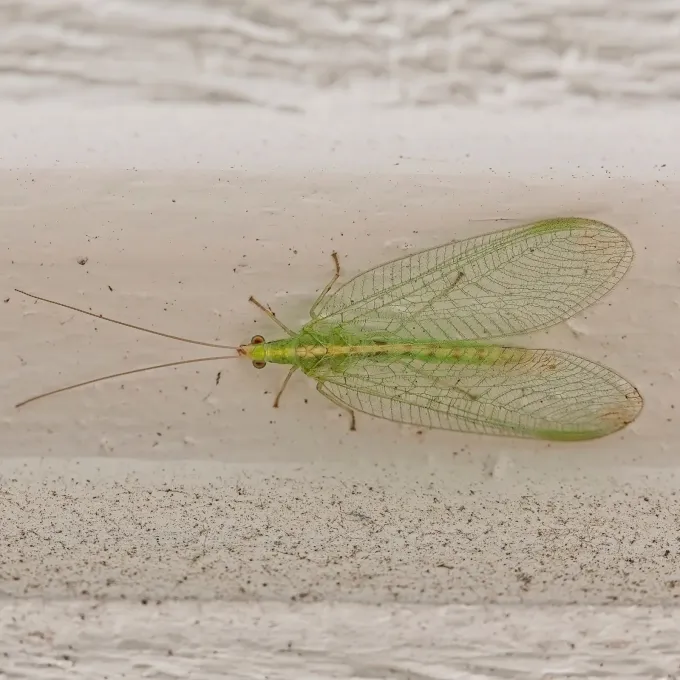
Description
How to identify
The common green lacewing (Chrysoperla carnea) is a member of the order Neuroptera and the family Chrysopidae. Adults are characterized by their delicate green bodies, large, clear, lace-like wings, and prominent golden-colored eyes.
The larvae, often referred to as "aphid lions," are highly effective predators. They possess long, sickle-shaped mandibles used to pierce prey and suck out body fluids.
Crucially, Chrysoperla carnea is not a plant pest; it is a vital beneficial insect used extensively in biological control programs worldwide.
The species exhibits a complex life cycle consisting of egg, larval, pupal, and adult stages. Females lay eggs on individual silken stalks to protect them from predation.
Its role in agroecosystems is to significantly reduce populations of aphids, mealybugs, thrips, whiteflies, and spider mites on various crops.
When it appears
The activity of Chrysoperla carnea typically begins in spring once temperatures exceed 10°C, following the emergence of adults from hibernation sites.
Depending on regional climate conditions, this species can complete multiple generations within a single growing season.
Adults hibernate during the winter months, hiding under tree bark, in leaf litter, or within protected structures to survive cold weather.
Population levels peak during the summer months when host prey (such as aphids) is most abundant, providing an optimal environment for larval development.
As autumn approaches and photoperiods decrease, the insect prepares for diapause, transitioning from its active reproductive state to a dormant overwintering phase.
Control measures
Integrated Pest Management (IPM) strategies should prioritize the conservation of green lacewings rather than attempting to control them.
To encourage their presence, agronomists should incorporate wildflower strips or nectar-rich plants like dill, coriander, and buckwheat into the landscape.
The use of broad-spectrum insecticides should be strictly avoided or replaced with target-specific, low-toxicity biological alternatives.
Mass releases of commercially reared larvae or eggs are an effective method for rapid pest suppression in greenhouses and high-value crop fields.
Successful management involves consistent monitoring of pest thresholds to determine if supplemental releases of lacewings are necessary to maintain ecological balance.
Taxonomy
- Latin name
- Chrysoperla carnea
- Family
- Chrysopidae
- EPPO code
- CHROCR
Discussion
No discussions yet — be the first.