
Green lacewing
Chrysoperla
Description
How to identify
The green lacewing (Chrysoperla carnea) is a member of the Neuroptera order and the Chrysopidae family. It is not a pest but a major beneficial insect in agriculture.
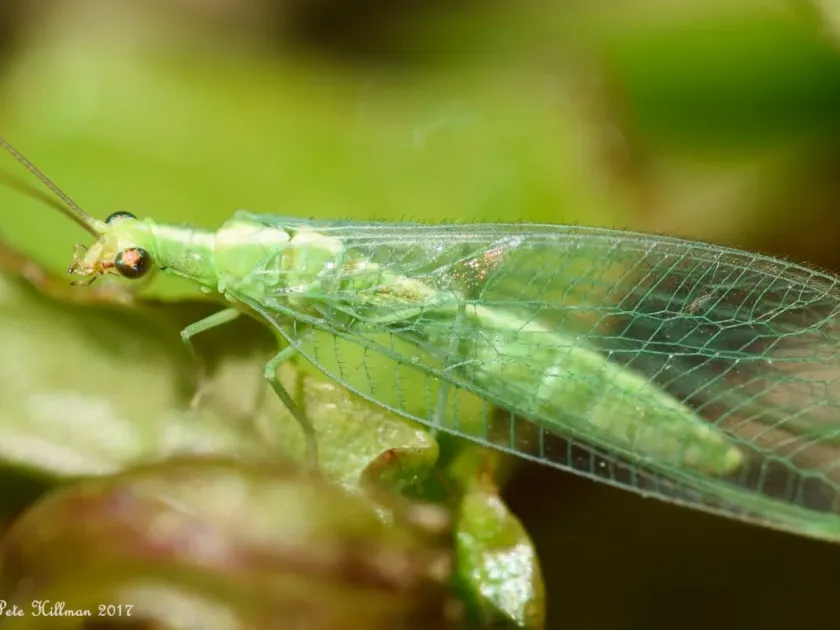
Adults are characterized by a delicate light green body, large golden eyes, and two pairs of transparent, heavily veined wings that are held tent-like over the body.
Larvae, often referred to as "aphid lions," have elongated bodies, mottled brown-gray coloration, and prominent sickle-shaped mandibles.
Lacewing eggs are distinctively laid on long, thin stalks, which is a defensive adaptation to prevent larvae from cannibalizing each other upon hatching.
The life cycle undergoes complete metamorphosis, consisting of the egg, three larval instars, a pupal stage within a silk cocoon, and the adult phase.
What it damages
It is important to clarify that green lacewings do not cause damage to crops. Adult insects feed exclusively on nectar, pollen, and honeydew.
Their larvae are voracious predators that play a crucial role in controlling populations of various agricultural pests.
Primary prey for the larvae includes aphids, spider mites, thrips, whiteflies, and the eggs of various lepidopteran pest species.
A single larva can consume hundreds of aphids during its development, significantly reducing pest pressure in orchards and field crops.
Their predatory nature makes them a cornerstone of integrated pest management (IPM) programs worldwide.
When it appears
Adult green lacewings typically overwinter in sheltered locations, such as leaf litter, tree bark, or outbuildings.
In the spring, as temperatures consistently rise, they emerge from diapause to feed and seek suitable sites for oviposition near prey colonies.
Larval activity peaks during the warmer months, coinciding with the rapid population growth of aphid infestations.
Depending on the climatic zone, multiple generations of lacewings can occur throughout the growing season.
As day length decreases in the autumn, the insects begin seeking overwintering sites to survive the cold winter months.
Control measures
In agricultural practice, the goal is to conserve and augment lacewing populations rather than to control them.
Minimize the use of broad-spectrum insecticides, as these chemicals often prove fatal to these beneficial natural enemies.
Encourage lacewing presence by planting nectar-rich flowering plants like dill, coriander, yarrow, or sweet alyssum near your crop fields.
Commercial biological control strategies involve the mass rearing and release of lacewing larvae into greenhouses or high-value crop fields.
Adopting sustainable farming practices ensures that these effective predators remain part of your ecosystem to provide natural pest suppression.
Taxonomy
- Latin name
- Chrysoperla
- Family
- Chrysopidae
- EPPO code
- CHPRSP
Discussion
No discussions yet — be the first.