
Common Green Lacewing
Chrysopa vulgaris
Description
How to identify
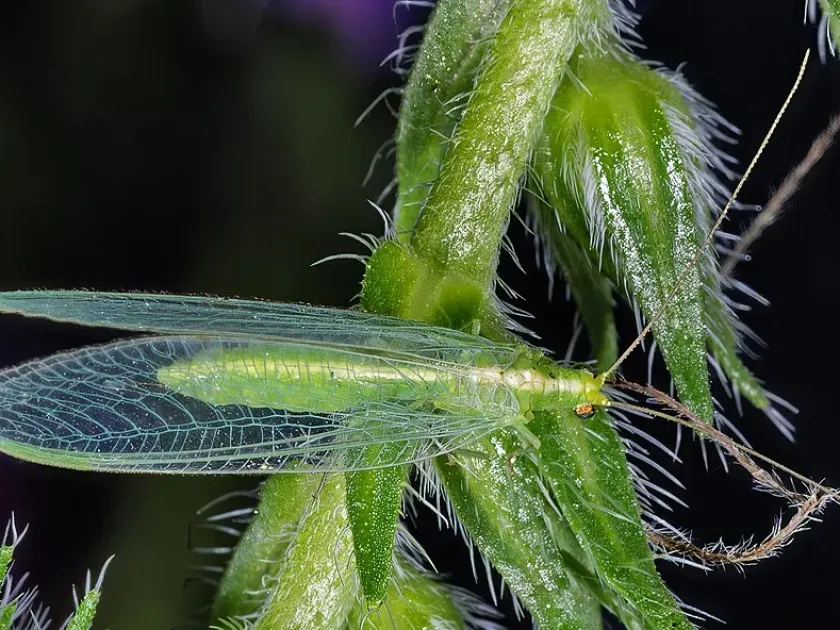
The Common Green Lacewing (scientific name: Chrysoperla carnea, historically often referred to as Chrysopa vulgaris) belongs to the order Neuroptera. It is a delicate insect with a pale green body and a wingspan of approximately 30 mm.
These insects are easily identified by their large, golden, metallic-looking eyes and their complex, transparent wings that feature a dense, lace-like network of veins, which explains their common name.
The larvae, often called "aphid lions," have a spindle-shaped, flattened body covered with small tubercles and stiff hairs. They are equipped with large, curved, sickle-shaped mandibles designed for piercing and sucking fluids from prey.
A fascinating biological feature is how they lay their eggs: the female places each egg at the end of a long, thin, silken stalk. This prevents larvae from eating their siblings after hatching.
While adults feed primarily on nectar, pollen, and honeydew, they play a crucial role in pollination, while the voracious larvae act as highly efficient predators within agricultural ecosystems.
What it damages
It is critical to clarify that the Common Green Lacewing is not a plant pest; rather, it is one of the most effective beneficial insects in organic and conventional agricultural pest management.
The larvae are specialized predators. Their primary food source consists of aphids, which are destructive pests that cause curling of leaves, stunted plant growth, and the spread of viral plant diseases.
Beyond aphids, the larvae consume spider mites, mealybugs, thrips, small caterpillars, and even insect eggs. A single larva can consume hundreds of prey items throughout its development cycle.
The presence of lacewings significantly contributes to natural biological control, reducing the reliance on toxic chemical sprays. They do not damage plant tissue or fruit at any stage of their life.
By protecting lacewing populations, farmers can suppress pest outbreaks before they reach economic threshold levels, ensuring healthier crops and a more stable environment for other native pollinators.
When it appears
The lifecycle of the Common Green Lacewing consists of four stages: egg, larva, pupa, and adult. Depending on the local climate, the species typically produces two to three generations per year.
Adults overwinter in a state of diapause, seeking shelter in bark crevices, dense foliage, leaf litter, or man-made structures to survive the cold winter months.
In spring, as temperatures rise, adults emerge to feed and mate. Females search for areas with high pest populations to lay their stalked eggs, ensuring the larvae have an immediate food source upon hatching.
The larval stage is the period of intense growth and feeding, lasting approximately 2-3 weeks. Once fully developed, the larva spins a white, silken cocoon to undergo pupation.
The species is most active during the summer and early autumn. Protecting them throughout these months is vital to ensure that the overwintering generation is large enough to manage pests the following spring.
Control measures
To integrate green lacewings into a pest management strategy, it is essential to restrict the use of broad-spectrum insecticides, as these chemicals are often as lethal to predators as they are to pests.
Intercropping with nectar-producing plants such as dill, coriander, buckwheat, or sweet alyssum provides the necessary food sources for adult lacewings, encouraging them to stay and reproduce on the farm.
In greenhouses or controlled environments, commercially reared lacewing eggs or larvae can be released directly into pest-infested areas to provide rapid and effective biological control.
Maintaining hedgerows or undisturbed grassy areas near fields provides vital overwintering sites, which helps sustain a healthy population of these beneficial insects throughout the year.
- Avoid spraying during the peak flight hours of beneficial insects.
- Use selective biological pesticides whenever possible.
- Establish floral borders to provide a diverse food source.
Taxonomy
- Latin name
- Chrysopa vulgaris
- Family
- Chrysopidae
- EPPO code
- CHROVU
Discussion
No discussions yet — be the first.