
Chrysopa rambouri
Chrysopa rambouri
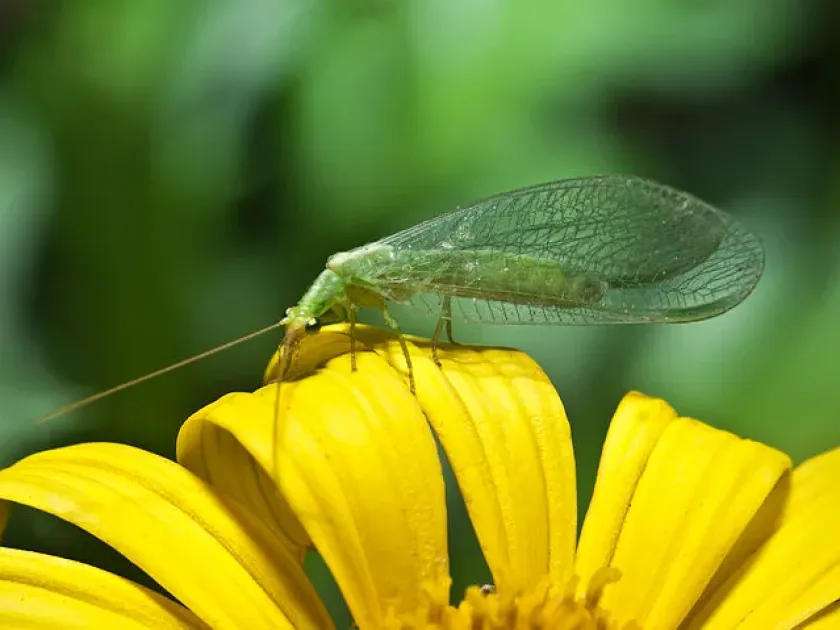
Description
How to identify
Chrysopa rambouri belongs to the order Neuroptera and the family Chrysopidae. Adult insects are characterized by a delicate body, transparent wings with a dense network of veins, and distinctive golden-colored compound eyes.
The adults typically display a light green or yellowish hue, which provides excellent camouflage among foliage. The body length of a mature insect usually ranges from 10 to 15 mm, with a wingspan reaching up to 30 mm.
While the larvae are known as predators, in agroecosystems with low prey density, they may exhibit behavioral shifts and feed on plant tissues. This makes them a subject of interest in pest control management.
Accurate identification of this species is complex due to the morphological similarity with other members of the family. Specialists often rely on microscopic examination of anatomical structures to confirm the species.
Field identification requires caution; since many species are beneficial, proper monitoring is essential to distinguish between those that serve as biological controllers and those that pose a threat.
What it damages
The damage caused by Chrysopa rambouri is primarily related to mechanical tissue injury. When typical prey like aphids are unavailable, larvae turn to plant sap, damaging young shoots and leaves.
Targeted crops include cereal grains, vegetables, and vineyards. Damage during the early vegetative stages often leads to stunted growth and reduced vigor in the infested plants.
Feeding sites appear as small necrotic spots on leaves. These lesions can serve as entry points for various bacterial and fungal pathogens, potentially escalating the scale of the damage.
In vineyards, the larvae may feed on ripening berries, resulting in cosmetic damage and loss of marketability, which is particularly detrimental during high-yield seasons.
Overall economic impact is reflected in reduced photosynthetic efficiency, disrupted metabolic processes, and increased plant susceptibility to secondary abiotic stress factors.
When it appears
Activity of Chrysopa rambouri begins in the spring when temperatures consistently exceed 10–12 degrees Celsius. Adults emerge from overwintering sites to commence the mating cycle.
Development is temperature-dependent, with peak population density typically occurring in mid-summer. This period aligns with the height of the growing season for many major crops.
Females lay eggs on long, silk-like stalks, attaching them to the underside of leaves. This unique mechanism protects the developing larvae from ground-level predators and harsh weather conditions.
As autumn approaches, the insects migrate toward sheltered areas for hibernation. They overwinter as adults, finding refuge in plant debris, under tree bark, or in protected structures.
Depending on the climatic zone, the species can complete three to four generations per year, making it capable of rapid population growth under favorable conditions.
Signs of infestation
The earliest sign of infestation is the presence of eggs on thin, white stalks on the underside of leaves. Finding these is a clear indicator that the population is establishing in the field.
Larval activity can be noted by the presence of small necrotic punctures on leaves or slightly curled and deformed foliage in the apical parts of the plants.
A noticeable loss of turgor and yellowing of the leaves in the affected areas of the field during the afternoon can suggest a severe infestation that disrupts plant water balance.
Adult insects are attracted to light, so the use of light traps in the evening can help confirm their presence and monitor the intensity of the flight activity.
The presence of exuviae (cast-off larval skins) on the leaf surface is a reliable sign of active development and high local population density.
Control measures
Effective management relies on an integrated pest management (IPM) approach. Cultural practices, such as the removal of crop residues, significantly reduce the number of overwintering sites.
Deep tillage after the harvest helps bury larvae and pupae, preventing successful hibernation and lowering the initial population for the subsequent spring season.
Biological control, including the use of entomopathogenic fungi, is highly recommended to keep populations below the economic threshold while preserving non-target beneficial insects.
Chemical intervention should be reserved for cases where population levels exceed the economic damage threshold, utilizing selective insecticides that minimize impact on ecosystem services.
- Monitoring flight activity with yellow sticky traps.
- Implementing crop rotation to break life cycles.
- Field scouting during peak vegetative stages.
- Using biorational insecticides for targeted control.
Taxonomy
- Latin name
- Chrysopa rambouri
- Family
- Chrysopidae
- EPPO code
- CHRORA
Discussion
No discussions yet — be the first.