
Green lacewing
Chrysopa prasina
Description
How to identify
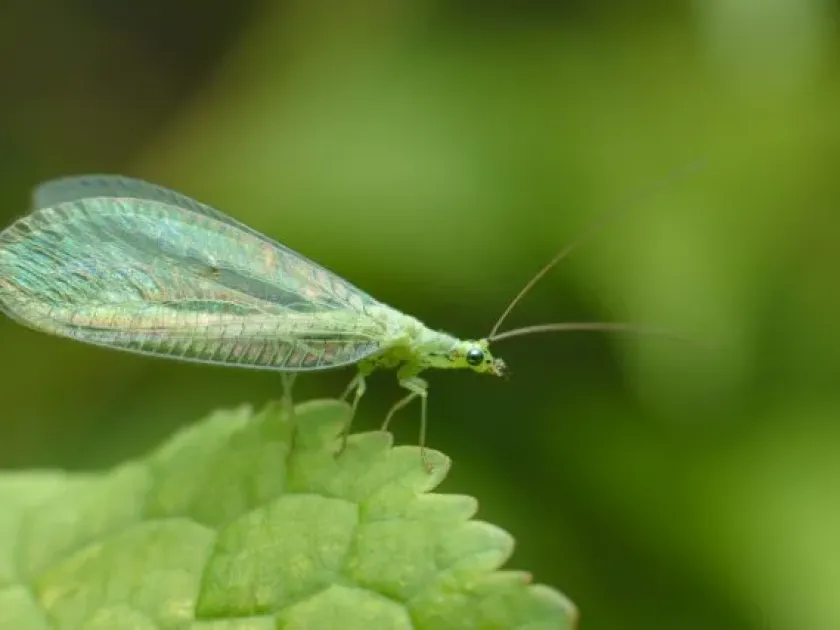
The green lacewing (Chrysopa prasina) belongs to the order Neuroptera. These insects are easily identified by their slender, pale green bodies and two pairs of large, transparent, lace-like wings.
The eyes of the adult lacewing are prominent and possess a brilliant metallic gold luster, which is the primary reason for their common name. They are typically about 10–15 mm long with a wing span of up to 30 mm.
The larvae, often called "aphid lions," are elongated, covered in tiny bristles, and possess large, sickle-shaped mandibles used to grasp and pierce their prey.
One of the most unique characteristics of the lacewing is their egg-laying process. Females deposit eggs on long, thin stalks, which keeps the eggs safe from predators and prevents cannibalism among hatched larvae.
While often found near pest infestations, the lacewing is a highly beneficial insect that serves as a cornerstone of integrated pest management in many farming systems.
What it damages
The green lacewing does not cause any damage to crops. It is not a pest, but rather one of the most effective predators available for natural biological control in agriculture.
The larvae are voracious predators that feed on a wide variety of soft-bodied pests, including aphids, spider mites, whiteflies, mealybugs, and scale insects.
An individual larva can consume several hundred aphids during its developmental stage, providing significant reduction in pest pressure without the need for synthetic chemicals.
Adult lacewings primarily feed on nectar, pollen, and honeydew, making them harmless to plant tissue and fruit, and often helping with incidental pollination in the garden.
Farmers are encouraged to identify these insects correctly rather than mistaking them for pests, as their presence indicates a healthy, self-regulating ecosystem.
When it appears
Green lacewings complete several generations throughout the growing season. Adult activity typically begins in late spring when temperatures are consistently warm.
The peak activity and population density occur during the summer months, aligning with the seasonal buildup of aphid populations in fields and orchards.
As autumn approaches, the adults seek protected overwintering sites, such as tree bark, leaf litter, or crevices in structures, where they enter diapause until the following spring.
The life cycle involves an egg stage, three larval instars, a pupal stage within a silken cocoon, and the adult stage. The duration of these stages is highly dependent on ambient temperature and food availability.
This rapid life cycle allows them to synchronize their population growth with the emergence of prey, ensuring an effective natural check on pest populations throughout the summer.
Control measures
Since the green lacewing is a vital ally for any grower, the management goal is to encourage and protect their population rather than to control or exterminate them.
To attract lacewings to your farm or garden, provide a steady supply of nectar by planting flowering herbs and annuals such as dill, coriander, sweet alyssum, and fennel.
Avoid the prophylactic use of broad-spectrum insecticides, which often kill beneficial predators and lead to secondary pest outbreaks due to the destruction of the natural balance.
When chemical intervention is strictly necessary, utilize selective insecticides that have low toxicity to predatory insects and follow application guidelines that minimize impact on local fauna.
In high-value greenhouse operations, growers can purchase and release lacewing larvae to manage localized outbreaks of aphids or mites, effectively using them as a biological pesticide.
Taxonomy
- Latin name
- Chrysopa prasina
- Family
- Chrysopidae
- EPPO code
- CHROPR
Discussion
No discussions yet — be the first.