
Common green lacewing
Chrysopa plorabunda
Description
How to identify
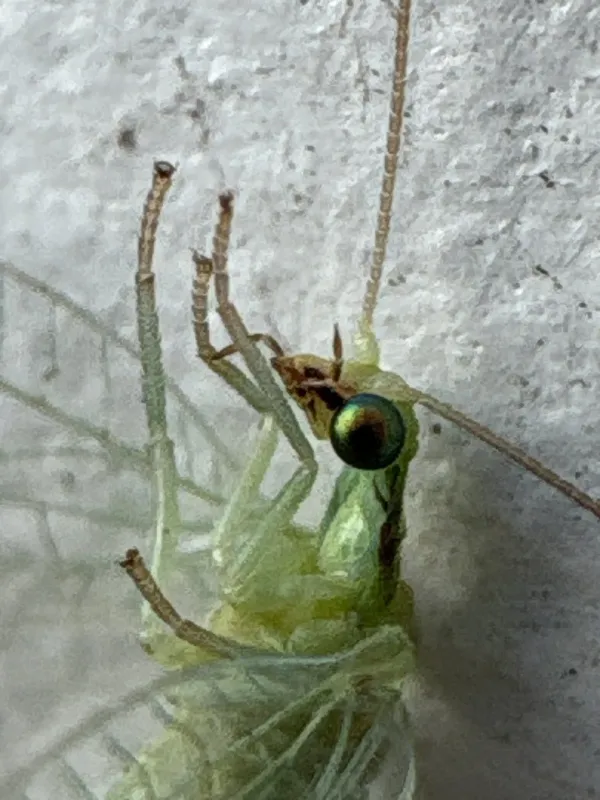
The common green lacewing Chrysopa plorabunda is a member of the Chrysopidae family within the order Neuroptera, widely recognized for its delicate appearance.
Adults typically feature a bright green body, long filiform antennae, and large, shimmering gold-colored compound eyes, with wings that have a complex, lace-like network of veins.
The larvae, often referred to as aphid lions, have an elongated, tapered body covered with bristles and tubercles, and possess large, curved, sickle-shaped mandibles.
Eggs are laid individually at the ends of long, thin, hair-like stalks, a unique adaptation to prevent predation and cannibalism within the brood.
Though they belong to a large insect order, they are easily distinguishable by their behavior and the specific, stalked egg-laying habit on foliage.
What it damages
It is a common misconception to categorize the green lacewing as a plant pest; in reality, they are strictly beneficial and do not consume plant tissues.
Larvae are voracious predators, feeding on a wide variety of soft-bodied insects, primarily aphids, spider mites, mealybugs, and small insect larvae.
An individual larva can consume hundreds of aphids throughout its developmental stages, making it an extremely efficient biological control agent in diverse ecosystems.
Adults mainly feed on honeydew, nectar, and pollen, acting as pollinators and non-destructive inhabitants of the crop canopy.
Farmers who observe green lacewings on their plants should recognize them as a sign of natural pest control occurring, rather than a threat to crop yield.
When it appears
The life cycle involves complete metamorphosis, including egg, three larval stages, pupation within a silken cocoon, and the adult stage.
Adults typically overwinter in protected environments, such as hollow tree trunks, leaf litter, or agricultural outbuildings, awaiting spring temperatures.
There are generally several generations per year, with activity peaking in mid-to-late summer, corresponding with the highest aphid populations in the field.
Spring emergence is triggered by rising temperatures, leading adults to seek nectar sources and aphid colonies for immediate oviposition.
Autumn triggers a shift in behavior as insects seek sheltered locations for diapause, preparing for the cold winter months ahead.
Control measures
Instead of control measures, agricultural management should focus on the conservation and promotion of green lacewing populations to leverage their biocontrol potential.
Broad-spectrum insecticides are detrimental to lacewing survival and should be avoided or replaced with selective alternatives that target specific pests without harming predators.
Establishing floral corridors or field margins with nectar-producing plants provides essential supplementary food for adult lacewings, keeping them in the vicinity of crops.
In greenhouses and integrated pest management (IPM) programs, lacewing larvae are often mass-reared and released specifically to curb heavy aphid infestations.
- Avoid non-selective chemical spraying during peak lacewing activity seasons.
- Integrate flowering plants into farm layouts to sustain adult population survival.
- Employ selective pesticides that minimize impact on beneficial predatory insects.
Taxonomy
- Latin name
- Chrysopa plorabunda
- Family
- Chrysopidae
- EPPO code
- CHROPL
Discussion
No discussions yet — be the first.