
Green lacewing
Chrysopa phyllochroma
Description
How to identify
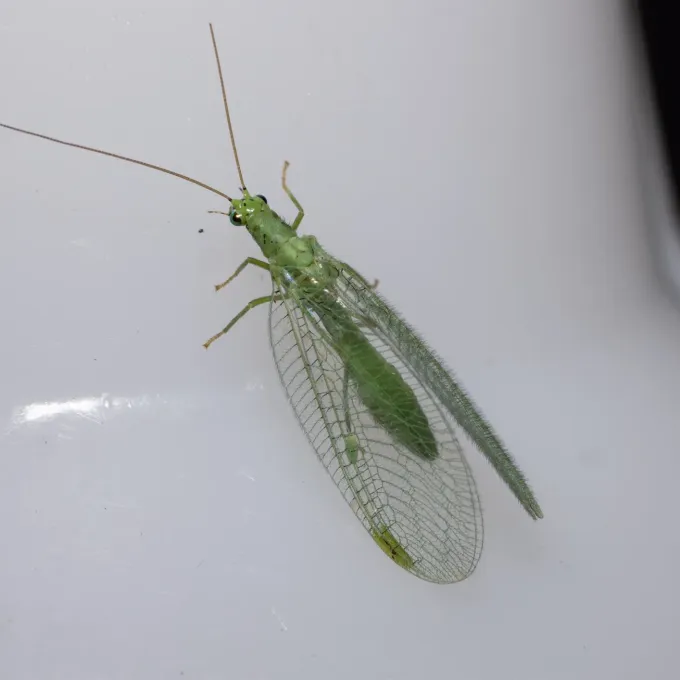
The green lacewing (scientific name: Chrysopa phyllochroma) belongs to the order Neuroptera and the family Chrysopidae. These insects are characterized by their delicate, bright green bodies and prominent, brilliant golden or copper-colored compound eyes.
Adult green lacewings possess two pairs of clear, membranous wings with a distinct network of veins, giving them a net-like appearance. Their wingspan typically ranges from 20 to 30 millimeters in width.
The larvae, often called aphid lions, have elongated, bristly bodies equipped with large, sickle-shaped mandibles. These mandibles are specifically adapted for grasping and piercing prey.
A distinctive feature of this species is the way females lay their eggs on long, thin, silk stalks. This biological strategy prevents larvae from eating each other shortly after hatching.
Identification in the field is usually facilitated by observing the bright green coloration and the characteristic flight pattern of the adults during twilight hours.
What it damages
The green lacewing is widely recognized as a beneficial insect rather than a pest. Its larvae are voracious predators of aphids, spider mites, thrips, whiteflies, and other small agricultural pests.
While adult lacewings occasionally feed on nectar, pollen, and honeydew, this behavior does not cause significant damage to crop yields. They are considered essential natural enemies in both organic and conventional farming.
Direct damage to plants is negligible or non-existent, making the species an ally in integrated pest management (IPM) programs rather than an object for eradication.
The economic impact of the species is highly positive, as it contributes to the biological suppression of pest outbreaks, thereby reducing the need for chemical intervention.
Agronomists encourage the presence of these insects to maintain the ecological balance within greenhouses, orchards, and open-field vegetable crops.
When it appears
Green lacewing activity begins in early spring as temperatures rise, signaling the emergence of adults from overwintering sites. Multiple generations occur throughout the growing season.
Peak populations are typically observed during mid-summer, coinciding with high pest activity, as the lacewings follow the availability of their primary prey sources.
The species survives the winter as an adult, finding refuge in bark crevices, leaf litter, sheds, or other protected areas where the temperature remains relatively stable.
Environmental conditions, such as humidity and the presence of flowering plants, significantly influence the population density and reproductive success of the lacewings.
By late autumn, adults enter a state of diapause, seeking shelter to endure the cold months before the cycle restarts the following spring.
Control measures
Control measures are rarely required for this species; instead, the focus should be on conservation. Protecting these insects is a critical component of sustainable crop management.
To support lacewing populations, farmers should minimize the use of broad-spectrum insecticides that could inadvertently kill these beneficial predators and disrupt natural control.
Maintaining floral borders and avoiding excessive weeding around field edges provides both prey and alternative food sources like nectar for the adult stage.
When applying plant protection products, preference should be given to selective, biorational insecticides that target specific pests while remaining safe for predators.
- Implement Integrated Pest Management (IPM) to preserve natural enemies.
- Avoid chemical applications during the peak flight times of beneficial insects.
- Provide habitat refuges such as hedgerows and wildflower strips near crops.
Taxonomy
- Latin name
- Chrysopa phyllochroma
- Family
- Chrysopidae
- EPPO code
- CHROPH
Discussion
No discussions yet — be the first.