
Common Green Lacewing
Chrysopa perla
Description
How to identify
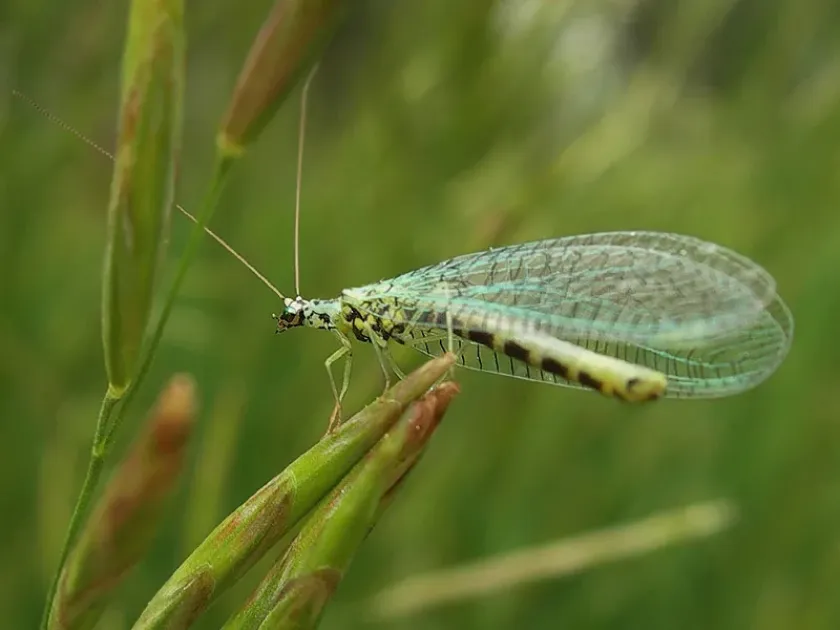
The Common Green Lacewing Chrysopa perla belongs to the Neuroptera order, Chrysopidae family. It is a delicate insect with a bright green body and distinctive golden eyes.
Adults have large, transparent, lace-like wings that reach a span of 25-30 mm. The wing venation is complex and beautiful, which gives the insect its characteristic appearance.
The larvae are brownish, elongated, and equipped with large, sickle-shaped mandibles. They are highly active predators, often nicknamed "aphid lions" due to their voracious appetite.
A unique identifying feature is how they lay their eggs: they place them on long, thin stalks, which keeps the larvae safe from predators or cannibalism upon hatching.
Although sometimes found in agricultural fields, these insects are essential beneficial predators, not pests, and play a vital role in natural crop protection.
What it damages
The Common Green Lacewing causes no damage to crops. Instead, it is highly valued by agronomists as a primary natural enemy of many soft-bodied plant pests.
Adults feed on nectar, pollen, and honeydew. They are pollinators and do not feed on plant tissues, ensuring the safety of your agricultural crops.
The larvae are extremely effective hunters. They roam across leaves and stems, actively searching for and consuming large numbers of aphids, mites, and scale insects.
One larva can consume several hundred aphids during its development phase. This makes the species a cornerstone of sustainable and organic pest management systems.
There are no negative impacts from this insect. Any perceived damage is impossible as they do not possess mouthparts capable of consuming plant tissues.
When it appears
The first generation of Common Green Lacewing adults emerges in late spring as soon as temperatures stabilize above 10-12 degrees Celsius.
Active flying and hunting occur throughout the growing season, typically from May until September, with multiple generations developing per year.
Larval activity peaks in early summer, coinciding with the rapid population growth of aphids on various horticultural and agricultural crops.
Adults are nocturnal and crepuscular, often attracted to porch lights or other artificial illumination in the evenings during the warm months.
As the weather cools in autumn, the adults seek protected areas such as tree crevices, leaf litter, or farm structures to hibernate until the following spring.
Signs of infestation
The most visible sign of their presence is the discovery of stalked eggs on the underside of leaves in aphid-infested areas.
Larvae are easily spotted within aphid colonies, where they move with purpose, using their specialized mandibles to grasp and feed on their prey.
The presence of adult lacewings can be confirmed by their flight activity around light sources or by observing them resting on foliage during the day.
An absence of pest outbreaks in sections of a field often points to the successful colonization of these beneficial predators.
Monitoring programs often use visual counts to estimate lacewing populations as a proxy for the level of natural biological control occurring in the garden.
Control measures
Management of the Common Green Lacewing involves protecting rather than controlling them. They are valuable allies that should be encouraged on all farms.
Avoid the routine application of broad-spectrum synthetic pesticides. These chemicals are toxic to lacewings and can cause pest outbreaks by removing natural predators.
Use integrated pest management (IPM) strategies, which prioritize selective insecticides that minimize harm to beneficial insects like Chrysopa perla.
Planting flowering borders with nectar-rich species like dill, fennel, or buckwheat provides the necessary nutrition for adults, increasing their lifespan and egg production.
Preserving natural habitats and winter cover in field margins helps ensure a healthy population density for the next season.
Taxonomy
- Latin name
- Chrysopa perla
- Family
- Chrysopidae
- EPPO code
- CHROPE
Discussion
No discussions yet — be the first.