
Common Green Lacewing
Chrysopa lanata
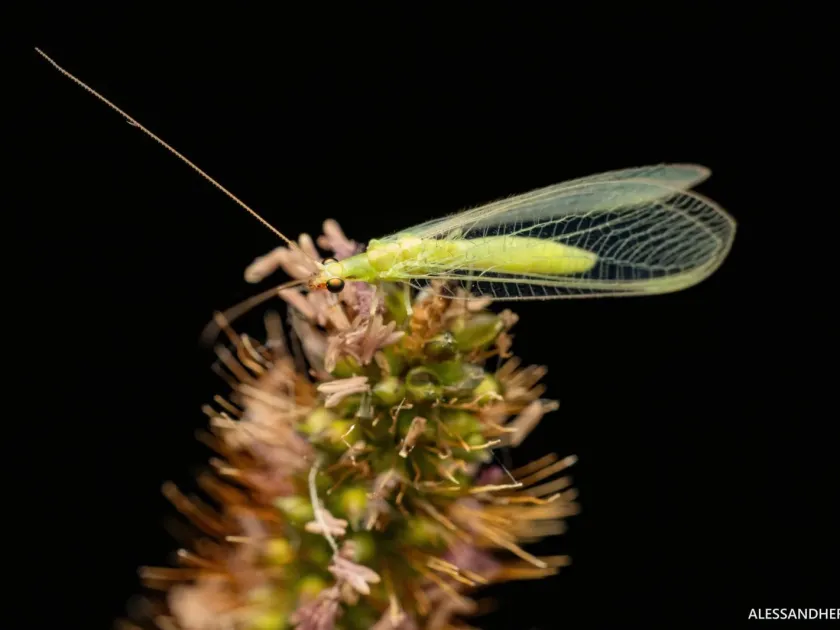
Description
How to identify
The Common Green Lacewing, scientifically known as Chrysopa lanata, belongs to the order Neuroptera and the family Chrysopidae. While widely recognized as a beneficial predator of aphids and mites, specific field conditions can occasionally lead to its recognition as a minor pest.
Adults possess delicate, pale green bodies with large, transparent, net-veined wings and metallic, golden eyes. Their wingspan typically ranges from 25 to 30 millimeters, making them easily identifiable in various agricultural landscapes.
Larvae are elongated with prominent, sickle-shaped mandibles designed for piercing and extracting fluids from their prey. Their appearance often varies, with mottled patterns that help them blend into the foliage where they hunt.
The life cycle undergoes complete metamorphosis, including egg, larva, pupa, and adult stages. A distinctive feature is the deposition of eggs on long, silk-like stalks, an adaptation that prevents early-stage larvae from consuming each other.
Biological success of this species is highly dependent on environmental variables and the continuous availability of prey. In balanced ecosystems, they serve as crucial natural regulators of insect populations.
What it damages
Although larvae are voracious predators, adult lacewings occasionally feed on floral nectar and pollen. In scenarios where prey populations are scarce, adults may cause minor physical damage to plant reproductive structures, such as flower buds and young fruits.
Crops most susceptible to this behavior include various vegetables, greenhouse-grown flowers, and certain orchard fruits. Damage is typically manifested as minute punctures, which may slightly reduce the aesthetic quality of ornamental plants.
It is important to emphasize that such damage is usually sporadic and economically insignificant compared to the extensive protection provided by the larvae, which consume large numbers of aphids, whiteflies, and spider mites daily.
Direct intervention is rarely required unless the lacewing population density becomes abnormally high in closed greenhouse environments. Even then, broad-spectrum insecticide use is discouraged to prevent the secondary outbreak of primary pests.
Assessing the economic threshold is vital; one must weigh the slight cosmetic injury caused by adults against the massive suppression of yield-reducing pests provided by the immature stages of the insect.
When it appears
Active development typically begins in late spring when temperatures consistently exceed 15 degrees Celsius. The first generation emerges in sync with the spring surge of aphid populations, providing an immediate food source.
Peak activity occurs throughout the summer months, with multiple generations overlapping. During high-temperature periods, adults may exhibit crepuscular activity to optimize survival and minimize dehydration.
As autumn approaches, adults prepare for overwintering, seeking shelter in leaf litter, tree bark, or sheltered agricultural structures. This behavioral shift marks the end of their significant presence in open fields.
The number of annual generations varies significantly based on geographic latitude and local climate, often ranging from two to five. Northern regions typically see fewer generations compared to warmer southern climates.
Early-season presence of lacewings serves as a reliable bio-indicator for farmers, signaling the potential for natural biological control and advising against unnecessary chemical pesticide applications.
Control measures
Integrated Pest Management (IPM) is the gold standard for handling lacewing populations. The primary strategy focuses on habitat conservation rather than eradication, ensuring that beneficial insects are not harmed by synthetic chemistry.
If adult feeding causes noticeable damage, habitat modification is recommended. Providing alternative food sources, such as flowering nectar-producing plants on field margins, diverts adults from sensitive crop parts.
In greenhouses, supplemental feeding with sugar-protein solutions can sustain adult populations, encouraging them to remain near the target crops without damaging plants, thereby keeping aphid numbers in check.
Selective pesticides should be chosen with extreme care, ensuring compatibility with Neuroptera. Always prioritize biological agents or soft chemistry that leaves the lacewing populations unaffected.
- Avoid prophylactic use of broad-spectrum insecticides.
- Maintain hedgerows as overwintering sites.
- Use selective biological pesticides for aphid control.
- Implement monitoring programs using visual inspections.
Taxonomy
- Latin name
- Chrysopa lanata
- Family
- Chrysopidae
- EPPO code
- CHROLA
Discussion
No discussions yet — be the first.