
Green Lacewing
Chrysopa formosa
Description
How to identify
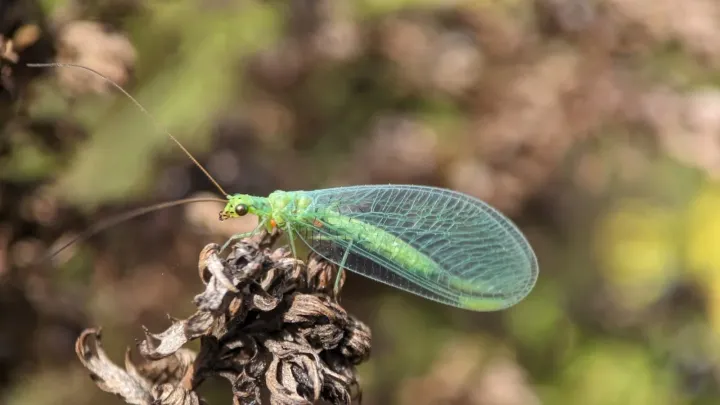
The green lacewing, scientifically known as Chrysopa formosa, is a member of the Neuroptera order and the Chrysopidae family. It is recognized for its delicate, lacy green wings and bright golden compound eyes.
Adults typically measure about 15 mm in length with a wingspan of up to 30 mm. Their larvae are distinctively predatory, featuring elongated bodies and large, sickle-shaped mandibles used to grasp their prey.
The life cycle consists of four distinct stages: egg, larva, pupa, and adult. Females lay eggs on thin, long stalks, an evolutionary mechanism designed to prevent cannibalism among hatching larvae and protect the brood from predators.
This insect is widely regarded as a beneficial predator in agricultural environments rather than a pest. It serves as a natural regulator of various plant-feeding insect populations.
Identifying the presence of lacewing larvae in a field is a positive sign, indicating that natural biological control processes are active within the ecosystem.
What it damages
Chrysopa formosa does not damage crops. Instead, it is an essential asset in modern pest management, preying on a wide range of agricultural pests, primarily aphids, spider mites, and scale insects.
The larvae are highly voracious predators, often referred to as "aphid lions." A single larva can consume hundreds of aphids during its development, making it an efficient biological tool for pest suppression.
Because they are effective at low pest densities, green lacewings are vital for integrated pest management (IPM) programs, helping to maintain balance in vineyards, orchards, and vegetable farms.
Their ability to seek out prey in complex foliage makes them superior to many chemical pesticides that may fail to reach hidden insect colonies.
By promoting populations of these predators, farmers can significantly reduce reliance on synthetic chemicals and improve the sustainability of their crop production.
When it appears
Green lacewing activity typically peaks from late spring through autumn. Depending on the local climate and temperature, these insects can produce several generations within a single growing season.
Adults are largely nocturnal, often hiding within dense vegetation or tree canopies during daylight hours. They overwinter as adults, finding shelter in leaf litter, tree bark, or buildings.
The seasonal appearance of lacewings often mirrors the emergence of aphid populations, ensuring that the larvae have an immediate food source upon hatching.
Flowering plants surrounding crop fields play a crucial role in maintaining lacewing populations, as adults rely on nectar and pollen for survival and reproduction.
Early season scouting should include looking for these predators to determine if natural control is sufficient before resorting to any corrective management actions.
Control measures
Management efforts for Chrysopa formosa focus on conservation and augmentation. As a beneficial species, the goal is to protect these insects and maximize their impact on pest populations.
One of the most important conservation strategies is to minimize the use of broad-spectrum insecticides that negatively impact beneficial insect communities.
Farmers are encouraged to implement habitat management, such as planting cover crops or flower strips, to provide food and shelter for adult lacewings throughout the season.
When chemical intervention is necessary, selecting narrow-spectrum or biorational products that have minimal toxicity to beneficials is essential for maintaining ecological balance.
In greenhouse settings, augmentative biological control is practiced by releasing mass-reared larvae directly into the crops to combat localized infestations of aphids or spider mites.
Taxonomy
- Latin name
- Chrysopa formosa
- Family
- Chrysopidae
- EPPO code
- CHROFO
Discussion
No discussions yet — be the first.