
Yellow-fronted lacewing
Chrysopa flavifrons
Description
How to identify
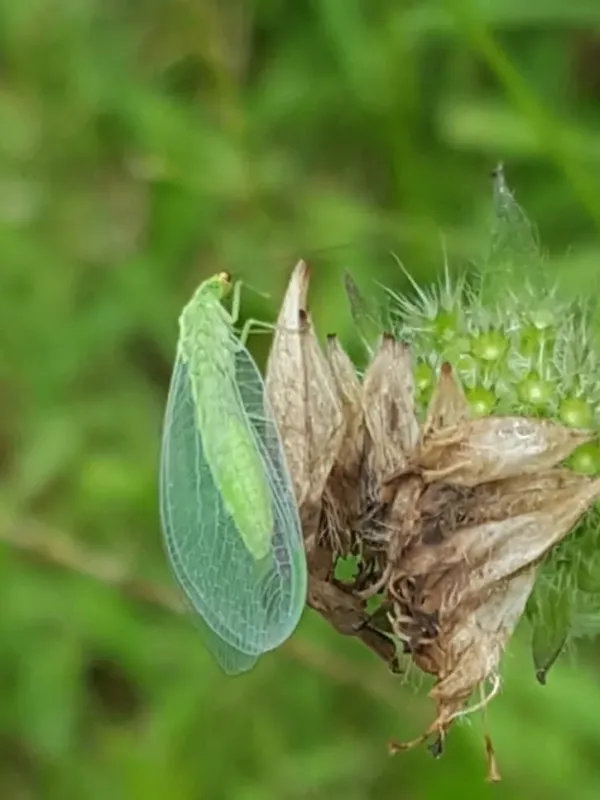
The yellow-fronted lacewing (Chrysopa flavifrons) is a member of the Neuroptera order and the Chrysopidae family. It is a delicate insect characterized by its light green body and translucent wings with a complex venation pattern.
This species is easily identified by a distinct yellow stripe located on the frons (the front of the head). Adults typically measure between 15 and 20 mm in length with a wingspan of about 30 mm.
The eyes have a notable metallic, golden luster, which is a common trait among lacewings. They are primarily nocturnal or crepuscular insects, often remaining hidden in dense foliage during the daylight hours.
Larvae, often referred to as aphid lions, possess elongated, slender bodies with large, sickle-shaped mandibles. They are highly mobile and constantly hunt for prey on various plant surfaces.
Eggs are unique because they are laid on individual long, slender, silk-like stalks. This specialized adaptation prevents siblings from eating each other immediately upon hatching.
What it damages
It is crucial to clarify that the yellow-fronted lacewing is not a plant pest. In agricultural and horticultural contexts, it is classified as a highly beneficial predatory insect.
Both the larvae and adults play a significant role in controlling populations of aphids, mealybugs, spider mites, and the eggs of various lepidopteran pests that attack crops.
The larvae are particularly aggressive predators; they seize their prey and inject digestive enzymes to liquefy the internal tissues before feeding. A single larva can consume hundreds of aphids during its development.
Adults do not cause any mechanical damage to vegetation. They feed on nectar, pollen, and honeydew secreted by aphids, making them harmless allies to farmers and gardeners.
Their presence is a reliable indicator of a balanced and healthy ecosystem. When their population is high, the need for chemical intervention to manage soft-bodied pests decreases significantly.
When it appears
Yellow-fronted lacewings overwinter as adults in protected locations such as bark crevices, leaf litter, or abandoned structures. They emerge from diapause in early spring as temperatures rise.
The flight period for adults typically spans from late spring through late summer. Depending on local climatic conditions, several generations can develop throughout a single growing season.
Larval activity reaches its peak during the summer months when aphid populations are most abundant. This synchronization ensures the lacewings have a constant supply of food for their development.
As autumn approaches and temperatures drop, adults search for suitable overwintering sites. Their activity levels decrease significantly during this transition period.
Optimal environmental conditions for the species include moderate humidity levels and the availability of diverse plant life that provides both food and shelter throughout the year.
Control measures
Since the yellow-fronted lacewing is a beneficial predator, no control measures are necessary. Instead, efforts should focus on conserving and enhancing their local populations.
Avoiding the broad-spectrum use of insecticides is the most effective way to protect these insects. Broad-spectrum chemicals often kill beneficial predators alongside target pests, leading to secondary outbreaks.
Integrating floral margins into agricultural landscapes helps attract lacewings by providing supplemental food sources like nectar and pollen for the adult stages.
Maintaining patches of wild vegetation or hedge rows near fields provides essential overwintering habitats, which increases the survival rate of the population from one year to the next.
Adopting an Integrated Pest Management (IPM) approach allows for the use of selective biopesticides, which are generally much gentler on lacewing populations compared to traditional chemical synthetic agents.
Taxonomy
- Latin name
- Chrysopa flavifrons
- Family
- Chrysopidae
- EPPO code
- CHROFF
Discussion
No discussions yet — be the first.