
Yellow lacewing
Chrysopa flava
Description
How to identify
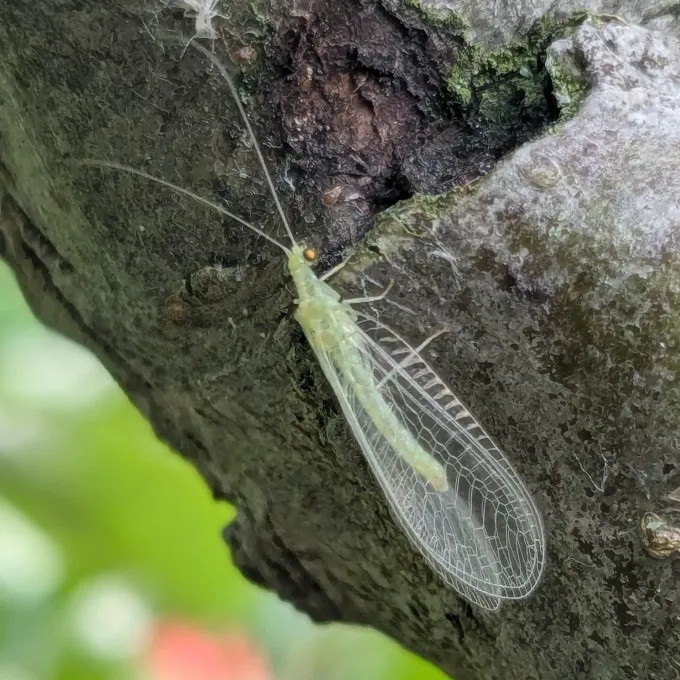
The yellow lacewing (lat. Chrysopa flava) belongs to the order Neuroptera and the family Chrysopidae. The adult has a slender body of a delicate green or yellowish-green color with characteristic golden compound eyes.
The insect's wings are transparent with a dense network of veins, and in a resting state, they are folded roof-like along the back. The wingspan ranges from 20 to 30 millimeters.
The larvae of the lacewing have an elongated shape, a gray or brownish color, and are equipped with powerful sickle-shaped jaws that allow them to pierce the skin of their prey.
It is worth noting that, unlike many other species in the family, adult Chrysopa flava can feed on pollen and nectar, sometimes impacting the tissues of certain plants.
Lacewing eggs are laid on long, thin stalks, which is a species-specific feature that prevents the eggs from being eaten by other predators and reduces cannibalism among the larvae.
What it damages
Although the lacewing family is more commonly known as entomophages, the Chrysopa flava species can pose a threat to garden and ornamental crops during mass reproduction.
Insects prefer to damage tender parts of plants, including young shoots, buds, and inflorescences of various deciduous trees and shrubs.
Under intensive agricultural conditions, this species can harm crops, reducing the aesthetic appeal and the overall condition of the plant's vegetative mass.
The main damage consists of tissue integrity violations, which open the way for secondary bacterial and fungal infections, leading to chlorosis or necrosis of the leaves.
The greatest risk of damage is observed in nurseries, where weakened or young plants are particularly sensitive to any mechanical impact from pests.
When it appears
The activity of adults begins in late spring when average daily temperatures exceed 15 degrees Celsius, which coincides with the active flowering period of many crops.
The yellow lacewing is capable of producing two to three generations per season, with the intensity of the flight directly depending on regional climatic conditions and the availability of a food base.
Insect flight continues until the beginning of autumn, after which fertilized females or adults begin to look for places for diapause in plant debris.
Pests overwinter mainly at the adult stage in protected places: under fallen leaves, in the bark crevices of trees, or in unheated outbuildings.
Mass appearance is observed during periods of prolonged wet spring and summer, which favor larval survival in early development stages.
Signs of infestation
The first sign of infestation is the presence of eggs on the underside of leaves, attached to characteristic thin stalks.
Visually, the presence of the pest is determined by the deformation of the leaf blade and the appearance of pinpoint punctures on the young tops of shoots.
In areas where larvae congregate, yellowing and premature drying of leaves are noted, accompanied by sticky residue if secondary pests are also present on the plant.
Detecting adults in the evening near light sources is an indirect confirmation of a high population density in the area.
- Deformation of young leaves
- Presence of thread-like egg clutches
- Point necrosis of young tissues
- Weakening of shoot growth
- Reduced quality of ornamental plants
Control measures
The main method of control is the use of biological plant protection agents, including entomopathogenic fungi, which effectively restrain population growth.
For private gardening, it is recommended to conduct regular sanitary cleaning of the site to remove dry plant residues where adults hibernate.
Chemical protection is justified only when the economic threshold of damage is exceeded and involves the use of contact-intestinal insecticides.
Agrotechnical measures include balanced nitrogen fertilization to avoid overfeeding plants and inadvertently attracting insects with excess tender new growth.
Using sticky bands on trees allows for the reduction of migrating larvae during their active search for food within the plant canopy.
Taxonomy
- Latin name
- Chrysopa flava
- Family
- Chrysopidae
- EPPO code
- CHROFA
Discussion
No discussions yet — be the first.