
Green lacewing
Chrysopa dorsalis
Description
How to identify
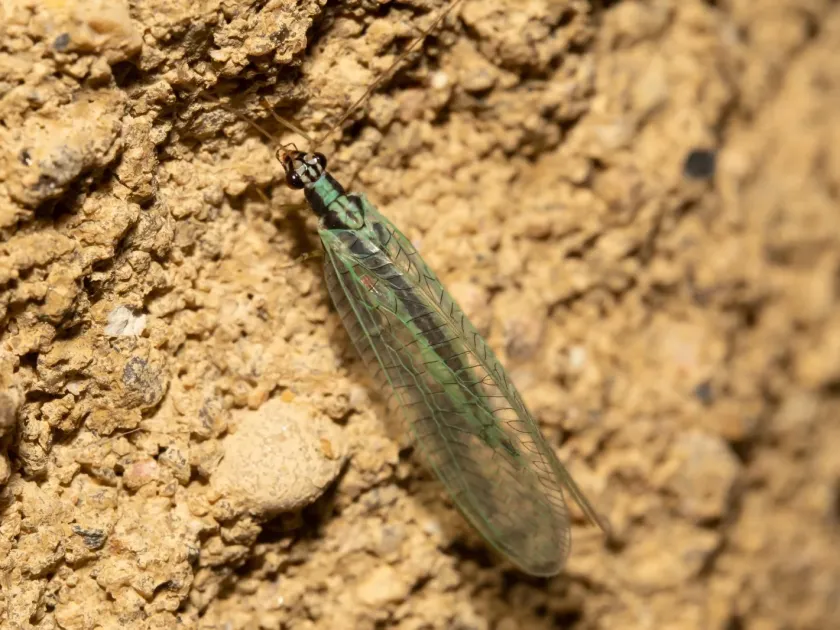
The green lacewing belongs to the order Neuroptera and the family Chrysopidae. Adult insects are characterized by a slender, pale green body, shimmering golden eyes, and delicate, transparent lacy wings.
A distinctive feature of the species is the complex venation of the wings. When at rest, the insect folds its wings roof-like over its back, effectively blending in with the surrounding foliage.
The larvae are elongated, covered in numerous stiff bristles, and possess powerful, sickle-shaped mandibles designed to pierce and consume their prey effectively.
The eggs are easily identified by their unique structure: they are laid on long, slender stalks attached to the underside of leaves to protect the eggs from predation and cannibalism.
While Chrysopa dorsalis is widely recognized as a beneficial predator, its presence in specific agricultural systems requires careful monitoring to ensure a balanced insect population.
What it damages
The primary diet of green lacewings consists of soft-bodied insects such as aphids, scale insects, thrips, and small lepidopteran larvae, which feed on various fruit and vegetable crops.
Damage can occur indirectly: in closed environments or specific agroecosystems where natural prey is scarce, larvae may occasionally feed on plant tissues.
The greatest agricultural risk stems from the disruption of natural predator-prey dynamics caused by the indiscriminate use of broad-spectrum insecticides in commercial orchards.
High population densities on ornamental plants may leave residues of insect activity, which can negatively impact the aesthetic and commercial value of nursery stock.
Because they prefer coniferous and deciduous trees and lead a relatively secretive life, controlling their population numbers requires specialized entomological knowledge.
When it appears
Adult activity begins in late spring as temperatures consistently exceed 10–12 degrees Celsius, coinciding with the early stages of crop development and pest emergence.
The life cycle undergoes complete metamorphosis: egg, three larval instars, pupa within a silk cocoon, and the adult stage, which often hibernates during the colder months.
Larval population peaks usually occur in mid-summer when aphid colonies are most abundant, providing an optimal nutritional source for the developing predatory larvae.
In autumn, adults migrate toward hibernation sites such as leaf litter, tree bark fissures, or sheltered structures, remaining dormant until the return of favorable spring weather.
Multiple generations can occur per season, particularly in warmer climates, necessitating regular inspections and population monitoring to maintain effective biological control.
Signs of infestation
A visual indication of their presence is the observation of eggs attached to stalks, which can be found by examining the undersides of leaves during regular field scouts.
The presence of adults attracted to artificial light sources during evening hours confirms an active reproductive phase and a healthy population level within the area.
A key indicator of larval activity is the rapid reduction or total disappearance of aphid colonies without the application of external chemical pest control measures.
Minor plant damage may manifest as microscopic puncture marks if the larvae are forced by food shortages to supplement their diet with plant fluids in specialized crops.
A sudden spike in aphid populations often serves as a warning sign that the local population of beneficial lacewings has declined, indicating an imbalance in the ecosystem.
Control measures
The primary management strategy is the elimination of broad-spectrum pesticides during periods of high lacewing activity to preserve the natural predator population.
Utilizing selective biological agents that target only specific pests allows green lacewings to continue their beneficial role in suppressing pest populations effectively.
Maintaining habitats for hibernation, such as preserved hedge rows or undisturbed leaf litter areas, helps sustain the population throughout the off-season.
In greenhouse settings, the professional release of laboratory-reared larvae is a highly effective strategy for controlling aphids and mites on high-value crops.
Integrated Pest Management (IPM) practices should include regular population counts of lacewings to refine control strategies and prevent economic losses in the fields.
Taxonomy
- Latin name
- Chrysopa dorsalis
- Family
- Chrysopidae
- EPPO code
- CHRODO
Discussion
No discussions yet — be the first.