
Common Green Lacewing
Chrysopa cognata
Description
How to identify
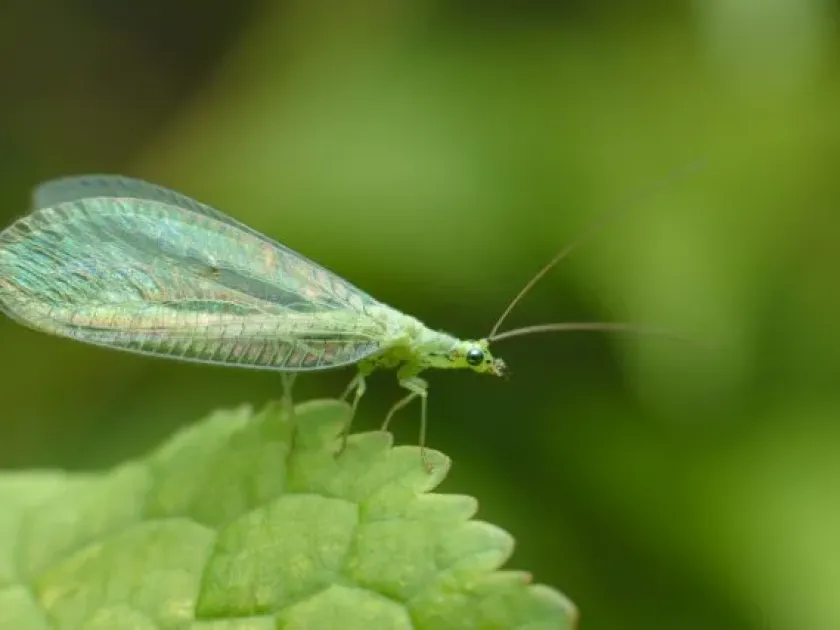
The Common Green Lacewing (Chrysopa cognata) is a member of the order Neuroptera. Adults possess a slender, bright green body, large iridescent wings with a complex network of veins, and distinctive golden-colored compound eyes.
The wingspan typically measures between 25 and 30 millimeters. When resting, the wings are held tent-like over the body, allowing the insect to blend perfectly into the foliage of host plants.
Lacewing larvae have a characteristic elongated, fusiform body covered with small tubercles. They are equipped with large, sickle-shaped mandibles used to grasp and pierce their prey.
A unique feature of this species is its eggs, which are deposited on long, thin stalks. This adaptation keeps the eggs safe from predators and cannibalistic siblings.
The life cycle involves complete metamorphosis, consisting of the egg, three larval stages, the pupal stage, and the adult stage. Hibernation typically occurs in the adult stage within leaf litter or crevices.
What it damages
It is crucial to clarify that the Common Green Lacewing is not a crop pest but a highly beneficial predatory insect. In agricultural systems, it serves as a natural enemy of many soft-bodied pests.
The larvae are voracious predators, primarily feeding on aphids, whiteflies, thrips, spider mites, and the eggs of various lepidopteran species, making them vital for pest management.
A single larva can consume hundreds of aphids during its development phase, significantly reducing the pest pressure in vegetable gardens, orchards, and field crops.
While adults may occasionally feed on nectar and pollen, they do not cause economic damage to crops. Their presence is generally a sign of a healthy, functioning ecosystem.
By effectively suppressing pest populations, the Common Green Lacewing reduces the reliance on synthetic chemical insecticides in farming operations.
When it appears
Adults emerge from overwintering sites in early spring once temperatures consistently remain above 10–12 degrees Celsius, signaling the start of the active season.
The active breeding period spans throughout the summer months. Depending on the climate, there can be several generations per year, ensuring a continuous presence of predators.
Larval activity is synchronized with the surge of aphid populations, as the availability of prey is the primary driver for their development and population growth.
As autumn approaches and temperatures drop, the adults begin to seek shelter for diapause, where they will remain inactive until the following spring.
Understanding these seasonal patterns allows farmers to implement better timing for conservation strategies, ensuring the population remains robust throughout the growth cycle.
Signs of infestation
The most common indicator of lacewing presence is the discovery of their stalked eggs, usually found on the underside of leaves or near aphid colonies.
Larval activity can be observed by inspecting plant colonies; they are highly mobile and constantly searching for prey items to consume.
Adults are attracted to light at night, so they are frequently seen around outdoor lamps or entering greenhouse facilities during evening hours.
Signs of their activity include empty, shriveled shells of aphids, as the larvae inject enzymes to liquefy the internal tissues of their prey before sucking them out.
Monitoring for these signs can help growers assess the natural biological control levels in their fields without the need for manual intervention.
Control measures
Conservation of the Common Green Lacewing is the best approach to managing its population. Farmers should aim to protect these beneficial insects through ecological management.
Minimizing the use of broad-spectrum insecticides is critical, as these chemicals often kill beneficial predators along with target pests, leading to secondary outbreaks.
Planting nectar-rich flora around the edges of fields or in hedgerows provides essential energy sources for adult lacewings, increasing their longevity and egg-laying capacity.
In greenhouse environments, mass-reared lacewing larvae are often released intentionally as part of a biological control program to manage stubborn infestations of aphids and mites.
- Reduce frequency of chemical applications.
- Integrate flowering plants into field margins.
- Utilize selective biopesticides that do not harm Neuroptera.
Taxonomy
- Latin name
- Chrysopa cognata
- Family
- Chrysopidae
- EPPO code
- CHROCO
Discussion
No discussions yet — be the first.