
Common Green Lacewing
Chrysopa ciliata
Description
How to identify
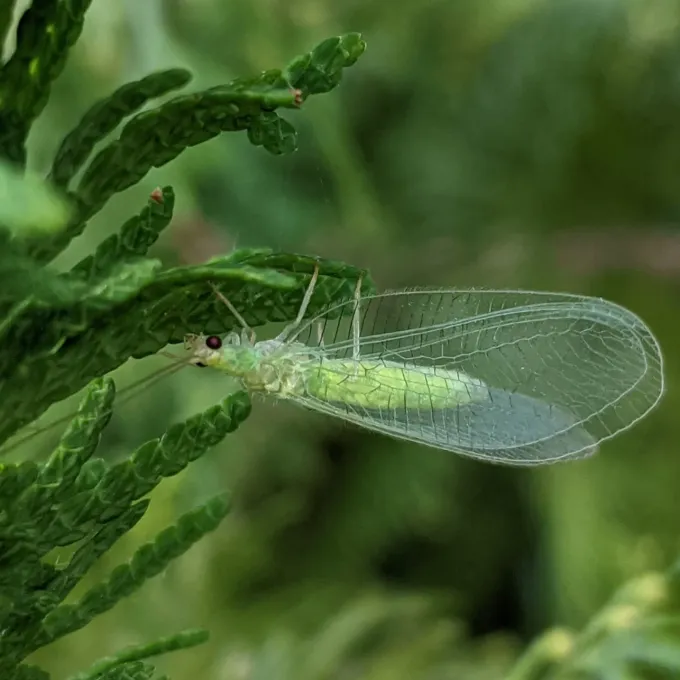
The Common Green Lacewing (Chrysopa ciliata) is a member of the order Neuroptera and the family Chrysopidae. It is a delicate insect with a pale green body and large, lace-like wings that reach up to 30 mm in span.
Adults are characterized by their brilliant, gold-colored compound eyes. They are relatively weak fliers and are often attracted to artificial light sources during the warm months.
The larvae, often called aphid lions, possess a fusiform body and large, sickle-shaped mandibles. They are highly active and aggressive predators that constantly patrol plant surfaces.
One of the most unique features is the way females lay their eggs: each egg is attached to the tip of a long, slender, silken stalk. This design prevents the hatching larvae from eating each other.
Recognizing these insects is crucial for organic gardening. Their presence indicates a healthy, self-regulating ecosystem where natural controls are actively working against pests.
What it damages
The Common Green Lacewing is not a pest; it is a beneficial predator that provides natural pest control. It does not cause damage to crops, flowers, or fruit trees at any stage of its life cycle.
The larvae are voracious predators that feed on a wide variety of soft-bodied insects. Their primary prey includes aphids, which can cause severe damage to horticultural plants.
In addition to aphids, they effectively hunt and consume spider mites, mealybugs, whiteflies, and scale insects. A single larva can consume hundreds of pests during its development.
Adult lacewings primarily feed on nectar, pollen, and honeydew. They are also important pollinators for many garden plants, although their primary agricultural value lies in their predatory larvae.
By protecting this species, farmers and gardeners can significantly reduce their reliance on chemical insecticides, promoting a more sustainable and productive agricultural environment.
When it appears
Common Green Lacewings become active in early spring as temperatures rise. Adults overwinter in sheltered locations, such as under tree bark, in leaf litter, or sometimes in man-made structures.
Depending on the climatic zone, they can produce several generations per year. This overlapping of generations ensures that predatory activity is consistent throughout the entire growing season.
The population of lacewings usually peaks in mid-summer, coinciding with the peak activity of many common plant pests. This synchronization allows them to exert maximum pressure on pest populations.
As autumn approaches and temperatures drop, adults begin searching for hibernation sites. This is when they are most commonly seen near homes or in garden sheds as they prepare for winter diapause.
Their life cycle is perfectly adapted to the seasonal dynamics of their prey, making them one of the most reliable natural enemies available in temperate gardening regions.
Signs of infestation
Identifying the presence of lacewings is easy once you know what to look for. Check the undersides of leaves for their distinctive stalked eggs, which appear as tiny white spheres on thin hairs.
The presence of larvae among aphid colonies is a clear sign that natural control is in progress. The larvae are often found crawling amidst the pests, actively feeding on them.
If you observe a rapid decline in aphid populations without applying any chemicals, it is highly likely that lacewings or other natural predators are responsible for the cleanup.
Adults can be seen on garden plants during the evening hours. Their light green color and fluttering flight are easy to spot for observant gardeners.
Maintaining a diverse garden with native plants and avoiding broad-spectrum pesticides ensures that these beneficial predators remain present in high numbers throughout the year.
Control measures
There is no need to control the Common Green Lacewing. Instead, the focus should be on conservation and habitat enhancement to encourage their population to thrive in your garden.
- Avoid the use of toxic, broad-spectrum insecticides that kill beneficial insects.
- Plant diverse nectar-producing flowers like dill, fennel, and alyssum to feed adult lacewings.
- Provide overwintering sites by leaving some garden debris or leaf litter in quiet corners.
- Adopt integrated pest management (IPM) practices to maintain a balance between pests and predators.
- Use selective biological pesticides only when necessary, choosing products that are harmless to neuropteran larvae.
Taxonomy
- Latin name
- Chrysopa ciliata
- Family
- Chrysopidae
- EPPO code
- CHROCI
Discussion
No discussions yet — be the first.