
Chrysochraon
Chrysochraon
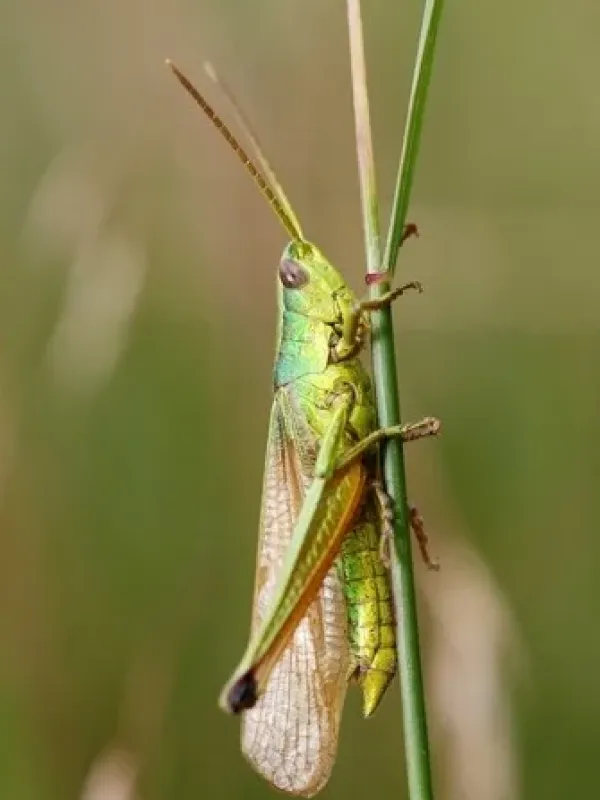
Description
How to identify
The genus Chrysochraon, particularly the species Chrysochraon dispar, belongs to the family Acrididae, order Orthoptera. These grasshoppers exhibit distinct sexual dimorphism.
Males are typically bright green or golden-green, while females are larger and often brownish or grayish, providing effective camouflage in dry vegetation.
Females often have shortened wings and are flightless, whereas males are more agile and capable of short flights to navigate their habitat or seek mates.
They possess typical grasshopper anatomy with strong mandibles adapted for chewing tough plant tissues found in grasses and cereal crops.
These insects prefer moist environments, frequently colonizing wet meadows, forest edges, and low-lying areas near agricultural fields where moisture is abundant.
What it damages
Both adults and nymphs cause damage by feeding on the vegetative parts of wild grasses and cultivated cereal crops using their powerful biting mouthparts.
Commonly affected crops include wheat, barley, oats, and forage grasses. In years of high infestation, corn and other grain crops may also suffer significant damage.
Feeding damage manifests as irregularly chewed leaf edges, which reduces the plant's total leaf area and inhibits the photosynthesis process required for growth.
Severe infestations can lead to significant defoliation, particularly during the early stages of crop development, which stunts growth and reduces grain yield.
The damage is often localized, as nymphs tend to feed in groups, creating patches of destroyed vegetation within a field before spreading to adjacent areas.
When it appears
These insects overwinter in the egg stage, with eggs deposited by females into the soil or plant stems, protected by a specialized casing known as an ootheca.
Nymphs emerge in late spring, typically around late May or June, once soil temperatures rise to levels suitable for their development and activity.
The nymphal stage lasts for approximately 40–50 days, during which they progress through several instars, increasing in size and intensity of feeding.
Adult grasshoppers appear in mid-summer and remain active throughout the warmer months, feeding and reproducing until the arrival of autumn frosts.
The life cycle is univoltine, meaning there is only one generation produced per year, which allows agronomists to predict infestation peaks based on spring weather.
Signs of infestation
The primary sign of an infestation is the presence of characteristic ragged or notched edges on the leaves of cereal plants and grasses.
During visual inspections, one can observe the insects jumping from the foliage when disturbed, especially near the base of the plants.
Look for evidence of feeding near the field borders and moist areas where the population density of these grasshoppers is typically at its highest.
During dry spells, they may migrate toward greener, more succulent crops, making their presence easier to detect through damaged patches in the field.
- Ragged leaf margins on cereal crops.
- Presence of nymphs in the lower vegetation layer.
- Localized thinning of plant density due to heavy feeding.
Control measures
Deep autumn plowing is a highly effective cultural control method, as it exposes and destroys the egg-containing oothecae buried in the topsoil.
Maintaining clean field edges and eliminating weed reservoirs is essential for preventing the build-up of grasshopper populations around cultivated areas.
When populations exceed economic threshold levels, the application of registered insecticides is recommended to prevent significant crop yield losses.
Biological control through the preservation of natural predators, such as birds and predatory insects, plays a significant role in long-term population management.
Regular scouting using sweep nets allows farmers to monitor population dynamics and apply targeted control measures only where and when strictly necessary.
Taxonomy
- Latin name
- Chrysochraon
- Order
- Orthoptera (locusts)
- Family
- Acrididae
- EPPO code
- KHKHSP
Discussion
No discussions yet — be the first.