
Senegalese grasshopper
Chrotogonus senegalensis
Description
How to identify
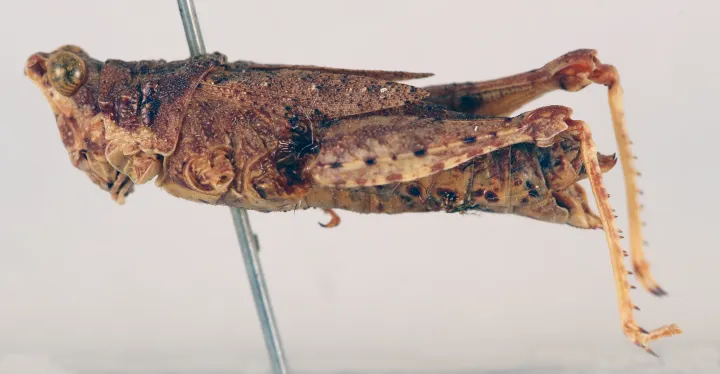
The Senegalese grasshopper (Chrotogonus senegalensis) belongs to the family Pyrgomorphidae (pyrgomorphids), order Orthoptera. It is a small insect characterized by its dorsoventrally flattened appearance.
Its coloration typically ranges from gray to dark brown or blackish-brown, providing excellent camouflage against soil surfaces and debris where it spends most of its time.
Adults possess short wings that often do not reach the end of the abdomen, along with strong, robust mandibles designed for feeding on a wide variety of plant tissues.
The life cycle involves incomplete metamorphosis, with nymphs appearing as miniature versions of adults but lacking fully developed wings and reproductive organs.
Unlike migratory locusts, this species tends to be sedentary, often forming localized clusters in fields or areas with favorable soil and vegetation conditions.
What it damages
This species is highly polyphagous, meaning it feeds on a broad range of plant hosts, causing significant losses to agricultural production in its distribution range.
The grasshopper particularly targets young seedlings of staple crops such as sorghum, millet, maize, and various legumes including peanuts during their early growth stages.
High population densities can lead to the total destruction of seedlings, often requiring farmers to perform replanting, which increases costs and delays the harvest.
Besides leaf consumption, the pest frequently severs the stems of young plants at ground level, causing the plants to wilt and die shortly thereafter.
The damage is most severe in arid regions where natural vegetation is scarce, causing the grasshoppers to concentrate heavily on irrigated or cultivated fields.
When it appears
The activity of the Senegalese grasshopper is closely synchronized with the onset of the rainy season, which triggers the hatching of eggs from the soil.
Higher ambient temperatures accelerate the growth rate, enabling the population to complete multiple generations within a single favorable growing season.
The eggs possess an remarkable ability to withstand desiccation, allowing them to remain dormant in the soil throughout the dry season until sufficient moisture is available.
Peak population levels are typically observed during the early vegetative phase of crops, as the abundance of succulent young plant tissues promotes rapid development.
As the crops mature, the grasshoppers remain active throughout the field, though their destructive capacity on established plants is generally less devastating than on emerging seedlings.
Signs of infestation
The primary sign of an infestation is the appearance of bare patches within a field, where young seedlings have been partially consumed or completely removed by the pests.
Observing the field surface during the early morning hours can reveal the presence of these insects, as they often sit still to blend in with the soil particles.
Feeding damage typically manifests as irregular notches on the leaves or completely chewed stalks, leaving behind only fibrous plant remnants in severe cases.
Large quantities of fecal pellets may be observed around the base of damaged plants, indicating a significant number of grasshoppers in the immediate vicinity.
If consistent plant loss is noted shortly after germination, it serves as a strong indicator for conducting a more thorough inspection of the soil and surrounding vegetation.
Control measures
Tillage practices, particularly deep plowing, are highly effective as they disturb the upper soil layers, exposing egg pods to natural predators and desiccation.
The application of chemical insecticides remains a primary control measure when nymphal populations reach established economic threshold levels in the field.
- Monitoring fields regularly during the early growth season.
- Using poisoned bait applications in hot spots to reduce population density.
- Implementing biological control options using entomopathogenic fungi.
Managing weeds at the borders of cultivated plots is essential, as these areas often serve as critical breeding grounds and reservoirs for the grasshopper population.
An integrated pest management approach, combining sanitation with targeted chemical or biological interventions, is necessary to ensure the protection of agricultural yields.
Taxonomy
- Latin name
- Chrotogonus senegalensis
- Order
- Orthoptera (locusts)
- Family
- Acrididae
- EPPO code
- CHRGSG
Discussion
No discussions yet — be the first.